 WhatsApp: +86 16626708626
 Email:
  Phone: +86 16626708626
Description
Product Core Brief
- Model: PFCL201C 3BSE023409R20
- Brand: ABB
- Series: Pressductor PillowBlock
- Core Function: Measures web tension vertically
- Product Type: Strain gauge load cell
- Key Specs: 20 kN range, IP67, -20 to +80°C
- Condition: New Original / New Surplus
Key Technical Specifications
| Parameter | Specification |
|---|---|
| Measuring Range | 0-20 kN (tension/compression) |
| Accuracy | ±0.1% full scale |
| Temperature Range | -20°C to +80°C operating |
| Protection | IP67 (dust/water ingress) |
| Output Signal | 4-20 mA DC (2-wire) |
| Supply Voltage | 10-30 VDC |
| Excitation | 10 VDC internal |
| Dimensions | 180 x 60 x 40 mm |
| Weight | 2.5 kg |
| Overload Capacity | 150% rated (30 kN) |
| Frequency Response | 0-500 Hz |
| Material | High-strength steel 4140 |

- PFCL201C 3BSE023409R20 20kN
Product Introduction
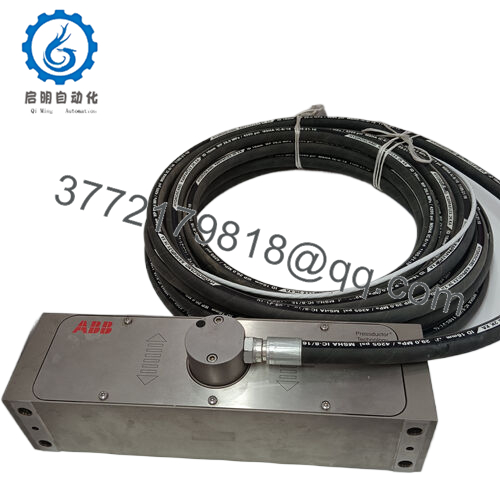
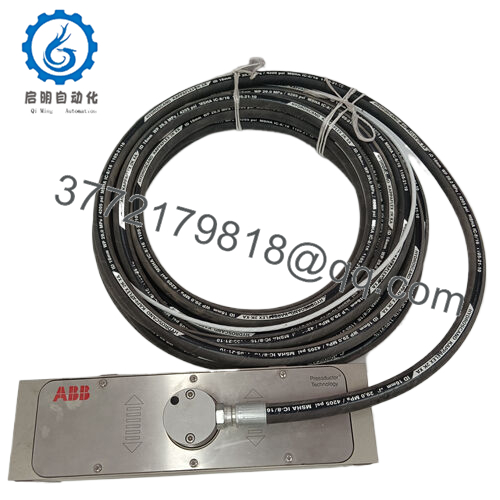
The ABB PFCL201C (3BSE023409R20) is a Pressductor PillowBlock load cell for vertical force measurement in roll applications like paper mills, metal processing, and converting lines. It detects web tension changes via strain on a C-shaped frame, outputting proportional current for tension controllers.
Installations pair it with adapter plates for roll bearing housings, achieving high repeatability under dynamic loads. Maintenance teams prefer it over traditional load cells for non-contacting design that eliminates roll bounce errors.library.abb+3
Installation & Configuration Guide
Stage 1: Pre-Installation Preparation (10 min)
⚠️ Safety First: Stop line drive, engage e-stop, lock out/tag out motor power. Verify zero tension on web/roll.
Tools Required: Torque wrench (20-50 Nm range), ESD strap (minimal static risk), feeler gauges (0.05 mm), level, camera.
Data Backup: Record baseline tension readings from controller, photograph existing mounts and cabling entry.
Stage 2: Removing the Old Module (15 min)
- Depressurize system. Slack web fully.
- Disconnect cable. Unplug connector or loosen gland; label wires if hardwired.
- Unmount assembly. Torque loosen foundation screws (start at 30 Nm reverse), lift roll/bearing housing, remove upper/lower adapter plates.
- Inspect foundation. Flatness check to 0.05 mm; no shims directly above/below cell.
⚠️ Note: Keep old PFCL201C until new one calibrates to match prior zero/tension span.
Stage 3: Installing the New Module (20 min)
- Surface prep. Clean foundation/machined faces; apply rust inhibitor if damp environment.
- Lower plate first. Bolt to cell per Table 3 torque (M12 screws, 45 Nm).
- Mount to base. Loose-fit cell assembly; add upper plate (45 Nm).
- Reinstall roll. Align bearing housing parallel to roll axis; torque foundation screws (60 Nm). Shim only between plate/foundation if needed.
- Cable route. Turn gland fitting for downward exit; secure protective hose.
Self-Checklist: [ ] Plates torqued, [ ] Roll perpendicular, [ ] Level <1°, [ ] Cable glands tight.
Stage 4: Power-On & Testing (15 min)
Pre-Power Check: Continuity on 4-20 mA loop (<5 Ω); insulation >100 MΩ at 100 VDC.
- Power tension controller; zero unloaded cell (expect 4 mA).
- Load ramp. Apply known tension (weights or drive); verify 12-20 mA span.
- Run web at speed; check repeatability (±0.1% drift max over 10 min).
- Thermal check: Stabilize at 50°C equivalent load.
- Cross-calibrate with adjacent cells for multi-roll sync.
⚠️ Troubleshooting: Zero drift? Reshim for parallelism. Nonlinear? Verify FR direction maximizes force on Pressductor ring.
Quality Control Process
PFCL201C units verify on a roll simulator with calibrated 20 kN deadweights and dynamic cycling.
- Inbound Scrutiny: Serial match to ABB docs; inspect cable glands, no corrosion on steel frame; connector pin check.
- Static Test: Load 0-20-0 kN cycle x5; measure mA output vs. traceable force standard (±0.05% verified).
- Dynamic Run: 1 Hz oscillation 24 hours; monitor hysteresis with Keysight scope. Thermal cycle -10 to 70°C.
- Electrical Proof: 500 VDC hi-pot on shield; loop resistance <600 Ω max load.
- Final Seal: QC stamp, IP67 test dunk, desiccant pack, corner protectors on box. Calibration cert photos available.
Caught a cable gland leak on one lot—failed water ingress. Bench rejects protect field installs.
Technical Pitfalls & Survival Guide
❗ Parallelism Miss: Cells out of plane cause 2% span error across bank. Laser level every mount. Steel mill swap took 8 hours realigning—web snagged immediately.
❗ Shim Placement: Shims touching cell face warp the frame. Only between foundation/plate. Learned after vibration zeroed out overnight.
❗ Cable Twist: Factory hose orientation blocks roll clearance. Rotate gland pre-mount—stripped threads mid-job once.
❗ Foundation Flex: Resilient base drops critical frequency below line speed. Machine to 0.05 mm flat; grout solidly. Converter line chatter came from 0.1 mm sag.
❗ Over-Torque: M12 at 70 Nm cracks adapter plate. Stick to 45 Nm spec. Snapped one on first install—roll dropped 2 mm.
Nail these, and tension holds ±0.5% at 1000 m/min.
Frequently Asked Questions (FAQ)
Can I swap PFCL201C under tension/load?
No—risks frame damage or roll drop. Slack web completely; takes 45 min total anyway.
Is this Pressductor model obsolete with new stock?
Active but low volume now; ours new surplus, full calibration from ABB chain. No recert needed.
Direct replacement available?
PFCL201CD for harsher env (IP68 option), same footprint. Or PFCL 301 horizontal—needs roll redesign.
Does cell swap require full recalibration?
Yes for bank accuracy; single cell zeros in 2 min if paralleled right. Match prior mA span.
Why price under ABB catalog?
Surplus skips repackaging; identical QC. Saves 30-50% vs. distributor markup.
4-20 mA or voltage output?
Strict 4-20 mA current loop only. Pairs direct to ABB tension controllers; no amp needed.