 WhatsApp: +86 16626708626
 Email:
  Phone: +86 16626708626
Description
Product Core Brief
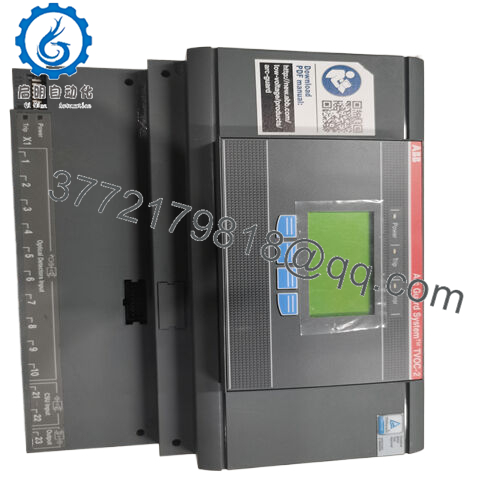
- Model: TVOC-2-240-C (1SFA664001R1003)
- Brand: ABB
- Series: TVOC-2 Arc Guard System
- Core Function: Optical arc flash detection and tripping
- Product Type: Arc monitor with integrated COM module
- Key Specs: 100-240 V AC / 100-250 V DC supply, up to 30 optical detectors, <10 ms trip time, Modbus RTU communication
- Condition: New Original / New Surplus
Key Technical Specifications
| Parameter | Value |
|---|---|
| Rated supply voltage | 100-240 V AC 50/60 Hz or 100-250 V DC |
| Power consumption | 5 W typical |
| Trip time (light to relay) | <10 ms (typically 1-2 ms from arc detection) |
| Detector inputs | 10 built-in; expandable to 30 with extensions |
| Communication | Modbus RTU via COM module |
| Relay outputs | 3 solid-state trip relays (K2, K3), indication relays |
| Ambient temperature | -25 to +55 °C operating |
| Degree of protection | IP20 (unit), IP54 (HMI front) |
| Weight | 0.95 kg |
| Functional safety | SIL 2 certified (IEC 61508 / IEC 62061) |
| Dimensions (H x W x D) | Approx. 96 x 144 x 80 mm (check exact drawing) |
| Configuration | DIP switches + HMI for settings |
Product Introduction
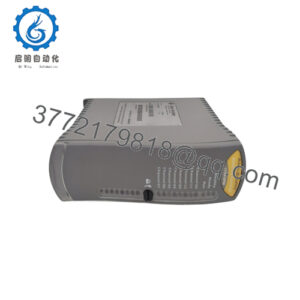
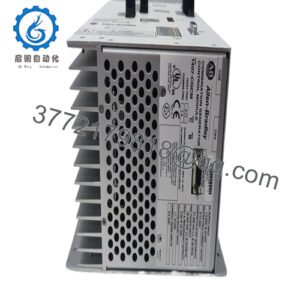
The ABB TVOC-2-240-C (1SFA664001R1003) is the main arc monitor unit in the TVOC-2 Arc Guard System, designed for medium- and low-voltage switchgear. It uses point-type optical sensors to detect arc flashes and issues trip signals to circuit breakers, reducing incident energy and protecting personnel and equipment in industrial power distribution applications.
This version includes the integrated COM module for Modbus RTU communication, allowing remote monitoring and integration with SCADA or DCS systems. In hundreds of MV/LV installations I’ve commissioned, the TVOC-2 series stands out for its fast detection (under 10 ms total trip), SIL-2 certification, and flexibility to connect up to 30 detectors without manual calibration. It remains a reliable choice where arc flash hazards demand proven optical protection over current-only or pressure-based alternatives.

- TVOC-2-240-C
Installation & Configuration Guide
Stage 1: Pre-Installation Preparation (15-20 minutes) ⚠️ Safety First: Notify operations of planned downtime. Confirm the system is in a safe state, lock out/tag out incoming power feeders, and wait at least 5 minutes for capacitor discharge. Tools Required: Grounded ESD wrist strap, PH1 or PH2 screwdriver, digital multimeter, permanent marker and wire labels, smartphone or camera for photos. Data Backup: Photograph all DIP switch positions on the old unit. Document Modbus address, baud rate, and any custom trip configurations via HMI. Export trip log and configuration if possible. Back up any connected SCADA mappings.
Stage 2: Removing the Old Module (10-15 minutes)
- Open the panel door and remove the HMI bezel/cover if attached.
- Label every wire on terminals X1–X3 (detectors), power (A1/A2/PE), and output relays before disconnecting—do not rely on memory.
- Disconnect all wiring carefully; avoid straining fiber cables.
- Release DIN rail or panel mounting clips and pull the unit straight out to prevent bending backplane pins or damaging optical connectors.
- Inspect the mounting area for dust, corrosion, or bent pins. ⚠️ Note: Keep the old unit intact and labeled until the new one runs fault-free for at least 24 hours.
Stage 3: Installing the New Module (15-20 minutes)
- Wear ESD strap and work on a grounded mat. Confirm the replacement is exactly TVOC-2-240-C (1SFA664001R1003).
- Configuration Clone (Critical): Set all 8 DIP switches to match the photographed positions from the old unit—especially reset mode (manual/auto), CSU usage, and trip logic. Use the HMI to verify/set language, time, and Modbus parameters if needed.
- Mount the unit securely on DIN rail or panel; ensure proper seating.
- Reconnect wiring exactly as labeled, using correct torque (typically 0.5-0.6 Nm on screw terminals). Double-check fiber detector polarity and shielding. Self-Checklist: [ ] DIP switches match photo, [ ] All wiring torqued and secure, [ ] Mounting tabs locked, [ ] No loose fibers.
Stage 4: Power-On & Testing (20-30 minutes) Pre-Power Check: Use multimeter to verify no shorts on 24 V or power rails; confirm supply voltage matches 100-240 V AC or 100-250 V DC. Power-On Steps:
- Energize the monitor power only (leave breakers/field devices off initially).
- Watch LEDs: Power green = OK; Trip red flashing = possible config issue; Error red = fault.
- Connect via HMI: Verify firmware version, connected detectors, and no error log entries.
- If Modbus is used, ping the unit from master and confirm communication.
- Simulate arc (if permitted by site procedures) or use built-in test function to verify trip relays actuate.
- Enable field devices, monitor for 1-2 hours under load. ⚠️ Troubleshooting Note: Solid red ERR LED usually means firmware mismatch or hardware fault—recheck DIPs first. No Modbus comms? Verify address, baud rate (default 9600), and cable termination. If detectors show IRF (fiber fault), inspect cable bends (min radius 45 mm) and connections.
Frequently Asked Questions (FAQ)
Can this unit be hot-swapped under power? No. The TVOC-2-240-C is not hot-swappable. Applying or removing power while connected risks damaging the backplane pins or corrupting detector signals. Always isolate power to the monitor first.
Is the TVOC-2-240-C obsolete, and is your stock genuinely new? The base TVOC-2 series remains active as of 2026, though some variants see reduced production. Units we supply are new original surplus from verified OEM channels—factory sealed where possible, or new excess stock. We perform full inbound verification, 24-hour load testing, and insulation checks. Test photos and reports available on request.
What is the direct replacement if this model goes out of stock? The TVOC-2 line continues with similar -C variants. For exact drop-in, stay with TVOC-2-240-C or consult ABB for the latest equivalent (e.g., newer firmware revisions). Avoid mixing generations without verifying protocol and pinout compatibility.
Will I lose my configuration or settings when replacing the unit? Yes—the TVOC-2 has no onboard non-volatile memory for full config backup beyond DIP switches. Document DIP positions and HMI settings (Modbus addr, language, trip logic) before removal. Replicate them exactly on the new unit. Trip logs are not retained across hardware swaps.
Why is your price lower than ABB’s current factory list? We source new surplus or excess OEM inventory that meets full spec but bypasses distributor markups. All units undergo our documented QC process (power-on, comms test, 24-hr burn-in). No refurbished or repaired parts here—price reflects supply chain efficiency, not condition compromise.
How many detectors can this support? Base unit has 10 optical inputs. Add TVOC-2-E1 extensions for up to 30 standard detectors (30 m max cable) or TVOC-2-E3 for longer 60 m runs. Keep total fiber length and bends within spec to avoid false trips or IRF faults.
Does it support redundant power supplies? Yes. The TVOC-2-240-C allows connection of two independent power sources (A1/A2 and A3) for redundancy. In critical applications, I’ve always recommended this to avoid single-point failure from supply loss.