 WhatsApp: +86 16626708626
 Email:
  Phone: +86 16626708626
Description
- Product Core Brief
- Model: UFC912A101 3BHE039426R0101
- Brand: ABB
- Series: UF C912 / EOI / Advant / DCS family (verify per system)
- Core Function: Configurable output interface for DO/AO in ABB DCS
- Product Type: EOI circuit plate / I/O output module
- Key Specs: 24 V DC supply; 8 configurable DO/AO outputs; 12-bit analog
- Condition: New Original / New Surplus (Brand New stock typical)
- Key Technical Specifications
| Parameter | Value |
|---|---|
| OEM Model | UFC912A101 |
| Part Number | 3BHE039426R0101 |
| Module Type | EOI circuit plate / I/O output module |
| System Type | DCS / ABB Advant / related control platforms (check your cabinet BOM) |
| Power Supply | 24 V DC (±20%) |
| Input Voltage Range | 20–30 V DC |
| Power Consumption | 5–30 W typical, 5 W max in some specs (confirm per datasheet) |
| Output Channels | 8 configurable output channels |
| Signal Type | Configurable DO / AO |
| Analog Resolution | 12-bit for AO |
| Update Rate | 10 ms typical |
| Isolation Voltage | 1,500 V AC between field and logic |
| Operating Temperature | -20 to +60 °C (some sources -10 to +55 °C, verify against OEM data) |
| Storage Temperature | -40 to +70 / +85 °C (source dependent, confirm for your unit) |
| Humidity | 5–95% RH, non-condensing |
| Dimensions | About 8 × 9 × 2.3 cm for bare EOI plate; larger if in drive chassis (420 × 135 × 65 mm) – check which variant you have |
| Weight | ~0.06–0.2 kg depending on assembly form |
| Typical Mounting | Internal module / plate in ABB drive or DCS cabinet |
| Status | Active / available via industrial spares channels |
(There are conflicting third-party specs for this code; verify exact electrical ratings and mechanical form against your ABB datasheet and installed hardware before final design decisions.)
- Product Introduction
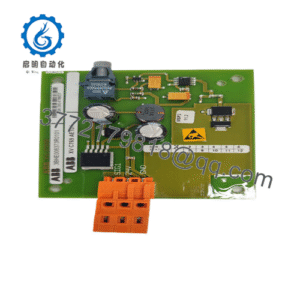
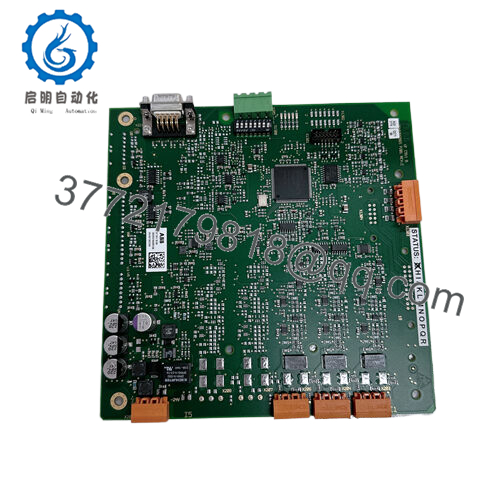
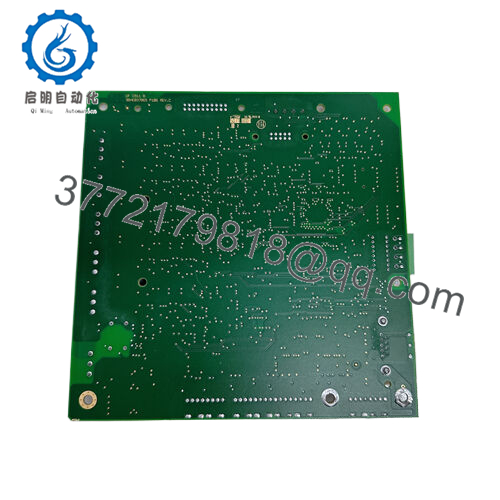
The ABB UFC912A101 3BHE039426R0101 is an EOI circuit plate / output I/O module used in ABB DCS and drive-based control systems to provide configurable digital and analog outputs from a 24 V DC powered board. It typically offers 8 configurable output channels with 12-bit resolution for analog signals, allowing the same hardware to drive DO or AO depending on the project configuration.
Engineers choose this unit because it packs flexible DO/AO capability, galvanic isolation, and industrial temperature ratings into a compact module that fits directly into ABB’s cabinet ecosystem. In practice it is used as a direct replacement in existing cabinets when an output section fails, avoiding re-engineering of the whole I/O chain as long as firmware and wiring remain consistent with the original installation.
- Troubleshooting Quick Reference
| Symptom | Possible Cause | Relevance to this Part | Quick Check Method | Recommendation |
|---|---|---|---|---|
| All outputs from UFC912A101 are dead | No or low 24 V DC supply to the module | ✅ High | Measure between the module’s 24 V and 0 V feed points; you should see roughly 24 V within 20–30 V DC range | Restore the 24 V DC feed or upstream fuse; only suspect the module after the supply is confirmed stable |
| Some channels work, others never change state | Internal channel driver damage or bad field wiring on specific outputs | ✅ Medium | Use the DCS/drive diagnostics to toggle each output; in parallel, meter the terminal for voltage/current change when commanded | If logic shows the channel changing but no change at terminals and wiring is correct, that output section on the UFC912A101 is likely damaged |
| Analog outputs are noisy or out of expected range | Grounding/shielding issues or incorrect configuration (DO vs AO) | ✅ Medium | Check that AO channels are configured as analog in engineering tools and verify shields/returns per wiring diagram | Fix grounding and configuration first; replace UFC912A101 only if a known-good unit behaves correctly on the same wiring |
| Outputs stuck at one level despite command changes | Wrong signal type or range configured, or frozen module | ✅ Medium | Read the module status in engineering software, confirm each channel’s type (DO/AO) and range, then perform a controlled power cycle | Correct the configuration; if a power cycle and config reload do not help and a swap cures it, retire the old module |
| I/O rack reports module fault / EOI error | Module hardware fault or communication issue | ✅ High | Check status LEDs (if present), review DCS diagnostics for that slot, and reseat the UFC912A101 with power isolated | If fault follows the card when swapped to another identical slot, treat the module as failed and replace it |
| Field devices see the right voltage but actuator does not move | External actuator or wiring issue, not usually the EOI module | ❌ Low | Measure load current and compare with actuator spec; temporarily drive the actuator from a known-good manual source | Focus on the field device and power circuit; UFC912A101 is less likely the root cause if voltage and current look correct |
| Module warm or hot compared to neighbors | High output load or marginal ventilation | ✅ Medium | Use an IR thermometer to compare module temperature to adjacent cards; check total load per channel vs 2 A/channel guideline | Reduce channel loading, redistribute loads, or improve cabinet cooling; replace the module if thermal signs persist or plastic discoloration is visible |
If you still are not sure whether the UFC912A101 is the culprit, capture screenshots of alarms, note firmware and configuration, and take clear photos of the module in the rack and field terminals; share these with technical support so they can map symptoms to the exact hardware and setup.

- UFC912A101 3BHE039426R0101
- Frequently Asked Questions (FAQ)
Q1: What exactly does the ABB UFC912A101 3BHE039426R0101 do in the system?
It works as an output I/O module, taking commands from the ABB controller or drive and turning them into either digital on/off outputs or analog output signals, depending on how each of the 8 channels is configured. In a running plant, it is usually tied to valves, drives, relays, or control signals that you absolutely do not want to lose unexpectedly.
Q2: Is this an analog-only card, digital-only, or mixed?
The UFC912A101 is documented as having configurable output channels that can operate as digital outputs or analog outputs, with 12-bit resolution on the analog side. In practice, that means engineering decides per channel, so you must match the configuration of the old card before putting a new one into service.
Q3: Can I just swap the module without touching configuration?
If you are replacing UFC912A101 with the same model and the same part number, and your DCS/drive keeps configuration centrally, then in most systems you can move the wiring, insert the new board, and the existing configuration will apply. To be safe, back up the project first, document any jumpers or DIP switches, and make sure the replacement is recognized cleanly in the diagnostics after power-up.
Q4: Is it hot-swappable, or do I need to shut down?
Treat this as a controlled-change part. Some ABB racks can technically handle live card swaps, but yanking an output module with real-world loads attached is asking for trouble. Plan a short outage, de-energize according to your plant LOTO, then pull and insert the UFC912A101 once everything is confirmed safe; that approach costs you a few extra minutes but avoids erratic outputs or damaged contacts.
Q5: Why do I see different specs for the same 3BHE039426R0101 code online?
Multiple third-party catalogs list this number against slightly different descriptions—EOI plate, drive module, even frequency converter—because it appears in several assemblies and marketing names. The only spec that truly matters is the ABB documentation that matches your cabinet and system type, so always cross-check the part number and system manual before finalizing a purchase.
Q6: Is this model still active or already obsolete?
Most distributors list UFC912A101 3BHE039426R0101 as in stock and active within ABB-based DCS and drive support chains, but it is not something you pick off a standard catalog anymore. Because lead times can stretch or stock can disappear after a big project buy, it is smart to carry at least one spare for any cabinet that would stop production if this module failed.
Q7: Any common mistakes to avoid when replacing the UFC912A101?
The big risks are not matching the channel configuration (DO vs AO), mixing up terminal assignments, and skipping the 24 V supply checks before blaming the card. Before touching the old module, grab detailed photos of labels and wiring, export the existing configuration, wear an ESD strap, and after install, run a controlled loop test on each affected output; that extra hour up front will save you a long night of chasing “random” output problems later.