 WhatsApp: +86 16626708626
 Email:
  Phone: +86 16626708626
Description
In legacy discrete manufacturing and process control environments where Series Six PLCs need to extend I/O racks over plant floors or campus networks without performance bottlenecks, the GE HE697BEM600E functions as a remote I/O interface module. It is commonly used in industrial automation for automotive stamping lines, conveyor systems, and packaging equipment that distribute sensors and actuators across multiple drops, enabling a central CPU to poll discrete inputs, outputs, and registers via serial multidrop links. Engineers deploy the GE HE697BEM600E in control systems requiring reliable data exchange up to 9600 baud over twisted-pair cabling, supporting up to 64 remote nodes for applications like machine status monitoring or safety circuit feedback in noisy factories.
This module typically connects local I/O racks to a master controller in water treatment or material handling setups, where it handles cyclic polling of limit switches, solenoids, and analog scalings without custom gateways. In textile or food processing, it is applicable in control systems linking remote pump controls or filler interlocks, providing fault-tolerant communication that maintains scan integrity during cable faults.
Product Introduction & Positioning
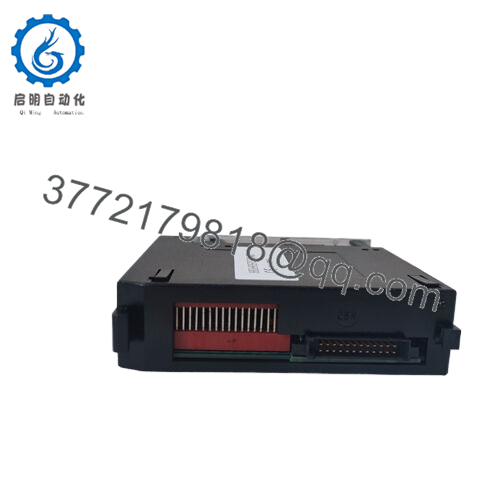
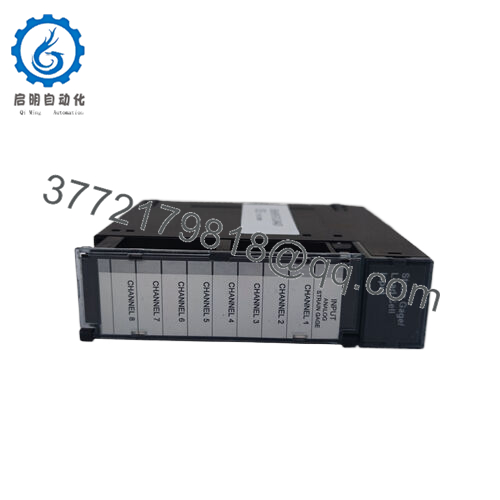
The GE HE697BEM600E is a Horner Electric remote I/O interface for GE Series Six PLC platforms, mounting in expansion racks to serve as a multidrop slave that exchanges discrete and register data with a host CPU over RS-485 serial links. It fits standard Six backplanes, buffering up to 256 I/O points locally while relaying status via screened twisted-pair at rates matching the master configuration.
Positioned as the network endpoint, the GE HE697BEM600E extends rack capacity transparently, mapping local modules to global references for ladder logic execution in simplex topologies. Configuration via handheld programmers sets node addresses and parity, with no rack-resident processor required.
Key Technical Features & Functional Benefits
The GE HE697BEM600E monitors parity errors, buffer overruns, and timeouts, latching diagnostics into reference tables for CPU alarming while supporting 9600 baud multidrop with 256-byte frames for dense I/O packs.
Hardware matches Series Six durability, drawing modest backplane current with optical isolation on comm lines and front LEDs for power/activity/fault states. Pluggable terminals enable daisy-chaining up to 64 drops over 120-ohm trunks.
Compatible with BF/YB I/O families, it integrates local discretes or analogs into host scans, with watchdog resets ensuring no stalled packets.

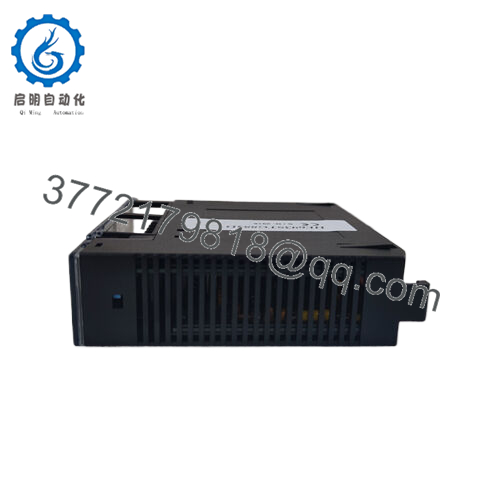
- HE697BEM600E
Detailed Technical Specifications
| Parameter | Value |
|---|---|
| Model | HE697BEM600E |
| Brand | GE Horner Electric Series Six |
| Product Type | Remote I/O interface module |
| Communication | RS-485 multidrop serial |
| Baud Rates | Up to 9600 |
| Max Nodes | 64 |
| I/O per Drop | Up to 256 points/registers |
| Backplane Power | 5 VDC @ 200 mA typical |
| Bus Termination | 120Ω |
| Operating Temperature | 0 to 60 °C |
| Isolation | Optical comm lines |
| Status Indicators | LEDs: power, RX/TX, fault |
Related Modules or Compatible Units
HE697BEM600D – Prior revision sharing HE697BEM600E mounting and protocol.
IC600YB800 – Series Six master transmitter polling the HE697BEM600E.
IC600BF/YB I/O – Local modules racked with HE697BEM600E for field termination.
Installation Notes & Maintenance Best Practices
Match node addresses across network before wiring the GE HE697BEM600E, using shielded twisted-pair terminated at ends. Slot into powered base and verify RX LEDs on first poll.
Quarterly fault bit scans and terminal reseats; clean slots annually in dusty areas.