 WhatsApp: +86 16626708626
 Email:
  Phone: +86 16626708626
Description
The GE IC200ALG630-GD is typically used wherever precise temperature monitoring and millivolt sensing are critical to safe, efficient plant operation. Engineers deploy this module in applications such as gas turbine control, boiler and furnace management, heat-treatment lines, food processing ovens, and environmental chambers where stable, high‑resolution thermocouple inputs are required to keep processes within narrow limits. In many of these systems, the module sits close to the field wiring inside distributed I/O panels, feeding real‑time temperature data back to PLCs or remote I/O nodes used in industrial automation and process control.
In power generation and energy facilities, the GE IC200ALG630-GD helps track combustion temperatures, exhaust gas profiles, and bearing metal temperatures, allowing operators to detect hot spots early and adjust firing or load accordingly. Oil and gas installations use it to monitor heater treaters, separators, and heat‑trace circuits, where reliable thermocouple measurements directly influence throughput and safety interlocks. In manufacturing and discrete automation, the module is often applicable in control systems that supervise curing ovens, plastic extrusion barrels, die‑casting tools, and drying tunnels, ensuring that each zone stays within its recipe limits to protect product quality and tooling.
Because the GE IC200ALG630-GD accepts multiple thermocouple types and fine millivolt ranges, a single module can serve mixed duties in one panel: from low‑level sensor signals on test rigs to high‑temperature furnace zones in a metallurgical lab. This flexibility is especially valuable for system integrators who standardize on VersaMax‑style I/O but face diverse temperature ranges across projects. The module’s multi‑channel architecture helps reduce panel footprint, wiring complexity, and per‑point cost compared with scattered standalone transmitters, while still providing the data density and diagnostic detail needed for modern SCADA, DCS, or PLC‑based systems used in industrial automation.
Product introduction and positioning
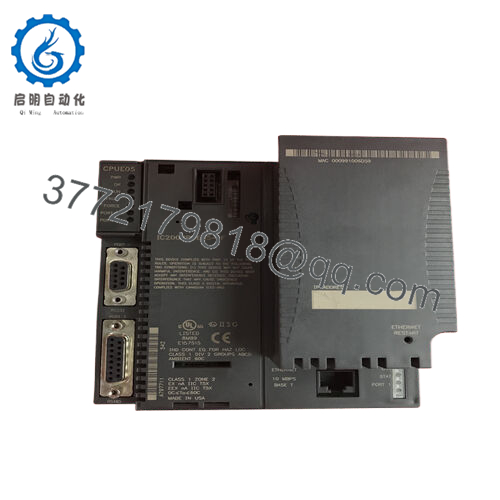
The GE IC200ALG630-GD is an analog input module designed for thermocouple and low‑level millivolt measurements, delivering high‑resolution temperature data into VersaMax modular I/O systems. It belongs to the VersaMax family historically associated with GE Fanuc and now under Emerson branding, and is widely used as a temperature front end for small to mid‑size PLC architectures. Within a typical control system, this module resides on a VersaMax I/O carrier, connected to a local CPU or network interface unit, and converts field thermocouple signals into scaled engineering values that the controller can use for regulation, alarming, data logging, and interlocks.
Functionally, the GE IC200ALG630-GD provides multiple isolated input channels with 16‑bit conversion, supporting standard thermocouple types such as J, K, T, S, and R, as well as selectable millivolt ranges. This allows one hardware type to serve both standard process temperature points and specialty sensor applications in the same rack. The module integrates with VersaMax CPUs and network interface units for Ethernet, Genius, Profibus, and DeviceNet, so it can be deployed as local I/O in a compact PLC panel or as remote I/O in widely distributed skids and process areas.
From an engineering perspective, the GE IC200ALG630-GD is positioned as a robust, general‑purpose thermocouple input module rather than a niche high‑end transmitter. It offers a practical balance of channel count, accuracy, and diagnostics at a cost that makes sense for multi‑loop temperature control and monitoring. For integrators, this translates into fewer module variants to stock and a consistent configuration approach across many projects, while operations teams benefit from uniform diagnostics and spare parts across their installed base of VersaMax I/O.
Key technical features and benefits
The GE IC200ALG630-GD delivers strong functional performance by combining 16‑bit plus sign analog‑to‑digital conversion with selectable engineering units, giving the controller fine temperature resolution suitable for tight process control and trending. The module supports several input spans up to approximately ±625 millivolts, enabling it to handle both standard thermocouple outputs and direct millivolt inputs from specialized sensors. Built‑in digital filtering and calibration routines help reduce noise and drift, so measurements remain stable even in electrically noisy industrial environments or over large ambient temperature swings inside control cabinets.
From a hardware standpoint, the GE IC200ALG630-GD is designed as a compact plug‑in module for VersaMax carriers, keeping depth and height modest so that it fits comfortably into crowded enclosures. Field terminations are arranged to support clean, shielded thermocouple wiring, with dedicated shield connections to improve noise immunity. The module’s low power draw from the backplane minimizes thermal loading inside the panel, which indirectly supports longer life for both the module and neighboring components. Typical weight is in the sub‑kilogram range, which simplifies handling and reduces stress on the carrier.
Compatibility is a core advantage of the GE IC200ALG630-GD. It operates with VersaMax PLC CPUs from specified firmware versions upward and with a range of network interface units, including Ethernet, Genius, Profibus, and DeviceNet variants, allowing the same module type to appear across many projects and topologies. This simplifies spare parts planning and allows integrators to design remote I/O drops that mirror local control panels, yet still maintain common configuration methods and diagnostic practices.
Long‑term reliability is supported by automatic periodic calibration routines and cold‑junction compensation options, which minimize the effect of ambient temperature drift on thermocouple accuracy. The GE IC200ALG630-GD incorporates diagnostics such as open thermocouple detection, over‑ and under‑range flags, alarm thresholds, and thermistor error reporting, giving maintenance teams actionable information rather than simply “bad value” readings. Combined with its industrial temperature rating and hazardous location approvals documented in the datasheet, the module is well suited to long service in demanding environments where downtime is costly and access to panels may be limited.

- IC200ALG630-GD
Detailed technical specifications
| Parameter | Value |
|---|---|
| Model | GE IC200ALG630-GD |
| Brand | GE / Emerson VersaMax |
| Product type | Analog input module, thermocouple and millivolt |
| System platform | VersaMax modular I/O and control system |
| Number of input channels | 7 thermocouple or millivolt input channels |
| Input signal types | Thermocouple types J, K, T, S, R and low‑level millivolt ranges |
| Converter resolution | 16‑bit (15 bits plus sign) analog‑to‑digital conversion |
| Input span ranges | Configurable spans up to approximately ±625 millivolts |
| Backplane power consumption | Up to 125 milliamps at 5 volts and 125 milliamps at 3.3 volts |
| Operating temperature range | 0 to 60 degrees Celsius typical module ambient |
| Mounting method | Plug‑in module on VersaMax I/O carrier |
| Isolation and ratings | Industrial control, Class I Division 2 / Zone 2 hazardous locations |
| Approximate dimensions | Compact VersaMax module size (panel‑mount carrier dependent) |
| Approximate weight | Around 0.3 kilograms |
| Cold junction compensation | Local thermistor, remote value, or fixed configuration selectable |
| Diagnostics | Open thermocouple, over/under range, high/low alarm, thermistor error |
| Supported network interfaces | Via NIU: Ethernet, Genius, Profibus, DeviceNet VersaMax interface units |
Related modules and compatible units
IC200ALG620 – Resistance temperature detector analog input module used when RTD sensors are preferred over thermocouples, offering complementary temperature measurement capability in the same VersaMax rack.
IC200ALG230 – Voltage and current analog input module suited for general process signals such as 4–20 mA transmitters, often paired with the GE IC200ALG630-GD in mixed temperature and process applications
IC200ALG240 – Isolated voltage and current analog input module used where channel‑to‑channel isolation and higher noise immunity are required alongside thermocouple measurement racks.
IC200ALG320 – Low‑channel‑count analog input module for voltage and current, typically used when only a few non‑temperature analog points are needed beside a bank of thermocouple channels.
IC200ALG331 – High‑resolution analog output module providing voltage and current signals for control valves, drives, or heaters, often driven by temperature loops that read from the GE IC200ALG630-GD.
IC200ALG430 – Mixed analog module with both input and output channels, useful in compact panels where a small number of temperature and control signals must be combined with minimal hardware.
EBI001 Ethernet NIU – Ethernet network interface unit that allows the GE IC200ALG630-GD and other VersaMax modules to operate as remote I/O on Ethernet‑based control systems.
GBI001 Genius NIU – Genius bus interface enabling integration of the GE IC200ALG630-GD into legacy Genius‑based distributed control architectures.
Installation notes and maintenance practices
Before installing the GE IC200ALG630-GD, engineers should confirm that the chosen VersaMax carrier and cabinet layout provide adequate clearance for thermocouple wiring, shielding, and bend radius, especially when multiple high‑density I/O modules share the same panel space. Panel designers should reserve a clean, grounded termination area for thermocouple pairs, route low‑level sensor cables away from high‑voltage or high‑current conductors, and bond shields in accordance with plant noise‑immunity standards. Grounding of the cabinet and carrier must be robust, as poor bonding can increase noise pickup on millivolt‑level signals and degrade measurement accuracy. Environmental conditions inside the enclosure should remain within the module’s specified 0 to 60 degrees Celsius operating range, and adequate ventilation or spacing should be provided around heat‑dissipating devices.
Ongoing care of the GE IC200ALG630-GD centers on preserving signal integrity and verifying that diagnostics remain clear. Regular visual inspections should look for loosened terminal screws, damaged thermocouple insulation, corrosion at terminals, or changes in cable routing caused by other work in the panel. Maintenance teams should review controller diagnostic logs for open thermocouple, over‑ or under‑range, and thermistor error flags, and investigate anomalies promptly rather than masking them with software filtering. Periodic checks of reference junction configuration and engineering‑unit scaling help ensure that firmware updates or configuration changes have not altered channel behavior. When plant standards allow, scheduled offline comparison of selected thermocouple points against reference instruments can validate that the GE IC200ALG630-GD and its compensation settings are still delivering the accuracy required by the process.