 WhatsApp: +86 16626708626
 Email:
  Phone: +86 16626708626
Description
The GE IC660BBD022N is typically installed out on the plant floor as a rugged field I/O block, close to conveyors, mixers, packaging lines, or pump skids where multiple 24 VDC devices need to be switched or monitored over a Genius network. Engineers use it in industrial automation projects to consolidate clusters of discrete signals—photoelectric sensors, proximity switches, solenoid valves, interlocks—into a single block that talks back to a PLC or DCS via Genius, instead of home‑running every wire to the main control cabinet. This reduces cable lengths, eases commissioning, and keeps local junction boxes orderly even in noisy, space‑constrained environments.
In automotive and discrete manufacturing, the GE IC660BBD022N is well suited to high‑density machine sections such as robot cells, palletizers, or transfer lines where 24 VDC devices dominate and fast response is required. Food, beverage, and packaging plants deploy it along conveyors and fillers where washdown is limited but vibration and frequent maintenance access are common, taking advantage of its robust Genius block form factor and clear channel diagnostics. In utilities and general industry, it is often mounted in small local panels beside motors, valves, and sensor clusters, serving as a Genius remote I/O node that feeds status and commands back to central GE controllers.
Because it is applicable in control systems based on Genius protocol, the GE IC660BBD022N is a popular choice for brownfield expansions where existing Genius networks must be extended without redesigning the entire architecture. OEMs and integrators favor it when building modular skids: each skid can have one or more blocks wired to its local devices, with just a Genius drop cable needed to integrate the skid into the larger plant system. The result is a compact, field‑mountable node that helps standardize wiring practices and supports fast replacement, all while keeping discrete I/O close to the process equipment where it belongs.
The GE IC660BBD022N is a 24 VDC discrete I/O block in the GE Fanuc Genius family, providing 16 source‑type circuits that can be configured as inputs, outputs, or mixed, depending on the application. It functions as an intelligent Genius node: instead of a typical rack‑based I/O card, it is a sealed block with integrated electronics and terminals that connects directly to field wiring and to the Genius bus. Within a control system using GE Series 90‑30 or other Genius‑capable controllers, the GE IC660BBD022N appears as a distributed I/O device whose points are mapped into the controller’s I/O table over the network.
In system architecture terms, the GE IC660BBD022N sits at the edge of the network, bridging local 24 VDC devices to the controller’s scan cycle through Genius protocol messages. It is typically one of several blocks daisy‑chained or trunk‑connected along a production line, each handling its own subset of sensors and actuators based on physical location. For engineers and integrators, this positions the block as a primary building element in Genius‑based distributed I/O schemes, simplifying both plant layout and logical segmentation of machine sections.
The module is valuable because it combines discrete I/O, configuration intelligence, and diagnostics in one enclosure, reducing reliance on separate terminal strips, interposing relays, and auxiliary hardware. The GE IC660BBD022N fits naturally into legacy Genius systems while still offering a flexible configuration model and compatibility with standard 2‑wire and 3‑wire 24 VDC sensors, which is critical when supporting a wide variety of field devices in one area.
A key strength of the GE IC660BBD022N is its ability to support 16 circuits as 24 VDC source‑type points, suitable for supplying current to loads such as solenoid valves or interpreting signals from sourcing sensors wired appropriately. Typical specifications list an operating voltage range of 18–30 VDC and a steady‑state load current up to about 2 amperes per point, with an inrush capability around 10 amperes for starting inductive loads within defined limits, which helps handle valves and contactors that draw briefly higher currents. This combination allows designers to handle a mix of light and moderate‑duty devices on the same block without additional relays in many cases
From a functional performance perspective, the block offers response times on the order of a few milliseconds plus a configurable input filter, giving engineers the ability to tune noise rejection versus speed. This is important in applications where contact bounce, electrical noise, or long cable runs would otherwise create nuisance transitions and require software debouncing. Channel‑level diagnostics and status indication help during commissioning, enabling technicians to quickly confirm which points are energized and whether the block is communicating correctly on the Genius bus.
Hardware design is tailored to harsh plant environments: the GE IC660BBD022N is packaged as a robust, field‑mountable block with integrated terminals and clear labeling, rather than a delicate rack card intended only for clean cabinets. The block format supports mounting near equipment on backplates in local panels or on appropriate supports, with wiring brought directly to the device. This minimizes junction points, reduces wiring complexity, and enhances maintainability compared to traditional terminal‑strip‑heavy designs.
Compatibility is a central advantage. The GE IC660BBD022N conforms to the Genius protocol and is designed to work with Genius‑enabled GE controllers and communication modules, including those used with Series 90‑30 systems. Because it is one of the standard Genius DC discrete I/O blocks, it coexists easily on networks that also include analog blocks, specialty devices, and other discrete types, giving integrators a scalable palette of nodes across the plant
Long‑term reliability comes from a conservative thermal design and industrial‑grade components sized for continuous operation within rated temperature and loading limits. When operated within its 18–30 VDC supply range and configured according to guidelines, the GE IC660BBD022N can run for years in demanding environments, with consistent behavior and predictable failure modes. This stability is particularly valuable in older facilities where Genius networks are expected to remain in service for extended periods and where downtime due to I/O block failures would be costly

- IC660BBD022N
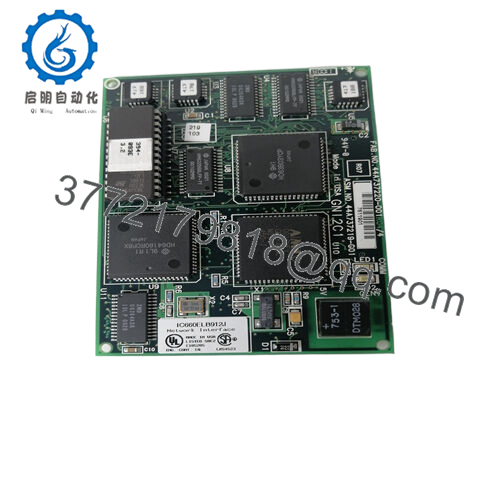
| Parameter | Value |
|---|---|
| Model | GE IC660BBD022N |
| Brand | GE Fanuc Genius I/O family |
| Product Type | 24 VDC discrete I/O block, source‑type circuits |
| Number of Circuits | 16 circuits in a single common group |
| Operating Voltage Range | 18 to 30 volts direct current |
| Load Current per Circuit | Up to 2 amperes steady state |
| Maximum Inrush Current | Approximately 10 amperes (limited duration) |
| Compatible Sensor Types | 2‑wire and 3‑wire 24 VDC sensors |
| Network Protocol | Genius fieldbus protocol |
| Typical Input Response Time | Around 1.7 milliseconds plus configurable filter |
| Power Dissipation | Up to about 68.8 watts at rated load |
| Mounting | Field‑mountable block on panel or structure |
| Field Wiring Interface | Integrated terminals for 16 circuits and common supply |
| Environmental Use | Industrial plant floor and local panel environments |
IC660BBD022 – Base 24 VDC 16‑circuit source I/O block; the GE IC660BBD022N is a variant within the same functional family.
IC660BBD024 – 12/24 VDC 32‑circuit source I/O block offering higher point density for similar applications on Genius networks
IC660BBD025 – Related Genius DC block with alternative current or wiring characteristics, used where load profiles differ from GE IC660BBD022N
IC660BBB024 – Sink‑type discrete I/O block selected when field devices require sink configuration rather than source.
IC660BBD100 – Isolated or specialty discrete block used in applications needing higher isolation or special features on Genius.
IC660TBD025 – Terminal‑style variant that offers a different mechanical connection but serves similar discrete I/O roles
IC660CBB902 – Genius bus controller or interface used in the PLC rack to communicate with blocks such as GE IC660BBD022N.
Before installing the GE IC660BBD022N, engineers should verify that the 24 VDC supply can handle the aggregate load current of all connected devices plus the block’s own consumption, with adequate margin for inrush events. Proper circuit protection, including appropriately rated fusing or breakers, helps prevent damage in case of wiring faults or device failures. Panel layout and mounting positions should allow space for cable entry, bend radius, and clear labeling so that each of the 16 circuits can be identified for maintenance and future modifications.
Network considerations include routing the Genius cable away from high‑noise sources, maintaining shield continuity, and observing recommended trunk and drop lengths and termination practices. During commissioning, technicians should validate addressing and configuration parameters in the host controller so that the GE IC660BBD022N is correctly represented in the I/O map, and should test each circuit under real load conditions to confirm correct polarity and operation. Periodic maintenance should involve checking terminal tightness, inspecting for insulation damage or moisture ingress, and reviewing diagnostics for signs of intermittent network or power issues.