 WhatsApp: +86 16626708626
 Email:
  Phone: +86 16626708626
Description
In industrial automation environments where even a few seconds of unscheduled downtime can cost tens or hundreds of thousands of dollars, the reliability of every field device ultimately rests on the digital output blocks that drive the final control elements. Solenoid valves, motor starters, interlocks, and alarm annunciators all depend on clean, noise-immune 115 VAC signals that arrive exactly when commanded and stay off when they should. Yet in large plants, running individual 115 VAC control cables hundreds of feet back to a central PLC rack invites noise pickup, voltage drop, ground faults, and an overwhelming amount of conduit. When a single loose connection or induced transient can trip a burner management system or drop a lube-oil pump, the risk becomes unacceptable.
The GE IC660EBS103 eliminates that risk by moving the output power switching out to the process area. As an 8-channel, individually isolated 115 VAC output block in the Genius I/O family, the GE IC660EBS103 lets you mount solid-state triac switching right next to the valves and contactors it serves, then control everything over a single low-voltage Genius bus drop. No more long 115 VAC home runs, no more interposing relay panels, and dramatically lower susceptibility to the electrical storms common around arc furnaces, welding lines, or VFD-heavy motor control centers. Plants that once budgeted entire outages just to chase intermittent output faults now enjoy years of trouble-free operation and far faster commissioning of new equipment skids.
The GE IC660EBS103 sits on the same deterministic Genius bus used by thousands of installations worldwide. Each of its eight outputs is rated for 2 A continuous (with 5 A inrush capability) and is fully isolated channel-to-channel and channel-to-logic, so a short on one valve coil never affects the others or crashes the bus. The block provides electronic fusing, open-wire detection, and active pulse-testing of the field circuit—meaning the host controller knows immediately if a valve failed to stroke or a wire broke, long before an operator notices a process deviation. Outputs can be configured for pulse-width modulation or simple on/off, and the block supports fail-safe states that are retained even if bus communications are lost. Redundant bus controllers and dual-cable layouts are fully supported, giving you bumpless transfer in safety-critical applications.
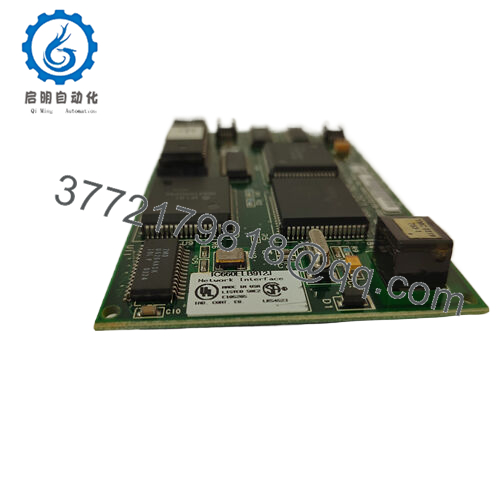
IC660EBS103
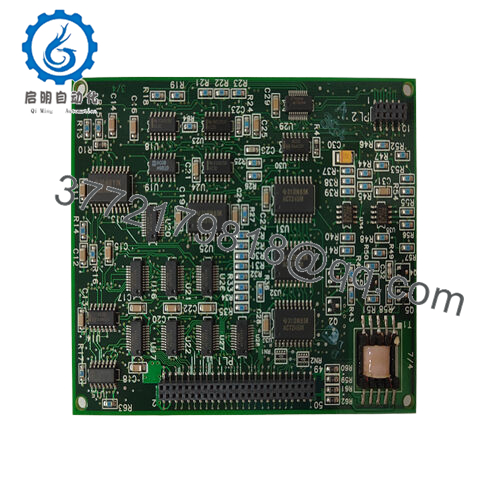
IC660EBS103
| Specification | Details |
|---|---|
| Model Number | GE IC660EBS103 |
| Brand | GE (now Emerson) |
| Type | 8-Channel 115 VAC Isolated Output Block |
| Input Voltage | 24 VDC logic (18–56 VDC) |
| Operating Temp Range | 0 °C to 60 °C |
| Mounting Style | Panel or optional DIN-rail |
| Dimensions | 8.83″ × 3.56″ × 4.42″ (224 × 90 × 112 mm) |
| Weight | 4 lb (1.8 kg) |
| Interface/Bus | Genius I/O dual terminal |
| Compliance | CE, UL, CSA, Class I Div 2 |
| Supported Protocols | Genius proprietary 89.3 kbaud |
| Typical Power Draw | 11 W (plus field load) |
Choosing the GE IC660EBS103 means you gain genuine field-level fault tolerance instead of hoping the central rack never sees a transient. The triac outputs are zero-crossing switched for minimum EMI and long contactor life, yet they can handle the high inrush of pilot lights and small motors without nuisance blowing of electronic fuses. Because each channel is truly isolated at 1500 VAC, you can mix grounding schemes on the same block—grounded neutrals on one circuit, floating loads on another—without creating loops. Maintenance teams particularly appreciate the per-channel diagnostic reporting: a failed solenoid, blown fuse, or open field wire lights the exact LED and sets the exact bit in the controller, turning what used to be a multi-hour troubleshooting exercise into a five-minute repair.
The real payoff shows up in total installed cost and long-term reliability. Cable and conduit savings alone routinely pay for the block on the first installation, while the elimination of interposing relays removes an entire layer of mechanical failure points. In practice, many plants report MTBF figures for the GE IC660EBS103 exceeding a million hours in continuous service.
You will find the GE IC660EBS103 doing heavy lifting in burner management systems for industrial boilers and furnaces, where it directly actuates fuel valves and ignition transformers with full SIL-capable diagnostics. Refineries and petrochemical plants use it extensively on pump and compressor skids, driving anti-surge valves and lube-oil solenoids in Class I Div 2 areas. Large water-treatment and power-plant auxiliary systems rely on it for chemical dosing valves and motor-operated dampers that must respond instantly during load changes. In every case the environment combines high electrical noise, long cable runs, and zero tolerance for false trips.
GE IC660EBS102 – Earlier revision, functionally identical and still widely supported
GE IC660EBD101 – 8-channel 24 VDC source output version for DC solenoids and relays
GE IC660EBD110 – 16-channel 24 VDC sink output for higher density DC loads
GE IC660EBS001 – 8-channel 5/24/48 VDC output block for mixed low-power signals
GE IC660BBS103 – Same electrical specs but with manual override switches on the front
GE IC660BBR101 – Redundancy link module when dual-cable fault tolerance is required
GE IC660EBA103 – Thermocouple block commonly paired on the same bus for flame-scanner inputs
Before installing the GE IC660EBS103, verify that field power is true 115 VAC (98–132 VAC tolerated) and that you have a solid safety ground on the block’s chassis terminal—triac leakage current demands it. Allow the usual 2 inches of airflow clearance top and bottom, and confirm total segment power budget (logic supply is separate from field load). If you are adding to an existing bus, remember that each output block adds about 11 W to the 24 VDC logic feed regardless of field loading.
Maintenance is almost an afterthought: the four front-panel LEDs plus handheld diagnostics instantly identify a blown electronic fuse or open field circuit. Electronic fuses automatically reset when the fault is cleared—no spare fuses to stock. A quick annual tug test on the spring-cage field terminals and a glance at the diagnostic report during a bus health check is typically all that is required for years of service.