 WhatsApp: +86 16626708626
 Email:
  Phone: +86 16626708626
Description
The GE IC670GB1002G is used in industrial automation projects as a Genius I/O module within GE field control systems, typically mounted in distributed I/O locations close to machinery instead of in a central PLC cabinet. In real plants, it sits in remote junction boxes or local panels near conveyors, packaging equipment, mixers, or utility skids, gathering or driving multiple signals while communicating back to a Genius‑based controller over the fieldbus. This layout reduces long home‑run cables, simplifies wiring in cable trays, and improves maintainability because technicians can service a local I/O node without disturbing the main control panel
Engineers apply the GE IC670GB1002G in applications where robust, multi‑channel I/O is required at the equipment level and where Genius networking is already part of the site standard—for example, in legacy GE systems in manufacturing, power, or process plants. By aggregating several channels in one compact hardware unit, it allows designers to treat each machine section or skid as a self‑contained I/O island, connected to the main PLC or DCS with a single bus cable rather than dozens of discrete wires. This makes the module applicable in control systems where segmented, distributed field I/O is preferred for uptime, troubleshooting, and modular expansion
At the definition level, the GE IC670GB1002G is a Genius I/O module designed to provide multiple field I/O channels—digital and/or analog, depending on configuration—within a GE Genius‑based control environment. It is part of the GE Genius / Field Control family and operates as a node on the Genius bus rather than a simple point‑to‑point I/O card. The module interfaces between field signals and the Genius network so that a host controller (such as a GE PLC with a Genius interface) can read inputs and write outputs through cyclic network exchanges.
Within the architecture of a control system, the GE IC670GB1002G sits at the field layer: it connects directly to sensors, actuators, or transducers and encapsulates those signals into a structured I/O image for the bus master. This gives system integrators a clean separation between central control hardware and distributed field I/O, enabling them to design scalable systems where additional modules can be added along the Genius trunk to support new equipment. Its role is particularly valuable in systems that still rely on Genius as a deterministic, proven fieldbus and where compatibility with existing GE infrastructure is essential.
For engineers and integrators, the GE IC670GB1002G offers value by combining multiple channels, bus communication, and diagnostics in a single, compact unit, minimizing the need for separate terminal blocks or interface hardware. Because it is designed for GE Genius networks, it fits naturally into established configuration tools and addressing schemes, which reduces engineering time and risk when upgrading or expanding legacy installations.
The GE IC670GB1002G stands out for its functional performance in distributed I/O applications, providing a multi‑channel interface that can handle a mix of industrial signals depending on the selected version and configuration. Its I/O channels are designed for stable operation in noisy environments, helping maintain reliable signal acquisition and actuation over long cable runs typical of field‑mounted nodes. The Genius communication layer gives deterministic behavior, so I/O updates occur predictably within the master’s scan cycle, which is important for time‑critical machine sequences.
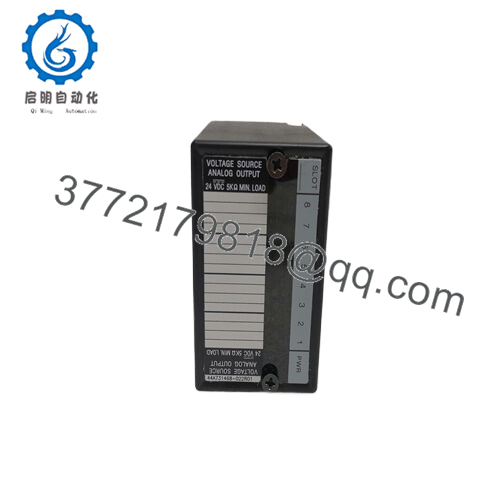
From a hardware design perspective, the GE IC670GB1002G uses a compact, panel‑mountable form factor typical of GE field control modules, with integrated connectors to simplify wiring and replacement. Mechanical robustness and clear labeling support installation in industrial cabinets or local enclosures where vibration and frequent access are expected. This physical design helps keep wiring organized and reduces the chance of connection errors during installation or maintenance.
Compatibility is a core strength of the GE IC670GB1002G, as it is intended to plug into GE Genius‑based architectures alongside other Genius field I/O and communication components. It communicates using standard Genius protocol conventions, allowing a wide range of GE controllers equipped with Genius interfaces to treat it as a regular I/O node. This makes the module a natural fit in mixed‑generation plants where newer and older equipment need to coexist on the same fieldbus without complex gateways.

- IC670GB1002G
In terms of long‑term reliability, the GE IC670GB1002G is built for continuous operation within industrial environmental limits, supporting extended service life when mounted in properly ventilated, protected enclosures. Its Genius‑based design, combined with the mature nature of the technology, means that behavior is well understood and stable over time, simplifying maintenance planning and troubleshooting. For facilities keeping Genius infrastructure in service for many years, this contributes to predictable lifecycle performance and reduced operational risk.
| Parameter | Value |
|---|---|
| Model | GE IC670GB1002G |
| Brand | General Electric (GE Genius / Field Control family) |
| Product Type | Multi‑channel Genius I/O module |
| System Platform | GE Genius field I/O / Field Control systems |
| Typical Role | Distributed field I/O node on Genius bus |
| I/O Function | Multi‑channel digital and/or analog I/O (model‑dependent) |
| Network Protocol | Genius fieldbus |
| Mounting Method | Panel or enclosure mounting as a field I/O unit |
| Intended Location | Remote field panels or junction boxes near equipment |
| Power Source | External low‑voltage supply plus bus power (as per Genius practice) |
| Diagnostics | Status and fault indication via module and bus data |
| Environmental Use | Industrial automation and process control environments |
IC670GB1002 – Base listing of the same Genius I/O module family, generally equivalent to GE IC670GB1002G in function for many applications.
IC670GBI002 – Related Genius interface or I/O head that operates on the same fieldbus and is used to connect similar field modules to a controller.
IC670ALG230 – Analog I/O unit commonly used alongside GE IC670GB1002G when both digital and analog signals are needed on a Genius node.
IC670MDL640 – Digital I/O module that can complement the GE IC670GB1002G in panels requiring higher discrete point density.
IC660BBD022N – Genius discrete I/O block used at the machine level, often sharing the same Genius network as GE IC670GB1002G in larger systems.
IC200GBI001-KL – VersaMax Genius Network Interface Unit that can connect newer VersaMax racks into Genius networks where GE IC670GB1002G might also be present.
IC693CGB001 – Genius communication module for certain GE PLC families that acts as the bus master for nodes including GE IC670GB1002G.
For installation, engineers should treat the GE IC670GB1002G like any field‑mounted Genius I/O node: ensure adequate cabinet or enclosure space, proper mounting, and sufficient cooling or ventilation according to the module’s environmental limits. The power supply must be sized for the module plus connected field loads where applicable, and overcurrent protection should be provided to protect wiring and equipment. Correct routing of Genius bus cabling, with attention to shield termination and separation from high‑noise power conductors, helps maintain communication integrity.
Network setup requires careful assignment of Genius addresses and adherence to recommended trunk lengths, drop lengths, and termination practices on the bus. During commissioning, it is good practice to validate that the GE IC670GB1002G is recognized correctly by the host controller, that the configured I/O map matches physical wiring, and that each channel behaves as expected under real operating loads. Periodic inspection of connectors, cable strain relief, and enclosure condition will help sustain reliable operation over time.