 WhatsApp: +86 16626708626
 Email:
  Phone: +86 16626708626
Description
The GE IC693331L is widely used in plants that still rely on proven GE Fanuc Series 90‑30 architectures but need dependable communication to distributed I/O and legacy field networks. Engineers encounter this module in material handling systems, packaging machines, batch processing units, and utilities where Genius bus or similar remote I/O remains the backbone of the control layer. In these environments, panel space is tight, wiring distances are long, and changeovers must be done with minimal downtime, so a rack-mounted bus interface that “just works” becomes essential rather than optional. The GE IC693331L helps controllers exchange deterministic data with remote blocks, drives, and instruments over a fieldbus instead of thousands of individual wires, which simplifies design and reduces points of failure.
Because it is used in industrial automation and applicable in control systems, the GE IC693331L often appears in brownfield modernization projects where only the CPU or select racks are being upgraded while I/O and field cabling remain in place. System integrators choose it when they need to retain Genius-based or similar remote I/O segments and still gain better diagnostics and control reliability at the PLC level. In a typical project, the module sits in a Series 90‑30 rack in the main control cabinet while remote I/O drops are spread around the plant in MCCs, process skids, or junction boxes. The GE IC693331L then owns the responsibility of keeping those segments synchronized with the control logic so that interlocks, sequences, and alarms behave predictably even when the system is expanded or modified. For plant maintenance teams, this translates into faster fault isolation, less time spent chasing wiring errors, and a smoother path for incremental system improvements.
Product introduction and positioning
The GE IC693331L is a bus interface and communication module for the GE Fanuc Series 90‑30 platform, designed to link the PLC backplane with remote I/O networks such as Genius-style fieldbus segments. Within the control system architecture, it acts as the dedicated gateway that packages discrete and analog I/O data into cyclic communications between the CPU and distributed devices. Instead of every field point terminating directly onto local I/O cards, signals are grouped into remote blocks, and the GE IC693331L manages their exchange as structured data in the PLC memory map. This gives engineers a cleaner architecture for medium to large installations, reducing cabinet wiring density and making system layout more modular.
In the context of the Series 90‑30 system, the GE IC693331L occupies a standard rack slot and integrates with familiar configuration tools, which keeps the learning curve low for teams with existing GE experience. It complements CPUs, power supplies, and local I/O modules to form a hybrid architecture where some signals are local to the rack and others are accessed remotely via the bus. For OEMs and integrators, this positioning is valuable: the module allows them to build scalable machines and process units that can ship with a base configuration and then be expanded with additional remote I/O panels as the project grows. The GE IC693331L therefore serves as a strategic component when the goal is to preserve installed assets, minimize rewiring, and still maintain a robust, maintainable communication backbone.
Key technical features and functional benefits
Functionally, the GE IC693331L focuses on deterministic, cyclic data transfer between the controller and distributed I/O, so update times are predictable and unaffected by the number of points on the bus within its rated capacity. This is especially important in applications with interdependencies between remote nodes, such as coordinated drives, valve manifolds, or safety-related permissives. Stable communication cycles help keep scan times consistent and prevent nuisance trips caused by intermittent I/O updates. The module typically supports configurable data blocks and diagnostics that allow engineers to map remote signals into specific address ranges, which simplifies programming and troubleshooting.
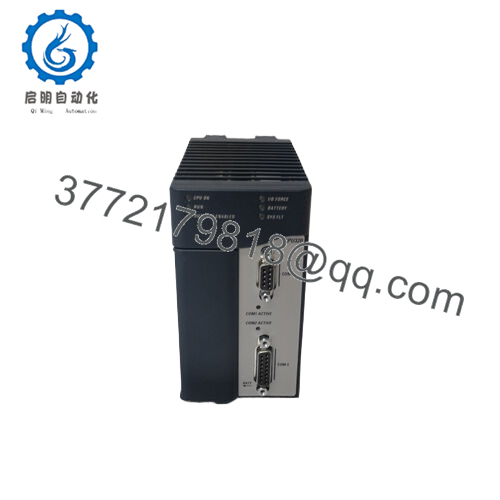
The hardware design of the GE IC693331L follows the established Series 90‑30 mechanical standard: a compact front profile, robust backplane connector, and front-panel LEDs that clearly indicate module and network status. This design makes it straightforward to install in dense control cabinets and easy to access for commissioning and maintenance. Status indicators allow technicians to quickly see whether a problem is local to the module, on the fieldbus segment, or related to power and addressing, cutting down on time with test equipment. The module’s solid-state construction and passive cooling approach suit it to typical control panel environments where vibration, electrical noise, and moderate temperature variation are expected.
Compatibility remains a key advantage. The GE IC693331L is tailored for Series 90‑30 racks and intended to work alongside CPUs, power supplies, and a wide range of local I/O cards, giving designers flexibility to mix remote and local I/O strategies without introducing a foreign communication platform. It can be deployed in systems that already host other communication modules, enabling multiple networks to coexist in the same controller. This is useful when bridging between existing Genius-style segments and newer equipment or when staging a gradual migration. Over the long term, this compatibility helps protect investments in field wiring and I/O hardware by allowing controllers to be refreshed while keeping the remote architecture intact.
From a reliability standpoint, the GE IC693331L is built for continuous operation in industrial cabinets, with an operating temperature range and electrical design suitable for typical plant environments when mounted and ventilated correctly. Its reliance on the Series 90‑30 backplane power and proven firmware philosophy means fewer moving parts and less susceptibility to random failures, provided installation guidelines are followed. When combined with a disciplined preventive maintenance routine, plants can run the module for years with minimal unplanned intervention, supporting high overall system availability and predictable lifecycle costs.

- IC693331L
Detailed technical specifications
| Parameter | Value |
|---|---|
| Model | GE IC693331L |
| Brand | GE Fanuc / Emerson Industrial |
| Product type | Bus interface / communication module |
| System platform | GE Fanuc Series 90‑30 PLC |
| Primary function | Interface between PLC rack and remote I/O fieldbus |
| Typical control data capacity | Supports cyclic transfer of grouped I/O data blocks |
| Power supply source | Powered via Series 90‑30 backplane |
| Expected operating temperature | Approximately 0 to 60 degrees Celsius (cabinet rated) |
| Mounting method | Rack-mounted in 90‑30 baseplate |
| Cooling method | Natural convection within control cabinet |
| Front-panel indicators | LEDs for module status and network activity |
| Typical application areas | Distributed I/O in industrial automation and control systems |
Related modules or compatible units
IC693CPU363 – Popular Series 90‑30 CPU commonly paired with the GE IC693331L in mid-size distributed control applications.
IC693CPU374 – Higher-performance CPU option that uses the GE IC693331L for larger or more demanding remote I/O networks.
IC693PWR330 – Rack power supply that provides backplane power for the GE IC693331L and other Series 90‑30 modules.
IC693CHS397 – 90‑30 rack/baseplate used to house the GE IC693331L, CPUs, and local I/O modules in a control cabinet.
IC660BBD025 – Remote Genius-style I/O block that can be addressed over the fieldbus network served by the GE IC693331L.
IC660TBA020 – Terminal assembly for field wiring to remote I/O blocks that communicate back through the GE IC693331L.
IC693331-CC – Related bus interface variant in the same family, often used in similar Series 90‑30 networking applications.
IC693ALG221 – Analog input module that can coexist with the GE IC693331L in the same rack to support mixed local and remote I/O designs.
Installation notes and maintenance best practices
Before installing the GE IC693331L, control engineers should confirm that the chosen Series 90‑30 rack provides sufficient slot availability, power margin, and thermal capacity for the complete configuration, including CPU, I/O, and communication modules. Cabinet design should allow clear access to the module’s front-panel LEDs and connectors so that commissioning and troubleshooting can be done without dismantling wiring. Proper bonding of the cabinet, careful routing of fieldbus cables away from high-voltage conductors, and correct termination at the ends of each bus segment are crucial to maintain signal integrity. It is good practice to document node addresses, segment lengths, and grounding points in as-built drawings so future maintenance staff can quickly understand the network layout.
Once operational, the GE IC693331L generally requires low-touch maintenance, focusing on periodic inspection and communication health checks rather than physical adjustments. Maintenance teams should periodically verify LED status, scan for any bus errors or retries reported in the controller diagnostics, and inspect connectors for signs of mechanical stress, contamination, or looseness. Cleaning dust from cabinet ventilation paths and confirming that ambient temperatures remain within recommended ranges will help preserve long-term reliability. When configuration or firmware changes are required, they should be planned during scheduled outages, with full backups and rollback procedures in place so that the module can be brought back into service without unexpected disruption.