 WhatsApp: +86 16626708626
 Email:
  Phone: +86 16626708626
Description
The GE IC693CBL305A communication cable solves a practical connectivity challenge in Series 90-30 PLC systems equipped with communications coprocessor modules: how to access both serial ports on a single combined connector without custom breakout wiring or signal degradation. In many industrial automation and process control installations, the PCM301, PCM311, or similar coprocessors feature a 25-pin D-sub port that multiplexes RS-232 and RS-485 signals for programming, HMI interfacing, or multi-drop networking. Engineers often need simultaneous or flexible connections to a programming device (like a laptop running Proficy Machine Edition) and another peripheral such as a barcode reader, modem, or downstream device—yet running separate cables risks pin conflicts, noise pickup, or unreliable handshaking.
The GE IC693CBL305A becomes essential when your setup demands clean, factory-supported splitting of that port into two independent connections, maintaining signal integrity over short distances while avoiding makeshift Y-adapters that can introduce crosstalk or impedance mismatches. It addresses common frustrations in brownfield expansions, commissioning, or maintenance where quick, reliable dual-port access speeds troubleshooting, data logging, or protocol bridging without rewiring the panel or risking communication errors. For systems still leveraging the durable Series 90-30 platform—common in manufacturing, utilities, and legacy machine control—this short high reliability cable ensures I/O signal and comms stability by providing a plug-and-play solution engineered specifically for the PCM modules. Typical scenarios include shop-floor debugging where one branch connects to a PC for ladder edits while the other links to an HMI or sensor network, or permanent installations requiring redundant or parallel serial paths without additional hardware.
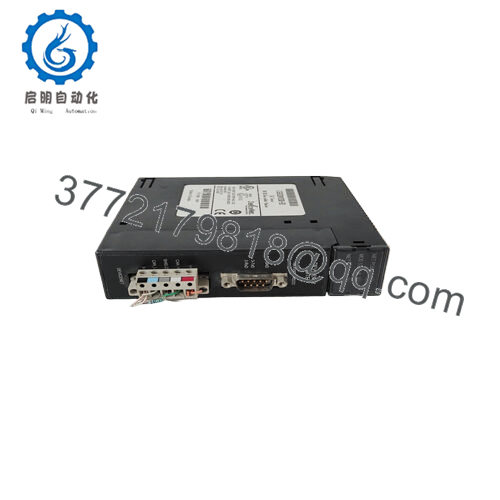
The GE IC693CBL305A functions as a purpose-built Wye (or Y-splitter) cable within the Series 90-30 ecosystem, attaching directly to the 25-pin communications port on coprocessor modules like the PCM301 or PCM311. It splits the combined RS-232/RS-485 signals into two separate 25-pin connectors, each capable of independent operation depending on the PCM configuration and protocol selected. One branch typically handles primary RS-232 for programming or point-to-point links, while the other supports RS-485 multi-drop or secondary RS-232 duties, with pin assignments following GE Fanuc standards to preserve full handshaking, ground isolation, and shielding effectiveness.
At roughly 1 foot (12 inches or 30.5 cm) long, the cable minimizes signal attenuation and clutter in tight panels, using shielded 26–28 AWG conductors and appropriate jacketing (often AWM 2464-rated for 300 V, 80°C) to reject electrical noise common in factory environments. It mounts inline—no rack space required—and integrates seamlessly into the backplane-powered coprocessor setup, allowing the CPU to manage communications without additional addressing or power considerations. In practice, this enables flexible topologies: connect one end to the PCM, route one leg to a serial HMI or SCADA port, and the other to a configuration PC or modem. The design supports the coprocessor’s ability to switch protocols or modes via firmware, ensuring both branches remain functional for diagnostics, data exchange, or redundancy in non-critical paths. Overall, GE IC693CBL305A sits at the field-to-controller boundary, delivering straightforward serial expansion that keeps communication layers clean and maintainable.
| Specification | Details |
|---|---|
| Model Number | IC693CBL305A |
| Brand | GE Fanuc (Emerson) |
| Type | Wye (Y-Splitter) Communication Cable |
| Input Voltage | N/A (passive cable, no power) |
| Operating Temp Range | Typically -40 to +85 °C (cable rating dependent) |
| Mounting Style | Inline connection, no mounting |
| Dimensions | Approx. 12 inches (30.5 cm) length |
| Weight | Approx. 0.2–0.3 lb (90–140 g) |
| Interface/Bus | 25-pin D-sub (RS-232/RS-485) to dual 25-pin |
| Compliance | CE, UL-listed components where applicable |
| Supported Protocols | RS-232, RS-485 (per PCM module config) |
| Typical Power Draw | None (passive) |

- IC693CBL305A
Opting for the GE IC693CBL305A brings tangible advantages in environments where serial communication flexibility directly affects commissioning speed and operational responsiveness. Its factory-engineered pinout and shielding ensure consistent signal quality across both branches, reducing bit errors or dropouts that plague improvised splitters—especially valuable in noisy panels with VFDs or motor starters nearby. This reliability translates to faster loop testing during startups or modifications, often cutting hours from debug sessions by allowing simultaneous programming and monitoring without swapping cables.
The compact length keeps cabinet layouts tidy, minimizing strain on connectors and reducing trip hazards or interference points. In long-running Series 90-30 systems, GE IC693CBL305A supports easy access for firmware updates, data trending, or HMI integration without panel intrusion, lowering engineering overhead and extending the useful life of legacy hardware. Its robust construction withstands repeated connect/disconnect cycles common in maintenance, delivering dependable performance that aligns with the overall durability of the 90-30 platform.
GE IC693CBL305A is routinely deployed in manufacturing cells, material handling systems, and process skids still running Series 90-30 PLCs with coprocessor enhancements. In automotive or food & beverage lines, it enables dual serial links for one branch to a local HMI displaying machine status while the other connects to a plant-floor PC for recipe downloads or fault logging, supporting critical system uptime during production changes. Utility and wastewater applications use GE IC693CBL305A to split ports for SCADA polling over RS-485 alongside local RS-232 diagnostics in remote panels, where high reliability in harsh, electrically noisy conditions prevents communication faults. Machine builders incorporate it in OEM equipment for flexible commissioning—allowing end-users to tie into programming tools without custom harnesses—ensuring smooth integration in process control environments with variable serial demands.
Related or compatible products include:
IC693CBL305 – Base/non-A variant, functionally equivalent in most applications
IC693PCM301 – Communications coprocessor module that pairs directly with this cable
IC693PCM311 – Higher-performance coprocessor with expanded protocol support
IC693CBL327 – Longer RS-232 programming cable for CPU direct connection
IC693ACC002 – RS-485 terminator or adapter for multi-drop setups
IC693CPU364 – CPU often used with PCM modules and this cable
IC693CMM311 – Communications module for alternative serial expansion
IC690CBL701 – Older-series cable sometimes cross-referenced for similar functions
Before installing GE IC693CBL305A, verify the target PCM module (e.g., PCM301/PCM311) has the 25-pin port and matches the cable’s pinout—cross-reference the GE installation manual for signal assignments to avoid protocol mismatches. Ensure both downstream devices use compatible baud rates, parity, and handshaking; test continuity and shielding integrity if the cable shows wear. In dense panels, route it away from high-power cables to preserve noise immunity, and confirm no strain on the connectors during door closure.
Ongoing maintenance is minimal for this passive cable: inspect connectors quarterly for corrosion, bent pins, or loose strain relief, especially in humid or vibrating areas. Tug gently to check secure seating, and clean contacts with isopropyl alcohol if oxidation appears. Periodically verify communication stability during system checks—monitor for CRC errors or timeouts in the PCM diagnostics via Proficy tools. If one branch fails, swap legs or test with a known-good device to isolate issues. These simple steps keep GE IC693CBL305A performing reliably with virtually no active upkeep.