 WhatsApp: +86 16626708626
 Email:
  Phone: +86 16626708626
Description
In industrial automation and process control systems, integrating legacy or third-party field devices—such as sensors, actuators, drives, or valve positioners—into a modern PLC architecture often creates headaches around protocol compatibility, network configuration complexity, and reliable data exchange. DeviceNet remains a widely installed fieldbus in many facilities for its cost-effective, deterministic communication, but mismatched or outdated master modules can lead to intermittent connectivity, limited slave support, slow polling cycles, or difficult diagnostics that increase downtime and complicate troubleshooting. When expanding or maintaining RX3i-based systems with existing DeviceNet networks, engineers need a straightforward, high-performance master that handles up to dozens of slaves without bottlenecking the controller or requiring extensive custom programming.
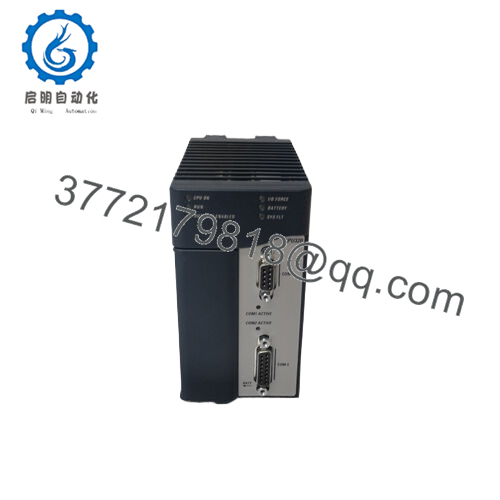
GE IC694DNM200-BB serves as a dedicated DeviceNet Master communication module for the PACSystems RX3i platform (and compatible with certain Series 90-30 setups), enabling the CPU to efficiently manage and exchange data with DeviceNet slave devices. This module becomes essential in mixed-automation environments where you must poll binary or analog I/O points, status information, or explicit messaging from multiple vendors’ equipment—think motor starters, variable frequency drives, or smart sensors—while maintaining tight control loops and minimizing latency. It supports full master functionality for up to 63 slaves, offers selectable baud rates for flexible network tuning, and provides robust diagnostics to help pinpoint issues like node failures or configuration mismatches. For teams focused on high reliability in industrial automation, GE IC694DNM200-BB ensures seamless DeviceNet integration without adding external gateways, preserving deterministic performance and simplifying system architecture in process control or discrete manufacturing applications.
GE IC694DNM200-BB installs directly into an RX3i rack slot, drawing power from the backplane (5 VDC at 450 mA) while supplying separate 24 VDC to the DeviceNet network cable for bus powering. It acts as the network coordinator, scanning configured slaves cyclically for I/O data (up to 255 bytes input/output per scan) and supporting explicit messaging for configuration or advanced diagnostics. The module connects via a standard 5-pin DeviceNet phoenix-style connector, supporting trunkline/dropline topologies with baud rates of 125 kbps, 250 kbps, or 500 kbps to match network requirements and cable lengths. It integrates tightly with the RX3i CPU (firmware version 3.5 or later recommended), mapping slave data directly into PLC memory for easy ladder or structured text access—no extra middleware needed. The module can also operate simultaneously as a slave on the same network if required for hierarchical setups. Positioned in the communication layer of the RX3i stack, GE IC694DNM200-BB bridges field-level DeviceNet devices to the controller, enabling real-time control, status monitoring, and fault handling while supporting redundancy or multi-master configurations in compatible architectures—ideal for distributed I/O or machine-to-machine coordination in expansive plants.

- IC694DNM200-BB
| Specification | Details |
|---|---|
| Model Number | IC694DNM200-BB |
| Brand | GE Fanuc / Emerson |
| Type | DeviceNet Master Module |
| Input Voltage | 5 V DC (backplane); 24 V DC (network) |
| Operating Temp Range | 0 to +60 °C (typical RX3i) |
| Mounting Style | RX3i rack slot (standard) |
| Dimensions | Approx. 140 x 100 x 40 mm (standard RX3i module) |
| Weight | Approx. 0.3 kg |
| Interface/Bus | DeviceNet (5-pin connector) |
| Compliance | CE, UL, RoHS, typical industrial |
| Supported Protocols | DeviceNet Master (up to 63 slaves); explicit messaging |
| Typical Power Draw | 450 mA at 5 V (2.25 W) |
Deploying GE IC694DNM200-BB delivers practical gains in network stability and maintenance efficiency for DeviceNet-reliant systems. Engineered for consistent, high-speed scanning, it ensures deterministic I/O updates that keep control loops tight and reduce variability in processes sensitive to timing—such as conveyor synchronization or batch dosing. The module’s extensive slave support and built-in diagnostics (node status, error counters, network health) allow operators and technicians to quickly identify and resolve issues like cabling faults or slave dropouts, often preventing minor problems from escalating into production stops. Integration stays simple within the RX3i environment, with configuration handled through Proficy Machine Edition or similar tools, cutting engineering time by avoiding custom protocol converters or additional racks. Overall, GE IC694DNM200-BB lowers lifecycle costs by leveraging existing DeviceNet infrastructure reliably, supporting long-term performance in harsh industrial settings with vibration, electrical noise, or temperature fluctuations.
GE IC694DNM200-BB sees common deployment in industries with established DeviceNet networks requiring reliable master control. In automotive manufacturing or material handling systems, it coordinates drives, sensors, and pneumatic actuators across assembly lines or conveyors, ensuring synchronized operation and rapid fault detection for critical system uptime. Food & beverage or packaging facilities use it to manage valve manifolds, level sensors, and motor controls in washdown environments, where deterministic polling supports hygienic processes and batch consistency. It’s also prevalent in discrete parts manufacturing like plastics or electronics assembly, handling multi-vendor I/O in high-cycle applications that demand fast, noise-immune communication over extended networks.
Here are some compatible or related products within the RX3i and Emerson PACSystems families:
- IC694DNM200 (earlier revisions like -AA or -CC) – Functionally equivalent base DeviceNet Master; -BB often indicates RoHS-compliant or minor hardware updates
- IC693DNM200 – Series 90-30 compatible predecessor for legacy migrations
- IC695CMM002 – Serial communications module as alternative for non-DeviceNet protocols
- IC694BEM331 – Genius Bus Controller for migrating from older Genius networks
- IC695ETM001 – Ethernet module for TCP/IP-based alternatives to DeviceNet
- IC694ACC310 – RX3i terminal block or accessory for field wiring support
- IC695CPU320 – High-performance RX3i CPU that pairs well with IC694DNM200-BB for demanding scans
- QuickPanel+ series (e.g., IC755) – HMI options for visualizing DeviceNet data polled by the module
Before installing GE IC694DNM200-BB, confirm RX3i rack slot availability (any universal slot) and ensure the CPU firmware is at least version 3.5 for full compatibility. Verify DeviceNet network power (24 V DC external supply) meets requirements, and check cable topology against baud rate limits (e.g., max trunk length at 500 kbps is ~100 m). During commissioning, use Proficy tools to configure the scanner parameters, map slave EDS files, and perform network commissioning—test connectivity node-by-node to validate I/O mapping and explicit messaging. Provide adequate ventilation in the rack and secure the DeviceNet drop cable to prevent strain or interference.
Ongoing maintenance for GE IC694DNM200-BB involves periodic network health checks rather than frequent intervention. Monitor module LEDs (OK, Network Status, Module Status) during routine inspections for green/normal operation or flashing/error states indicating bus faults or configuration issues. Review diagnostic buffers in the PLC for error counters, offline nodes, or scan times, and clear logs after analysis. Inspect DeviceNet connectors and cabling annually for wear, corrosion, or loose terminations—especially in vibration-prone areas—and verify terminating resistors are correctly placed. Firmware updates (if available) should be applied during planned outages, with backups of scanner configurations beforehand. These steps help maintain reliable performance over years in typical industrial environments.