 WhatsApp: +86 16626708626
 Email:
  Phone: +86 16626708626
Description
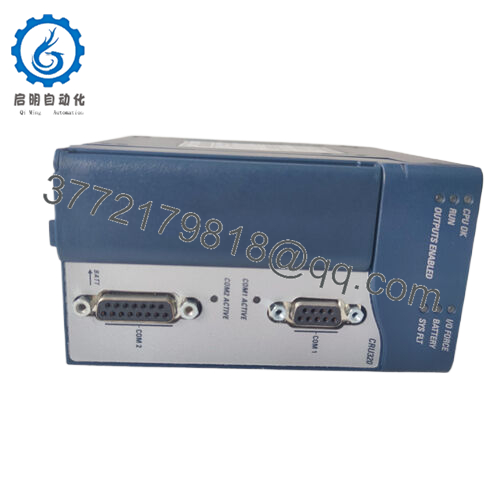
GE IC695ALG600-AB is typically selected when a plant wants one flexible analog front end that can handle almost any sensor they are likely to encounter on an RX3i‑based system. It shows up on packaged skids, utility modules, and balance‑of‑plant panels where a mix of thermocouples, RTDs, 4–20 mA transmitters, and low‑level voltage or resistance inputs all need to terminate in a single rack. Instead of scattering different analog cards across the chassis, engineers use GE IC695ALG600-AB to simplify design: one module covers temperature, process, and specialty measurements. This is particularly useful on OEM skids—chillers, compressors, test stands—where the same control panel may serve multiple variants of a machine, each with slightly different instrumentation requirements used in industrial automation.
In real‑world deployments, GE IC695ALG600-AB is applicable in control systems for chemical injection skids that combine temperature monitoring, pressure and flow transmitters, and RTDs on a single card. It is equally at home in power generation or boiler applications where thermocouples track flue gas temperature, RTDs monitor bearing or winding temperature, and 4–20 mA loops report drum level or fuel flow. Maintenance teams appreciate that a failed temperature probe or transmitter can often be replaced with a different sensor type, then reconfigured in software rather than forcing a hardware change. Because GE IC695ALG600-AB supports such a broad range of signal types, it is often standardised as the “universal analog” choice that is fully applicable in control systems built around PACSystems RX3i, reducing spares inventory and design complexity across the site.
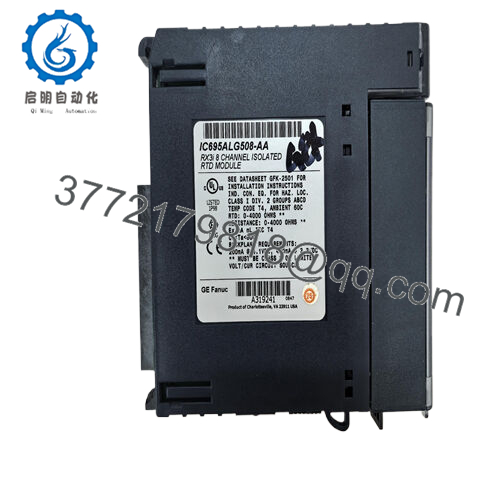
GE IC695ALG600-AB is a universal analog input module for the PACSystems RX3i platform that provides eight general‑purpose input channels and two dedicated cold‑junction compensation channels. Each of the eight inputs can be independently configured for thermocouple, RTD, resistance, current, or voltage measurement, so a single module can support everything from high‑temperature furnace thermocouples to low‑range millivolt signals and standard 4–20 mA process transmitters. Within a control system architecture, GE IC695ALG600-AB sits as a high‑density, multi‑function analog front end: it converts diverse sensor signals into floating‑point or integer values that the RX3i CPU uses for control, trending, and alarms.
The module is designed for the RX3i universal backplane and occupies one slot, using the PCI‑based bus structure for rapid data exchange with the controller. Its eight inputs are organised into two isolated groups of four channels, which improves noise immunity and offers flexibility in grounding strategies when mixing signal types. For thermocouple applications, GE IC695ALG600-AB relies on external cold‑junction compensation devices, allowing accurate temperature measurement across a broad range of thermocouple types. In system positioning terms, it is aimed at engineers and integrators who want maximum flexibility—one part number that can be dropped into almost any analog measurement role on an RX3i rack.
A central strength of GE IC695ALG600-AB is the breadth of input types and ranges it supports. Each channel can be configured for multiple thermocouple types (B, C, E, J, K, N, R, S, T), industrial RTDs (including common platinum and nickel curves), several resistance ranges (for general resistive sensing), and standard current and voltage ranges such as 0–20 mA, 4–20 mA, ±20 mA, ±50 mV, ±150 mV, 0–5 V, 1–5 V, 0–10 V, and ±10 V. This allows one hardware platform to handle everything from cryogenic temperature measurements to high‑temperature furnace monitoring, as well as typical process loop and low‑level sensor signals. For designers, it means fewer hardware variants to qualify and keep in stock, while still meeting tight measurement requirements across multiple projects.
Performance‑wise, GE IC695ALG600-AB uses sigma‑delta A/D conversion with up to 16 bits of usable resolution, combined with configurable digital filtering on each channel. Several filter frequencies—ranging from a few hertz up to tens of hertz—let engineers trade off noise rejection against response time to suit individual signals. For fast process loops, a higher filter frequency yields channel update times on the order of tens of milliseconds, while slower, highly filtered settings improve accuracy and noise immunity for noisy or slowly varying signals. The module’s normal‑mode and common‑mode noise rejection are specified at high levels for 50/60 Hz mains, so it maintains stable readings even in cabinets with substantial electrical noise.
In terms of hardware design, GE IC695ALG600-AB provides two cold‑junction compensation channels for thermocouple inputs, supporting accurate temperature conversion when used with appropriate terminal blocks and CJC sensors. The two groups of four channels share isolation barriers, allowing different grounding schemes or signal source references between groups while preserving field‑to‑backplane isolation. Internal flash memory supports field firmware upgrades and auto‑calibration at power‑up, helping maintain accuracy over time without manual adjustments. All configuration is handled in software—there are no module jumpers—so channel type, range, filter, and alarm thresholds can be adjusted from the engineering workstation without opening the cabinet.
Long‑term reliability is enhanced by robust isolation, conservative input protection, and compliance with industrial standards. GE IC695ALG600-AB is designed to meet CE, UL/cUL 508 and 1604, and ATEX requirements when installed in appropriate enclosures, which makes it suitable for use in many regulated industrial environments. Input channels include over‑current and over‑voltage protection appropriate to their range, and maximum continuous currents are specified to prevent damage when loops are miswired. The combination of auto‑calibration, strong noise rejection, and industrial certifications makes the module well suited for continuous service in harsh plants where uptime and measurement integrity are critical.
| Parameter | Value |
|---|---|
| Model | GE IC695ALG600-AB |
| Brand | GE Fanuc / Emerson Industrial Automation |
| Product Type | Universal analog input module |
| System Platform | PACSystems RX3i programmable automation controller |
| Number of Analog Inputs | 8 general‑purpose channels |
| Channel Grouping | 2 isolated groups, 4 channels per group |
| Cold Junction Compensation | 2 channels for thermocouple cold‑junction compensation |
| Supported Thermocouple Types | B, C, E, J, K, N, R, S, T |
| Supported RTD Types | Common PT (385/3916), Ni, Cu curves (e.g., N, NiFe, Cu families) |
| Resistance Input Ranges | 0 to 250 / 500 / 1000 / 2000 / 3000 / 4000 Ohms |
| Current Input Ranges | 0–20 mA, 4–20 mA, +20 mA (typical universal current support) |
| Voltage Input Ranges | ±50 mV, ±150 mV, 0–5 V, 1–5 V, 0–10 V, ±10 V |
| A/D Conversion Type | Sigma‑delta, up to 16‑bit effective resolution |
| Filter Options | Six selectable digital filter frequencies per channel (approx. 2.3–28 Hz range) |
| Typical Channel Update Times | From about 10 ms per channel (fast filter) to 120 ms per channel (slowest filter) |
| Field‑to‑Backplane Isolation | Industrial‑grade isolation suitable for 250 VAC continuous / 1500 VAC for 1 minute class |
| Certifications | Designed to meet CE, UL/cUL 508 & 1604, ATEX requirements when properly installed |
| Configuration | Fully software‑configurable; no jumpers; auto‑calibration at power‑up |
| Backplane Compatibility | RX3i universal backplane, PCI‑based bus, occupies one slot |

- IC695ALG600-AB
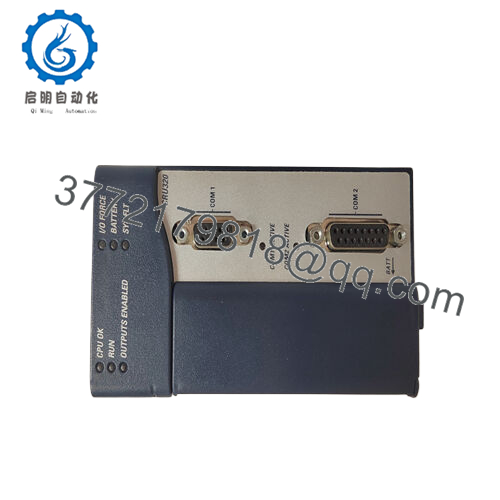
GE IC695ALG600 – Base universal analog input module of the same family; GE IC695ALG600-AB is a specific revision with identical core capabilities and minor hardware or firmware updates.
GE IC694ALG223A – Sixteen‑channel current‑only analog input module commonly paired with GE IC695ALG600-AB when a system needs both universal and high‑density 4–20 mA inputs in RX3i.
GE IC694ALG392A – Eight‑channel analog output module used alongside GE IC695ALG600-AB to provide companion control outputs for the measured analog signals.
GE IC695ALG106-EA – Isolated analog input module focused on current and voltage, selected when fewer but fully isolated channels are required instead of universal inputs.
GE IC695CPU320 – RX3i CPU frequently deployed in systems where GE IC695ALG600-AB collects diverse analog data for advanced control strategies.
GE IC695PSA040 – RX3i power supply that provides the backplane power required by GE IC695ALG600-AB and related I/O modules in medium‑sized systems.
GE IC694TBC032 / IC694TB3x32 – Terminal blocks typically used to terminate field wiring to RX3i analog modules like GE IC695ALG600-AB, including thermocouple and RTD inputs.
When planning installation of GE IC695ALG600-AB, engineers should carefully design the I/O grouping to take advantage of the two isolated channel groups. High‑noise or widely separated reference signals should be placed in different groups, and thermocouple and low‑level millivolt signals should be kept physically and electrically separate from high‑current or high‑voltage wiring. The external cold‑junction compensation devices must be correctly mounted and wired at the appropriate terminals to ensure accurate thermocouple readings; placement near the field termination point, not in hot zones, is important for accuracy. Careful routing of shielded twisted pair cables, with shields bonded to cabinet ground at one end, helps maintain signal integrity, especially when low‑level voltage or resistance ranges are used.
From a maintenance perspective, GE IC695ALG600-AB benefits from periodic checks of terminal tightness, inspection of thermocouple and RTD terminations, and verification that the configured channel types and ranges still match the connected instruments. During planned shutdowns, technicians can validate channel performance by injecting known currents, voltages, or simulated thermocouple signals and comparing the PLC values to reference instruments. Because configuration is entirely software‑based, any changes to sensor type or range should be carefully documented and controlled through change‑management procedures so that scaling, alarming, and historical trends remain consistent over time. Keeping up‑to‑date backups of the module configuration and channel assignments ensures a replacement GE IC695ALG600-AB can be commissioned quickly with minimal impact on the process.