 WhatsApp: +86 16626708626
 Email:
  Phone: +86 16626708626
Description
The GE IC695ETM001-EH (commonly referenced as IC695ETM001 with -EH revision) serves as a dedicated Ethernet interface module in the PACSystems RX3i family, solving the challenge of providing robust, high-speed network connectivity when the CPU’s embedded Ethernet port is insufficient or unavailable. In industrial automation and process control environments, many applications require multiple Ethernet connections—for HMIs, SCADA systems, peer controllers, historians, or remote I/O—while maintaining deterministic performance and minimizing latency. Built-in CPU Ethernet ports (even on advanced models) often limit channel counts, force shared bandwidth with control traffic, or lack flexibility for daisy-chaining devices. Without a separate interface like this, engineers add external switches, gateways, or multiple NICs, increasing points of failure, cabinet space, and integration complexity.
GE IC695ETM001-EH becomes essential in setups needing expanded Ethernet capability, such as multi-node networks, distributed I/O over Ethernet, or high-traffic communications without compromising the main CPU’s processing focus. It fits scenarios where you want independent IP addressing, redundant links, or separation of control and supervisory networks—all while preserving high reliability and low overhead. GE IC695ETM001-EH integrates natively into the RX3i rack, offloading Ethernet tasks to free the CPU for logic execution and enabling seamless SRTP, Modbus TCP, and other protocol handling. This module helps avoid bottlenecks, supports scalable architectures, and ensures stable data exchange in demanding 24/7 operations.
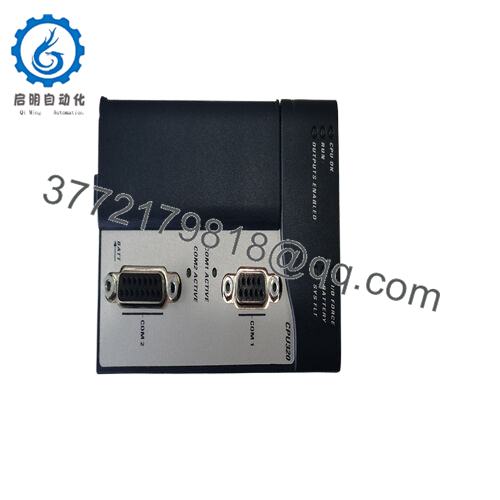
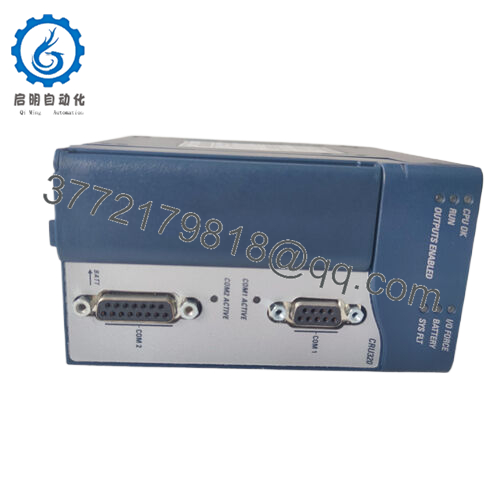
The GE IC695ETM001-EH operates as a single-slot Ethernet transmitter module in the RX3i universal backplane, featuring a dedicated 200 MHz processor that manages network communications independently of the main CPU. It provides two auto-sensing 10/100 Mbps RJ-45 ports (one IP address shared across both) with support for half/full duplex, auto-crossover, and embedded switching for daisy-chaining devices without an external hub. An additional RS-232 Station Manager port (9-pin D-sub) enables local diagnostics, configuration, and firmware updates via terminal emulation.
Positioned in the RX3i rack alongside the CPU and I/O, GE IC695ETM001-EH connects the controller to Ethernet networks for TCP/IP services including SRTP (for Proficy programming and HMI), Modbus TCP client/server, Ethernet Global Data (EGD) for peer-to-peer exchange, and Channel API for custom messaging. It supports up to 32 SRTP connections and multiple Modbus sessions, with built-in web server for status monitoring and diagnostics. The module handles network redundancy via link monitoring and failover logic in application code if paired with dual modules. Status LEDs provide at-a-glance health (link, activity, faults), while detailed diagnostics feed into the controller for HMI display or alarming. The -EH revision incorporates firmware updates for improved stability, security patches, and compatibility with newer RX3i CPUs and Proficy tools. This positions GE IC695ETM001-EH as a flexible networking layer in centralized or distributed RX3i architectures.
| Specification | Details |
|---|---|
| Model Number | IC695ETM001-EH |
| Brand | GE / Emerson (PACSystems RX3i) |
| Type | Ethernet Interface Module |
| Input Voltage | 5 VDC / 3.3 VDC backplane (from power supply) |
| Operating Temp Range | 0 to +60 °C |
| Mounting Style | RX3i universal backplane (1 slot) |
| Dimensions | Standard RX3i single-slot (approx. 145 x 112 x 135 mm) |
| Weight | Approx. 0.45 kg |
| Interface/Bus | PCI/Serial dual backplane; 2x RJ-45 Ethernet + RS-232 Station Manager |
| Compliance | CE, RoHS, UL Class I Div 2 |
| Supported Protocols | SRTP, Modbus TCP, EGD, Channel API, FTP, Web Server, SNMP |
| Typical Power Draw | ~4-5 W |

- IC695ETM001-EH
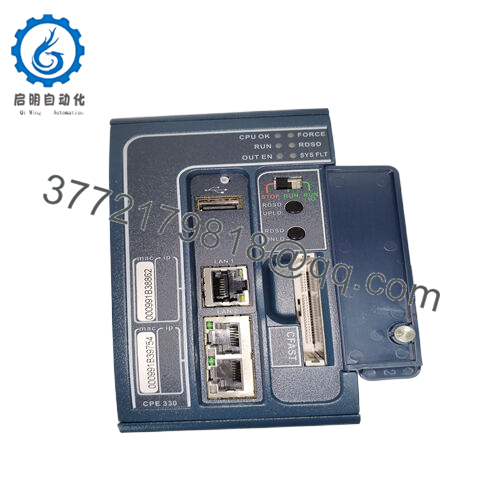
Selecting GE IC695ETM001-EH gives your RX3i system dedicated, high-throughput Ethernet handling that keeps control logic responsive by offloading network overhead from the CPU. Engineered for industrial reliability, its dual ports with built-in switching simplify cabling—daisy-chain HMIs, drives, or remote racks without extra hardware—while supporting robust protocol stacks for seamless integration into plant-wide networks.
The module reduces engineering time during setup and expansion: configure once via Proficy Machine Edition, monitor via web interface or Station Manager, and diagnose faults quickly with clear LEDs and detailed logs. It enhances long-term performance by enabling network separation (e.g., control vs. IT traffic) and supporting higher connection counts without performance degradation. In practice, GE IC695ETM001-EH helps maintain stable communications, minimizes latency issues, and allows focus on process optimization rather than network troubleshooting.
GE IC695ETM001-EH is commonly used in discrete manufacturing for networked machine lines, where it connects multiple HMIs, barcode scanners, and vision systems to the RX3i controller over Ethernet without taxing the CPU. In process industries like water treatment, oil & gas, or food production, it supports distributed I/O racks, remote operator stations, and SCADA links in environments requiring reliable, low-latency data exchange under continuous operation. Power utilities deploy it for substation monitoring or auxiliary controls needing robust TCP/IP connectivity alongside deterministic logic.
These applications share needs for expanded networking, harsh electrical conditions, and critical system uptime—where GE IC695ETM001-EH provides dependable Ethernet expansion without introducing unnecessary complexity or single points of failure.
Here are some related or alternative products within the RX3i family and beyond:
- IC695ETM001 (other revisions, e.g., -EK, -EL) – Same core module; -EH denotes a specific firmware/hardware iteration with updates.
- IC695CPE330 – CPU with dual embedded Gigabit Ethernet ports, reducing need for separate ETM in many cases.
- IC695CPE400 – Advanced standalone CPU with integrated high-performance Ethernet and edge capabilities.
- IC695CMU310 – Older RX3i CPU with limited Ethernet; often upgraded using IC695ETM001-EH for better networking.
- IC693CMM321 – Legacy Series 90-30 Ethernet module; migration path to RX3i often includes IC695ETM001.
- IC695PNC001 – PROFINET controller module for fieldbus integration when Ethernet/IP or Modbus isn’t sufficient.
- IC695RMX128 – Redundancy Memory Xchange; used in pairs with redundant CPUs that may also leverage IC695ETM001-EH for network links.
- IC695ACC400 – Energy Pack accessory (for CPUs); unrelated directly but part of same rack ecosystem.
Before installing GE IC695ETM001-EH, confirm RX3i rack slot availability and that the backplane power supply supports the added draw (typically minimal). Verify IP address configuration doesn’t conflict with any embedded CPU Ethernet, and set unique MAC if needed for network uniqueness. Use Proficy Machine Edition to assign firmware version matching your system—update if required for protocol enhancements or bug fixes. Ensure proper grounding and cable shielding, especially in noisy environments, and allow space for airflow around the module.
Ongoing maintenance is straightforward: check Ethernet link/activity LEDs and fault indicators during routine inspections—steady green usually means healthy connections. Access the web interface or Station Manager port periodically to review statistics, errors, or firmware status. Inspect RJ-45 connectors and cables annually for damage or loose fits in vibrating panels. Back up module configuration via PME, and test communications (ping, SRTP) during outages to catch issues early. No routine calibration applies, but firmware reviews keep compatibility with evolving networks and controllers.