 WhatsApp: +86 16626708626
 Email:
  Phone: +86 16626708626
Description
In sprawling semiconductor fabs where wafer etchers demand millisecond data handoffs between cleanroom islands, the GE IC695ETM001-HT bridges controllers over Ethernet without a stutter, dodging costly yield dips from network stalls. Engineers at Midwest battery gigafactories wire it into RX3i racks to sync cell assemblers with quality scanners, handling EGD exchanges amid high EMI from welders—traditional hubs choke here. Used in industrial automation for automotive body shops, it daisy-chains PACsystems to VersaMax I/O drops over 100 meters of CAT5, tackling cable clutter and switch failures during line changeovers. Applicable in control systems for pharmaceutical blister packs, the GE IC695ETM001-HT shuttles SRTP commands and Modbus TCP to remote fillers, ensuring recipe syncs hold through steam bursts or power blips. Over in European solar panel lines battling dust and heat, it maintains LAN integrity for 24/7 uptime, outlasting consumer-grade NICs in vibration-prone zones.
Oil rig drilling platforms lean on its redundant IP mode, letting primary nodes claim shared addresses on failover while legacy Series 90 PLCs tag along seamlessly. Food co-packers coordinate multi-lane pouch machines via its embedded switch, slashing cabling costs versus external gear. Wind turbine nacelles endure -40°C gales as it pipes diagnostics to SCADA hubs, no transceivers needed. This frontline toughness reveals its makeup: a high-temperature Ethernet interface module from GE Vernova’s RX3i PACsystems, hardened for extreme ops with 200 MHz processing and dual auto-sensing ports.
Product Introduction & Positioning
The GE IC695ETM001-HT acts as a single-slot Ethernet powerhouse in the RX3i PACsystems ecosystem, snapping into universal backplanes to deliver TCP/IP connectivity for programming, data sharing, and peer-to-peer talks. With dual 10/100 Mbps RJ-45 ports featuring an internal switch, it supports daisy-chaining without extra hardware, running SRTP, Ethernet Global Data (EGD), and Modbus TCP over a full four-layer stack. A dedicated RS-232 Station Manager port at 115.2 kbps max lets operators tweak IPs or sniff diagnostics live, no laptop tether required.
Integrators slot the GE IC695ETM001-HT ahead of CPUs like CPE310 for network offload, freeing processor cycles in dense racks—up to 32 SRTP client channels and 80 total connections handle enterprise-scale traffic. Hot-swap ready with firmware 2.51+ CPUs, it boasts configurable redundant IP for high-availability pairs, plus SNTP time sync. This positions it as the go-to upgrade from Series 90-30 CMM modules, blending legacy compatibility with modern throughput for hybrid factories eyeing Proficy Machine Edition workflows.
Key Technical Features & Functional Benefits
Dual auto-negotiating ports on the GE IC695ETM001-HT detect speed, duplex, and crossover on the fly, pushing 100 Mbps full-duplex for EGD exchanges that clock sub-10 ms unicast—crucial for coordinated robotics in press shops. The embedded switch cuts latency in daisy chains up to dozens of nodes, while recessed restart button reboots firmware sans power cycle, a lifesaver mid-shift. LEDs scream status: OK, LAN active, log status, and per-port link/speed, spotting CRC errors before they snowball.
Hardened for hellish spots, the GE IC695ETM001-HT gulps ≤1.5W at 5VDC, sailing -40 to 70°C with backplane cooling—no fans to foul in fiberglass plants. RS-232 DCE port doubles for WinLoader firmware flashes from CPUs, and single MAC/IP keeps addressing clean despite dual connectors. Redundant IP floats shared addresses under logic control, syncing active Ethernet in duplex setups.
Station Manager unlocks SNMP traps and IO stats, while PCI backplane ties it to RX3i buses for zero-drop EGD consumption. Field reports hail its decade-plus MTBF in foundry pours, with hot insertion dodging rack faults on swaps.rsmodules+2
Detailed Technical Specifications
| Parameter | Value |
|---|---|
| Model | GE IC695ETM001-HT |
| Brand | GE Vernova (formerly GE Fanuc) |
| Type | Ethernet Interface Module |
| Processor Speed | 200 MHz |
| Ethernet Ports | 2x 10/100 Mbps RJ-45 (auto-sensing) |
| Serial Port | 1x RS-232 (9-pin D-sub, 1200-115200 bps) |
| Power Supply | 5 VDC via backplane (≤1.5 W) |
| Operating Temperature | -40 to 70°C (-40 to 158°F) |
| Mounting | RX3i Universal Backplane (1 slot) |
| Dimensions | 125 x 72 x 138 mm |
| Weight | Approx. 0.3 kg (0.66 lbs) |
| Protocols | SRTP, EGD, Modbus TCP |
| Certifications | CE, UL, cUL; IEEE 802.3 |
| Cooling | Passive (backplane airflow) |
| Environmental Rating | Suitable for harsh industrial use |
| IP Addresses | 1 (with redundant IP support) |

- IC695ETM001-HT
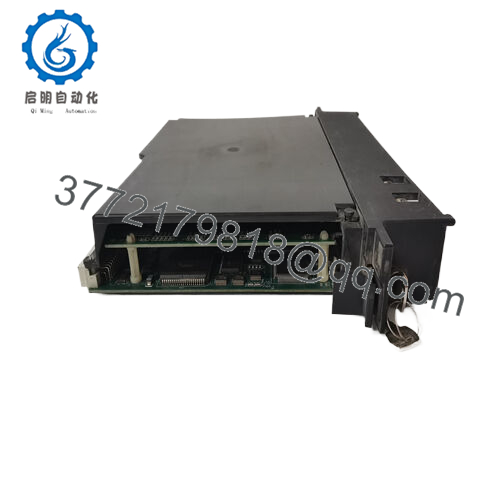
Related Modules or Compatible Units
IC695CPE310 – Host CPU that offloads networking to the IC695ETM001-HT for balanced loads.
IC695NIU001 – High-unit count Ethernet alternative for EGD-heavy spines.
IC695CRU320 – Redundant CPU pairing for failover via redundant IP mode.
IC695PNS001 – PROFINET scanner complementing TCP/IP versatility.
IC695CMX128 – Fiber Xchange module for hybrid wired/wireless backbones.
IC694ETM001 – Series 90-30 Ethernet cousin for mixed-protocol legacies.
Installation Notes & Maintenance Best Practices
Seat the GE IC695ETM001-HT in RX3i racks with CPU firmware 2.51+, confirming PME assigns static IPs pre-power—dynamic DHCP risks boot loops in isolated subnets. Bend radius CAT5/6 at 4x diameter near ports, grounding shields to backplane earth per TIA-568; segregate from VFD harmonics with ferrite clamps. Daisy-chain ports A/B smartly, pinging end-nodes post-insert to baseline latency under 5 ms.
Monthly Station Manager polls via HyperTerminal flag log overflows or port flaps—clear via CLI if amber LAN LED blinks. Firmware upgrades cascade from CPU without pulls; in sub-zero oilfields, pre-heat enclosures to nix condensation on swaps. Vibration tables demand DIN isolators; annual OTDR scans on long runs catch splitter faults early, always tagging Ethernet Restart pre-tweak.