 WhatsApp: +86 16626708626
 Email:
  Phone: +86 16626708626
Description
The GE IC695RMX128-AB (a specific revision of the IC695RMX128 series) addresses the critical requirement for deterministic, high-speed data synchronization in high-availability industrial automation systems: enabling seamless, real-time memory sharing between redundant controllers without introducing latency, single points of failure, or CPU overhead that could compromise process control integrity. In PACSystems RX3i Hot Standby (HSB) CPU redundancy setups—particularly those using CRU320 redundant CPUs—engineers often contend with synchronization delays, data inconsistencies during failover, or excessive processing load when replicating state across primary/secondary units. These challenges can lead to extended switchover times, potential process disruptions, or the need for custom application logic to handle data mirroring in mission-critical environments like turbines, chemical processing, or power generation.
The GE IC695RMX128-AB becomes essential when configuring RX3i redundancy pairs that demand sub-millisecond data exchange over a dedicated, fiber-optic link for state variables, I/O status, timers, counters, and other memory-mapped elements. It’s particularly valuable in applications requiring fault-tolerant operation with minimal downtime—such as continuous processes, safety instrumented systems, or facilities where even brief controller mismatches could affect production or safety. By providing 128 MB of reflective memory and operating as a dedicated redundancy link (or node on a broader reflective memory network), GE IC695RMX128-AB ensures high reliability in synchronized data transfer, supports fast failover (typically under 100 ms in properly configured systems), and offloads synchronization tasks from the CPU—reducing engineering complexity and enhancing overall system resilience in critical system uptime scenarios.
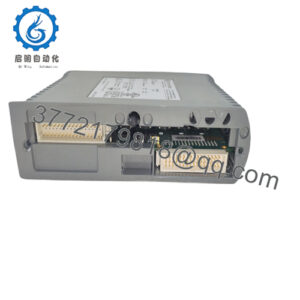
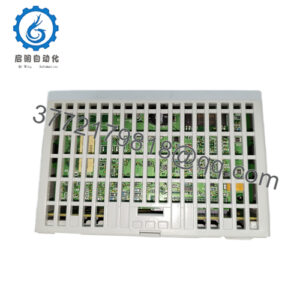
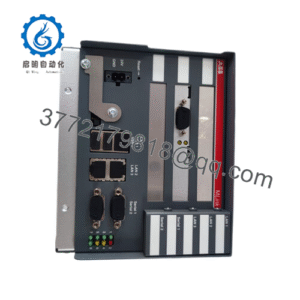
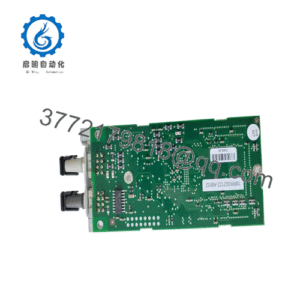
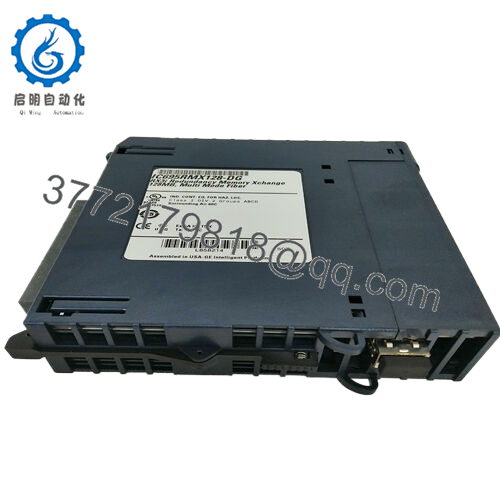
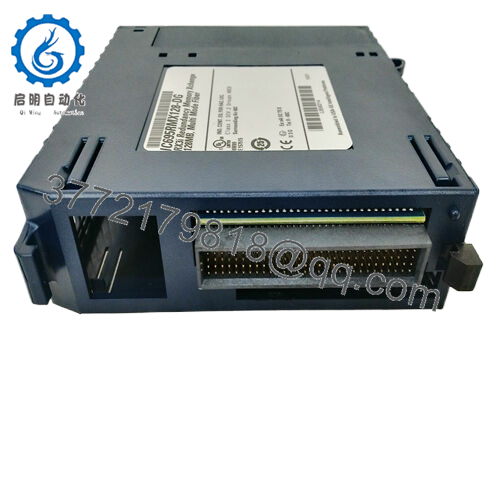
The GE IC695RMX128-AB functions as a Redundancy Memory Xchange (RMX) module within the PACSystems RX3i platform, serving primarily as the dedicated link for Hot Standby CPU redundancy in RX3i systems. It uses reflective memory technology over a high-speed fiber-optic network (2.12 Gbaud) to mirror selected portions of controller memory between primary and secondary CPUs, ensuring both units maintain identical process state for bumpless transfer during failover.
In a typical industrial automation stack, the GE IC695RMX128-AB occupies a single slot in the main RX3i universal backplane (PCI-based) of each redundant rack, connected via single-mode fiber-optic LC connectors (up to 10 km separation) to form a point-to-point redundancy link—GE strongly recommends dual links (four modules total) for maximum availability. It operates independently of the CPU, with no processing overhead required for network handling, and supports features like network error detection, programmable interrupts, and redundant transfer mode to minimize packet loss. While configurable for broader reflective memory networks (compatible with VMIC 5565 family when not in strict HSB mode), its primary role in RX3i is CPU-to-CPU synchronization via Emerson Automation Studio (formerly Proficy Machine Edition) setup. The module’s design enables hot-insertion/removal and integrates diagnostics into the CPU fault tables, making it a core enabler of fault-tolerant architectures in process control environments.
| Specification | Details |
|---|---|
| Model Number | IC695RMX128-AB |
| Brand | GE (GE Fanuc / Emerson Automation) |
| Type | RX3i Redundancy Memory Xchange (RMX) Module |
| Input Voltage | Backplane-powered (from RX3i supply) |
| Operating Temp Range | 0 to 60 °C (32 to 140 °F) |
| Mounting Style | RX3i universal rack slot (single-slot) |
| Dimensions | Standard RX3i module form (approx. 140 x 100 x 130 mm) |
| Weight | Approx. 0.3–0.5 kg |
| Interface/Bus | Fiber-optic LC (single-mode); RX3i backplane |
| Compliance | CE, UL, industrial standards |
| Supported Protocols | Reflective memory network (2.12 Gbaud); no external protocol required |
| Typical Power Draw | 580 mA at 3.3 VDC; 220 mA at 5 VDC |
Choosing the GE IC695RMX128-AB provides rock-solid synchronization for RX3i redundancy, ensuring controllers remain in lockstep with 128 MB of shared reflective memory for comprehensive state replication—critical for applications where process continuity outweighs everything else. Engineered for the RX3i platform, its fiber-optic link delivers deterministic performance over long distances with built-in error detection and redundant mode options, minimizing the risk of data corruption or loss during high-speed transfers and supporting near-instantaneous failover that preserves loop stability and output.
Maintenance teams benefit from the module’s independent operation—no CPU cycles consumed for synchronization—and integrated fault reporting via the primary controller, which accelerates diagnosis of link issues or module problems. The single-slot, hot-swappable design reduces downtime during upgrades or replacements, while the lack of moving parts (fanless, no batteries) enhances long-term reliability in harsh industrial settings. In plants with stringent availability targets, GE IC695RMX128-AB lowers risk and engineering overhead by providing a proven, out-of-the-box redundancy solution that scales with dual-link configurations and integrates smoothly with existing RX3i infrastructure.
The GE IC695RMX128-AB is widely deployed in high-availability industrial automation where controller redundancy directly safeguards production or safety. In power generation and utilities, it’s used in RX3i Hot Standby setups for turbine controls, boiler management, or substation automation, ensuring seamless transfer during faults to maintain grid stability and critical system uptime. Chemical and petrochemical facilities rely on it for continuous processes like reactors or distillation columns, where synchronized state prevents batch losses or hazardous conditions in redundant CPU pairs.
Discrete manufacturing with critical lines—such as automotive assembly or pharmaceuticals—also incorporates this module for synchronized PLC pairs handling high-speed sequencing or safety functions, supporting deterministic operation in vibration-prone or temperature-variable environments. Across these applications, the GE IC695RMX128-AB proves indispensable when sub-second failover and consistent memory mirroring are non-negotiable for operational integrity.

- IC695RMX128-AB
Here are some compatible or related products in the RX3i PACSystems and redundancy families:
- IC695RMX128 – Base model (later revisions like -AC or -AD offer firmware enhancements; -AB is an early production release)
- IC695RMX228 – Higher-capacity variant (e.g., 256 MB reflective memory) for larger datasets in similar redundancy setups
- IC695CMX128 – Reflective memory controller module (CMX) for broader network use beyond strict HSB links
- IC695CRU320 – RX3i redundant CPU that requires GE IC695RMX128-AB for Hot Standby operation
- IC695CPU series (non-redundant) – Standard CPUs that can use RMX in reflective memory networks
- IC695ETM001 – Ethernet module often paired for supervisory connectivity in redundant racks
- PACSystems RX3i Redundancy Kits – Bundles including dual RMX modules and fiber cabling for dual-link setups
- VMIC 5565 series – Compatible reflective memory nodes for mixed-network expansions (hub required for mode mixing)
Before installing the GE IC695RMX128-AB, confirm your RX3i rack is a universal (PCI) backplane type and that CPU firmware is 5.70 or later (CRU320 required for redundancy). Plan fiber-optic cabling (single-mode LC, up to 10 km) with proper attenuation checks, and strongly consider dual links (two modules per rack) for availability—configure via Emerson Automation Studio with matching node parameters (no jumpers/switches). Pre-validate link status and memory mapping in a test rack, ensuring offset settings align for data groups, and follow hot-insert guidelines to avoid disruption.
Ongoing maintenance includes monitoring module LEDs and CPU fault tables during routine checks—watch for link errors, sync faults, or fiber issues. Inspect connectors and cables annually for dust, bends, or degradation (especially in industrial atmospheres), and use diagnostic tools in Automation Studio to trend network health or interrupt status. Firmware upgrades (e.g., to 1.04 or later) address rare data corruption fixes and should be applied from Emerson resources. With solid-state design and no active components beyond optics, failures are infrequent, but spares in redundant pairs allow immediate swaps to sustain synchronization.