 WhatsApp: +86 16626708626
 Email:
  Phone: +86 16626708626
Description
The GE IC697CMM742-FD (a production revision of the IC697CMM742 series) solves one of the primary connectivity bottlenecks in legacy Series 90-70 PLC systems: enabling high-performance Ethernet communication for TCP/IP-based data exchange, remote programming, and integration with modern networks without the limitations of older serial or proprietary interfaces.
In industrial automation setups with GE Fanuc Series 90-70 controllers—often in utilities, power generation, chemical processing, or large manufacturing—engineers frequently encounter slow or unreliable connectivity when attempting to link the PLC to HMIs, SCADA systems, historians, or peer PLCs over Ethernet. Serial ports or early network options can bottleneck data throughput, limit simultaneous connections, or complicate remote access and diagnostics, leading to delayed troubleshooting, restricted global data sharing, or challenges supporting configuration-based Ethernet Global Data (EGD) and logic-initiated SRTP services in process control environments.
The GE IC697CMM742-FD becomes essential when your Series 90-70 CPU requires a dedicated Ethernet interface capable of IEEE 802.3-compliant 10 Mbps LAN connectivity via multiple media types (10BaseT, 10Base2, AUI), supporting up to four modules per rack for redundancy or multi-network segmentation. It’s particularly valuable in retrofits of VME-based systems, expansions needing EGD for peer-to-peer data exchange, or facilities transitioning to TCP/IP for remote monitoring and programming. By providing pre-loaded firmware, multiple network ports, and robust TCP/IP services (including SRTP for client/server communication), GE IC697CMM742-FD ensures high reliability in network-linked I/O signals and data, reduces latency for global data broadcasts, and facilitates seamless integration with supervisory systems—critical for maintaining critical system uptime in applications where real-time visibility and remote access prevent production losses.
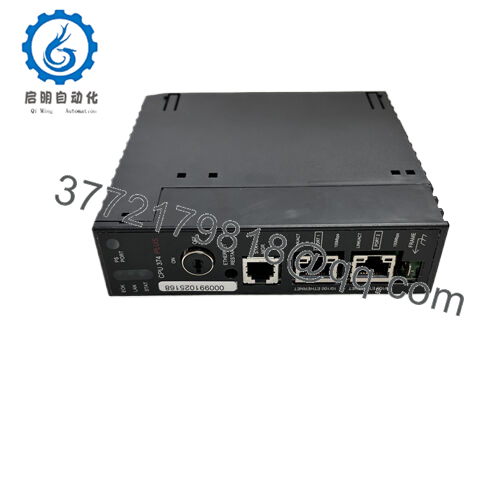
The GE IC697CMM742-FD functions as a Type 2 Ethernet Interface module in the Series 90-70 family, acting as a high-performance TCP/IP communications coprocessor that offloads network handling from the main CPU. It plugs into a single VME slot, drawing power from the backplane, and connects to Ethernet LANs through three selectable ports: 10BaseT (RJ-45 twisted-pair), 10Base2 (BNC thin coaxial), and AUI (15-pin transceiver).
In a typical industrial automation stack, the module mounts in the main CPU rack (or expansion via compatible bus extensions), interfacing with the VME backplane to exchange data with the CPU while managing Ethernet traffic independently. It supports configuration-based EGD for periodic global data publication/subscription, logic-based SRTP channels for explicit messaging (read/write), and up to eight simultaneous SRTP connections. Diagnostics include four front-panel LEDs (MODULE OK, LAN ONLINE, SERIAL ACTIVE, STATUS OK) for quick health checks, plus detailed fault reporting to CPU tables. While operating at 10 Mbps (CSMA/CD), it delivers reliable performance in noisy environments with proper cabling, making GE IC697CMM742-FD a versatile bridge for legacy PLCs to modern Ethernet infrastructures in process control setups.
| Specification | Details |
|---|---|
| Model Number | IC697CMM742-FD |
| Brand | GE Fanuc (now Emerson Automation) |
| Type | Series 90-70 Ethernet Interface Module (Type 2) |
| Input Voltage | Backplane-powered (+5 VDC and +12 VDC from rack) |
| Operating Temp Range | 0 to 60 °C (32 to 140 °F) |
| Mounting Style | Series 90-70 rack slot (single-slot VME) |
| Dimensions | Standard 90-70 module form (approx. single-slot) |
| Weight | Approx. 0.8–1 kg |
| Interface/Bus | 10 Mbps Ethernet (10BaseT RJ-45, 10Base2 BNC, AUI 15-pin); VME backplane |
| Compliance | CE, UL, industrial standards |
| Supported Protocols | TCP/IP, SRTP (Service Request Transfer Protocol), EGD (Ethernet Global Data) |
| Typical Power Draw | Approx. 1–1.5 A (module-dependent) |

- IC697CMM742-FD
Opting for the GE IC697CMM742-FD brings robust Ethernet connectivity to Series 90-70 systems, enabling efficient TCP/IP services like EGD for configuration-driven peer data sharing and SRTP for programmatic access—reducing CPU load and supporting multiple simultaneous connections for SCADA, HMI, or remote engineering tools.
Maintenance crews appreciate the multi-port flexibility (allowing media selection without adapters), clear LED diagnostics for rapid fault isolation (e.g., LAN ONLINE for network presence, STATUS OK for operational health), and pre-loaded firmware that minimizes setup complexity. Its rugged VME design withstands industrial vibration and electrical noise, while up to four modules per rack enable redundancy or network segmentation. In aging plants, GE IC697CMM742-FD extends platform life by bridging legacy control to Ethernet-based monitoring, lowering integration costs and enhancing process control reliability without full migration.
The GE IC697CMM742-FD is widely deployed in legacy Series 90-70 installations across industries requiring Ethernet for supervisory integration. In power generation and utilities, it’s used to connect PLCs to SCADA or historians for turbine monitoring, substation control, or grid data exchange, ensuring critical system uptime through reliable TCP/IP links. Chemical and petrochemical facilities favor it for process networking, enabling EGD between PLCs for coordinated batch or continuous operations in distributed plants.
Manufacturing and heavy industry sites also rely on this interface for machine-to-machine data sharing or remote access in large facilities, supporting diagnostics and programming over Ethernet in noisy or extended environments. Across these, the GE IC697CMM742-FD excels when 10 Mbps Ethernet connectivity directly improves visibility, reduces downtime, and facilitates legacy system sustainment.
Here are some compatible or related products in the GE Series 90-70 and communication families:
- IC697CMM742 – Base or earlier revision (FD is a later production variant; functionally equivalent)
- IC697CMM711 – Serial communications module (alternative for RS-232/422 needs)
- IC697BEM731 – Genius Bus Controller (for Genius I/O networks)
- IC697CPU series (e.g., IC697CPU788) – CPUs that host this Ethernet module
- IC697CHS series – Rack chassis for mounting the module
- IC693CMM321 – Similar Ethernet module in Series 90-30 for cross-family reference
- IC697BEM741 – FIP/WorldFIP bus controller (alternative fieldbus option)
- RX3i IC695ETM001 – Modern Ethernet module for migration to PACSystems platforms
Before installing the GE IC697CMM742-FD, confirm rack slot availability in a powered Series 90-70 backplane and select the appropriate port (10BaseT preferred for modern twisted-pair networks). Configure IP address, subnet, and EGD/SRTP settings via Logic Developer software, ensuring network cabling meets IEEE 802.3 standards (e.g., proper termination for 10Base2 if used). Pre-validate module diagnostics (LEDs should show MODULE OK and STATUS OK after power-up) and basic ping connectivity before integrating into live networks, and test EGD exchanges or SRTP channels in a controlled setup.
Ongoing maintenance includes routine LED monitoring during rounds—check for MODULE OK (steady green), LAN ONLINE (indicating network presence), and any fault patterns—and annual inspection of connectors/cables for corrosion or damage in industrial atmospheres. Review CPU fault tables for Ethernet-related errors, and use network tools (e.g., ping, ARP) during outages to verify link health. As a coprocessor-based module with no moving parts, failures are uncommon, but spares support quick swaps to restore communication without extended disruption.