 WhatsApp: +86 16626708626
 Email:
  Phone: +86 16626708626
Description
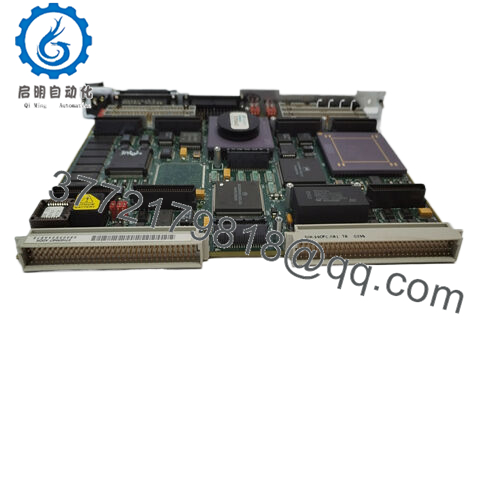
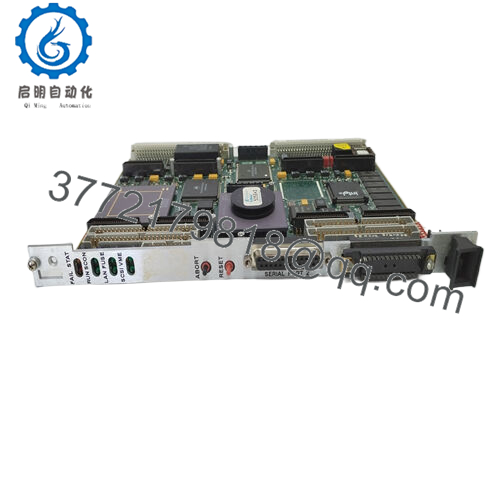
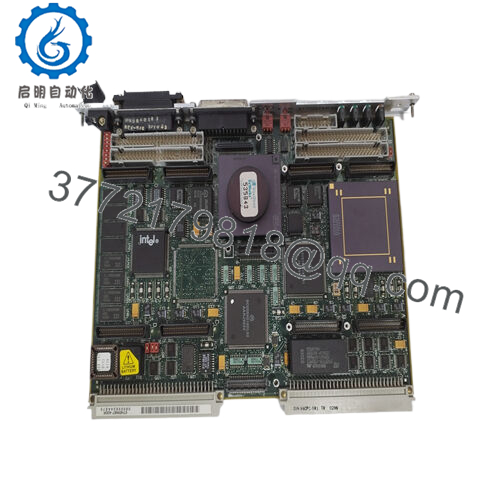
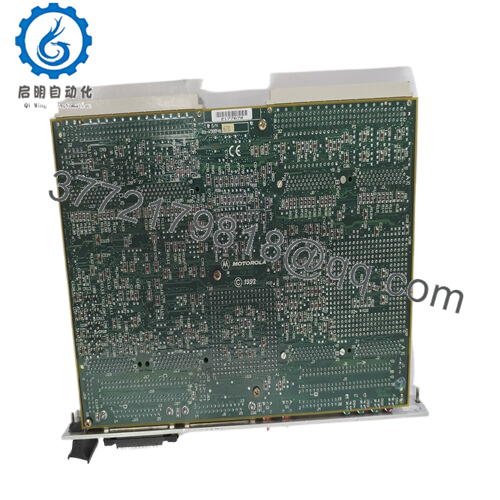
Product Model: Motorola MVME162-512A
Product Brand: Motorola
Product Series: MVME Series (VMEbus Single-Board Computers)
Product Features:
- Motorola 68040-based embedded VMEbus controller
- Proven stability for industrial and defense applications
- Flexible I/O interfaces and expansion capability
- Ideal for real-time control, data acquisition and system management
Product Role & System Fit
The Motorola MVME162-512A is the beating heart of countless automation and embedded control systems built during an era when reliability defined engineering success. This 6U VMEbus single-board computer acts as the system controller in distributed architectures, orchestrating communication among peripheral cards and handling deterministic real-time tasks.
Based on the Motorola 68040 processor, it offers robust computing performance while maintaining the energy efficiency and predictable timing essential in industrial environments. The module integrates tightly with the VMEbus backplane, serving as either a bus master or slave depending on system configuration. Engineers value the MVME162-512A for its ability to coordinate complex tasks across motion controllers, analog/digital I/O cards, and communication modules without latency issues.
Compatibility remains a standout advantage. The board supports a wide spectrum of operating systems — from VxWorks and LynxOS to embedded UNIX and bespoke RTOS solutions — enabling integration across legacy and hybrid automation platforms. For manufacturers modernizing control systems, this compatibility allows incremental upgrades rather than full redesigns, keeping validated software frameworks intact.
Applications & Industry Context
Across aerospace test facilities, semiconductor manufacturing, transportation control systems, and defense electronics, the MVME162-512A continues to deliver dependable service. Its durability and deterministic behavior make it a mainstay wherever downtime equates to lost productivity or compromised safety.
In automated production lines, the board often governs real-time process loops — executing PID control, synchronizing robotic arms, or bridging data between PLCs and supervisory systems. Power generation plants rely on it for turbine control interfaces, where continuous operation and high EMC resilience are mandatory.
Defense programs and radar installations deploy the MVME162-512A as mission computers, communication routers, or test rack controllers. Its proven resistance to vibration and temperature variation, combined with long-term component availability, make it ideal for military and aerospace environments where certification cycles are lengthy and stability is paramount.
Even in research laboratories, this module plays a role in data acquisition and instrumentation control. Scientists value its predictable timing and straightforward I/O expansion through the VMEbus — a setup that remains hard to replicate with modern PC-based solutions.
Technical Features & Benefits
Motorola designed the MVME162-512A with a focus on long-term reliability and modular flexibility. Key attributes include:
- Processor Performance: The Motorola MC68040 CPU provides 32-bit RISC-style efficiency with onboard cache, giving deterministic response times critical for real-time tasks.
- Memory Architecture: The board supports dynamic RAM and non-volatile storage for boot firmware, allowing fast startup and stable operation.
- Integrated Peripherals: Ethernet 10Base-T, serial ports (RS-232/422), and SCSI interfaces are standard, minimizing the need for auxiliary modules.
- Diagnostic Capability: On-board LEDs and self-test routines simplify maintenance and reduce downtime.
- Environmental Resilience: Designed to operate under industrial temperature and vibration conditions, it delivers consistent performance in challenging environments.
The true strength of the MVME162-512A lies in its predictable behavior. In real-time control, deterministic scheduling outweighs raw clock speed, and that’s where this board excels. It handles interrupt-driven tasks with minimal jitter, ensuring smooth process control in applications such as servo coordination or networked automation systems.
Engineers also appreciate its modular approach. Expansion via mezzanine connectors and the VMEbus means the same controller can be repurposed across multiple projects — from a robotics test bed to an aerospace simulator — with only minor reconfiguration.

- MVME162-512A
Technical Specifications
| Specification | Details |
|---|---|
| Processor | Motorola MC68040 microprocessor |
| Clock Speed | 25 MHz nominal |
| Memory | Up to 32 MB DRAM, Flash/EPROM for firmware |
| Bus Standard | VMEbus IEEE 1014 compliant |
| I/O Interfaces | Ethernet, SCSI, two serial ports (RS-232/422), parallel I/O |
| Expansion Options | Local bus connectors for custom modules |
| Operating Systems Supported | VxWorks, LynxOS, UNIX, custom RTOS |
| Power Supply | +5 V DC |
| Cooling Requirement | Forced air recommended |
| Form Factor | 6U VME single-board computer |
| Operating Temperature | 0 °C to 55 °C (industrial range) |
| Compliance | CE, UL, MIL-STD environmental qualified |
Installation & Maintenance Insights
Installing a Motorola MVME162-512A is straightforward for engineers familiar with the VME ecosystem, yet small details matter. Before installation, inspect the backplane for dust or oxidation and ensure slot alignment to avoid contact stress. Once seated, secure the card gently into the guides to maintain connector integrity.
Power requirements are modest, but clean regulated +5 V DC is crucial — noise on the supply rail can cause intermittent resets. Adequate airflow should be maintained, especially in enclosures with multiple heat-generating modules.
For maintenance, periodic visual inspection and connector cleaning are usually sufficient. The board’s diagnostic LEDs quickly pinpoint boot or bus issues. Firmware updates can be performed via SCSI or serial link, and many operators keep a spare board pre-configured for rapid swapping in case of failure.
In mission-critical installations, technicians often implement redundant MVME162-512A controllers running in failover pairs. Because configuration is stored in non-volatile memory, a replacement card can be online within minutes — a key reason this model still anchors 24/7 control systems decades after its release.
Related Models
- MVME162-512B – Updated firmware revision with enhanced memory timing
- MVME167-33B – Higher CPU clock rate and expanded cache for performance-intensive tasks
- MVME172-263260 – Next-generation 68060-based board with faster data bus
- MVME162LX-344 – Extended temperature variant for rugged applications
- MVME177-005B – Enhanced I/O bandwidth and dual Ethernet support
- MVME2700 – PowerPC architecture successor for modernized systems
- MVME712M – I/O transition module compatible with MVME162 series