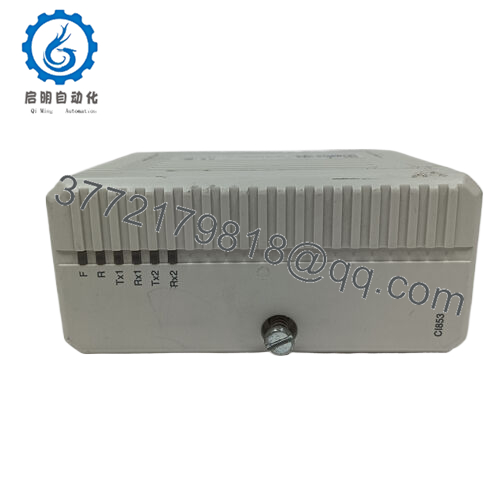
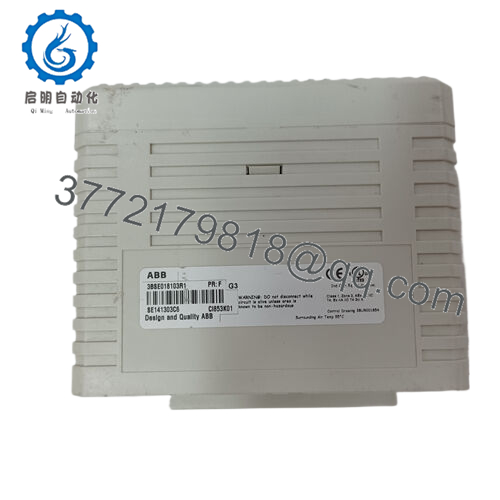
 WhatsApp: +86 16626708626
 Email:
  Phone: +86 16626708626
Description
The challenge in modern process control is maintaining a seamless, high-speed bridge between the sophisticated logic of a Central Processing Unit and the rugged reality of field-side I/O. In large-scale industrial plants, controllers are often physically separated from the sensors and actuators they manage. This distance introduces the risk of communication latency and signal loss, which can compromise system stability. The ABB CI840 is a Profibus DP-V1 Communication Interface designed to solve this by acting as the intelligent “head station” for the S800 I/O system. It ensures that data from dozens of field devices is packetized, synchronized, and delivered to the AC 800M controller with the microsecond precision required for high-performance automation.
When an engineer integrates the ABB CI840, they are addressing the need for high reliability and modular flexibility. Typical situations where this product becomes essential include refinery expansions or pharmaceutical batch processing, where adding new I/O points must be done without overhauling the entire network. The ABB CI840 manages the complex task of bus arbitration and cyclic data exchange, allowing the main control application to focus on logic rather than network housekeeping. By providing a rugged, industrial-grade gateway to the Profibus network, it eliminates the “bottleneck” effect often seen in high-density I/O signal environments, ensuring that the industrial automation stack remains responsive under heavy data loads.
The ABB CI840 functions as the primary node on a Profibus DP network, sitting directly on a MTU (Module Termination Unit) alongside the S800 I/O modules. It is the “brain” of the remote I/O rack, translating the serial Profibus protocol into the internal ModuleBus signals used by individual I/O cards. This positioning allows the ABB CI840 to aggregate data from up to 12 I/O modules (or more with clusters) and present them as a single, organized station to the master controller.
A standout feature of the ABB CI840 is its native support for line redundancy. In critical applications, two ABB CI840 units can be mounted on a redundant MTU (like the TU840 or TU847). If the primary unit or the physical bus cable fails, the system performs a “bumpless” transfer to the backup unit, ensuring continuous operation without process interruption. Furthermore, the module supports the DP-V1 protocol, which enables acyclic communication. This means that while the unit is busy sending high-speed process data, it can simultaneously transmit calibration data, HART instrument parameters, and detailed hardware diagnostics. This dual-path communication is what allows the ABB CI840 to fit into the most advanced digital transformation strategies, providing the “big data” necessary for plant-wide optimization.
| Specification | Details |
| Model Number | CI840 (3BSE022457R1) |
| Brand | ABB |
| Type | Profibus DP-V1 Communication Interface |
| Input Voltage | 24V DC (via MTU) |
| Operating Temp Range | -25°C to +70°C (-13°F to 158°F) |
| Mounting Style | DIN Rail via TU840/TU847/TU848 MTU |
| Dimensions | 119mm x 45mm x 102mm |
| Weight | 0.16 kg (0.35 lbs) |
| Interface/Bus | Profibus DP-V1 (up to 12 Mbit/s) |
| Compliance | CE, RoHS, ATEX (Zone 2), G3 Corrosion |
| Supported Protocols | Profibus DP, DP-V1, ModuleBus |
| Typical Power Draw | 100 mA at 24V |

- CI840
The real-world benefit of specifying the ABB CI840 is the drastic reduction in unplanned downtime through superior diagnostics. Engineered for high-availability environments, the module monitors the “health” of every connected I/O channel. If a field-side wire breaks or a module enters an error state, the ABB CI840 reports the exact location of the fault to the HMI. This level of insight ensures that maintenance teams can head directly to the source of the problem, reducing the “Mean Time to Repair” (MTTR) and keeping production targets on track.
Another significant advantage is the efficiency in system engineering and scaling. Because the ABB CI840 is designed for modularity, it reduces engineering overhead by allowing for “Hot Configuration in Run” (HCIR). In many process environments, you cannot shut down the plant to add a new sensor; with the ABB CI840, new I/O modules can often be added and configured while the communication interface remains active. This flexibility ensures long-term performance and allows the control system to evolve alongside the physical plant without requiring costly outages.
Finally, the ABB CI840 is engineered for the harshest industrial climates. With an extended operating temperature range and optional G3 conformal coating, it provides performance consistency in environments that would cause standard networking gear to fail. Whether it is the humidity of a paper mill or the temperature swings of an outdoor remote terminal unit (RTU), the ABB CI840 ensures that your process data remains uncorrupted and timely.
The ABB CI840 is frequently deployed in power plants for auxiliary control systems where critical system uptime is a mandatory requirement. In these settings, the unit manages the synchronization of secondary pumps and cooling towers, providing the AC 800M controller with a high-speed link to hundreds of digital and analog points. The redundancy features of the ABB CI840 are particularly valued here, as a communication failure in a power generation environment can have massive economic consequences.
You will also find the ABB CI840 used in water and wastewater treatment facilities. These plants often utilize a distributed architecture where I/O racks are spread across a wide geographic area. The ABB CI840 excels in these process control environments by allowing the operator to use standard Profibus fiber optic or copper media to bridge long distances while maintaining full diagnostic visibility. From chemical dosing to filtration monitoring, the ABB CI840 provides the reliable backbone needed for environmental compliance and safe operation.
CI801 – Compact Profibus DP-V1 interface for smaller, non-redundant racks
CI840A – Updated version with enhanced firmware and component longevity
CI830 – Legacy Profibus DP interface for older S800 I/O installations
TU840 – Redundant Module Termination Unit specifically for the CI840
TB840 – ModuleBus Outlet for extending the I/O cluster to additional rows
CI854A – Profibus Master module for the AC 800M controller side
Before installation, verify that the Profibus station address is correctly set using the rotary switches on the front of the ABB CI840. A common error during commissioning is an address conflict on the bus, which can prevent the entire segment from initializing. Ensure that the GSD (General Station Description) file in your control software matches the firmware revision of the hardware. Additionally, always check that the Profibus terminators are correctly switched “ON” only at the physical ends of the cable segment to prevent signal reflections that cause intermittent data drops.
Maintenance of the ABB CI840 is straightforward but requires consistency. We recommend a monthly check of the “Prim” and “Dual” LEDs to ensure the redundancy link is active and healthy. Periodically inspect the Profibus connectors for tightness; in high-vibration environments, these can slowly back out, leading to high error rates on the bus. While the unit is designed for a long service life, we suggest a yearly review of the network’s “error telegram” count through the controller’s diagnostic tools, as an increasing error rate is often an early warning sign of a failing cable or external EMI interference.