 WhatsApp: +86 16626708626
 Email:
  Phone: +86 16626708626
Description
3. Key Technical Specifications
| Parameter | Value |
|---|---|
| Rated Capacity | 150 kN |
| Measurement Principle | Magnetoelastic (Pressductor technology) |
| Measurement Type | Vertical force / strip tension |
| Accuracy Class | Up to ±0.5% FS |
| Linearity | < ±0.3% |
| Repeatability | < ±0.05% |
| Hysteresis | < 0.2% |
| Signal Type | Low-impedance AC output |
| Material | Solid stainless steel construction |
| Operating Temperature | +20 to +80 °C (compensated range) |
| Mounting Type | Pillow block (bearing-mounted) |
| Overload Capacity | High tolerance to shock and overload |
4. Product Introduction & Supply Chain Strategy
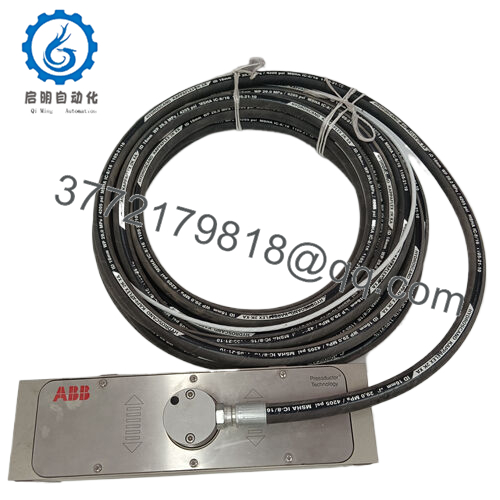
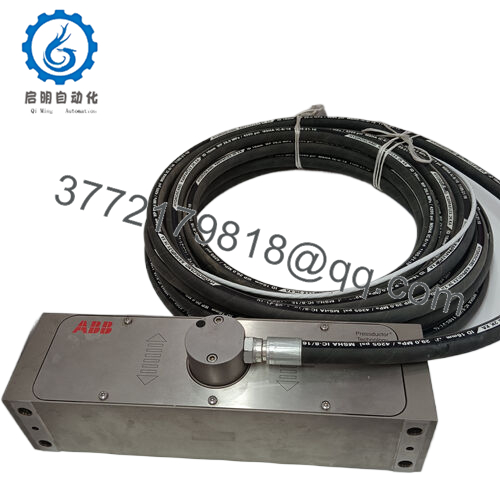
The ABB PFCL201CE 150kN 3BSE006699D0005 is a magnetoelastic load cell designed for high-precision strip tension measurement in continuous industrial processes. Installed under roll bearings, it measures vertical force proportional to material tension, making it standard in steel, paper, and processing lines.
From a supply-chain standpoint, this is a mission-critical sensing element with long service life but limited replacement availability. Lead time variability is increasing due to aging product lines. Securing New Surplus units protects against unplanned downtime and avoids the hidden degradation risks found in secondary-market sensors. Strategic buffer stock ensures continuity in tension-controlled processes where failure directly impacts product quality.

- PFCL201CE 150kN 3BSE006699D0005
5. Installation & Configuration Guide
Stage 1: Pre-Installation (Prep & Safety)
- Lock-out/tag-out all mechanical and electrical systems.
- Use lifting tools—this unit mounts under mechanical load points.
- Inspect mounting surfaces for flatness and alignment.
- Record wiring connections and shielding configuration.
Stage 2: Removal
- Release mechanical load carefully before removal.
- Unbolt the pillow block assembly evenly to prevent stress distortion.
- Disconnect signal cables with shielding intact.
Stage 3: Installation (Clone & Seat)
- Position the load cell precisely under the bearing housing.
- Torque mounting bolts according to ABB mechanical specs.
- Ensure correct load direction (vertical force axis alignment is critical).
- Reconnect shielded signal cable—avoid ground loops.
Stage 4: Power-On & Testing
- Energize the measurement system (via tension electronics unit).
- Verify stable baseline signal (no drift or noise spikes).
- Perform calibration check with known load or system reference.
- Confirm tension feedback loop stability in control system.
6. Firmware/Software Versions & Upgrade Notes
- System Dependency: Works with ABB tension electronics (e.g., PFEA series amplifiers).
- Compatibility Note: Signal characteristics must match the connected measurement amplifier—mismatch leads to unstable readings.
- Critical Warning:
- Changing amplifier firmware without recalibration may distort force readings.
- Do not substitute with strain-gauge sensors—signal type and impedance differ significantly.
- Always validate calibration parameters after installation to maintain measurement integrity.
7. Frequently Asked Questions (FAQ)
Q1: Is this unit truly new or just surplus stock?
This product is a Brand New Surplus unit. It is not used, not refurbished, and not removed from a plant. The sensing core and housing are original, with zero mechanical fatigue exposure.
Q2: Why avoid refurbished load cells?
Load cells degrade internally due to stress cycles. Refurbished units may pass initial tests but fail under continuous load. In tension control systems, this leads to unstable readings and product defects.
Q3: Is PFCL201CE still actively manufactured?
Production is limited, and availability depends on global surplus channels. This is not a fast-moving item—plan for last-time-buy scenarios.
Q4: What stocking strategy is recommended?
- Critical lines: Keep 1–2 units onsite as buffer stock
- Multi-line plants: Consider cross-site sharing to reduce capital lock
- Low-usage sites: Evaluate vendor-managed inventory if available
Q5: Does this require calibration after installation?
Yes. Always verify calibration against system reference. Even identical models require fine-tuning due to installation tolerances.
Q6: What causes signal instability after replacement?
Common issues include misalignment, improper grounding, or amplifier mismatch. Mechanical installation accuracy directly impacts measurement quality.
Q7: What is the expected lifecycle?
Under proper installation, these sensors can operate for 10–15 years. This long lifecycle supports higher upfront cost but lowers Total Cost of Ownership (TCO) compared to short-life alternatives.