 WhatsApp: +86 16626708626
 Email:
  Phone: +86 16626708626
Description
3. Key Technical Specifications
| Parameter | Value |
|---|---|
| Rated Voltage | 400 V AC |
| Rated Speed | 3000 rpm |
| Nominal Torque | 8.0–8.2 Nm |
| Peak Current | ~18 A |
| Feedback Type | SinCos encoder (variant dependent) |
| Brake | 24 V DC holding brake (16 W) |
| Flange Size | 100 mm |
| Shaft Type | Smooth shaft (no keyway) |
| Protection Class | IP64 / IP65 |
| Insulation Class | Class F |
| Thermal Protection | PTC sensor |
| Weight | ~12–13.5 kg |
| Compatibility | ELAU PacDrive C200 / C400 / C600 |
Specification values aligned with SM-100 series variants sharing the same base order code 19203304-
4. Product Introduction
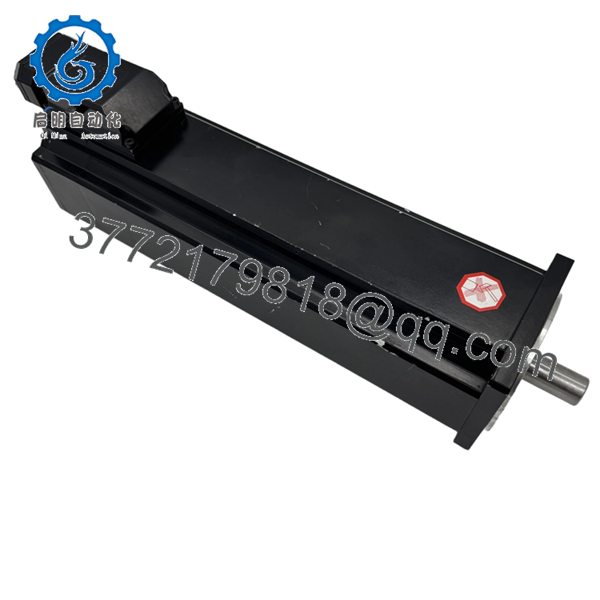
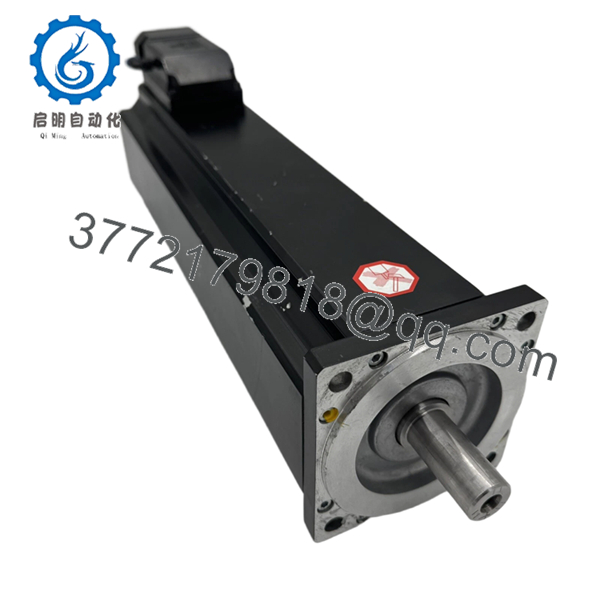
The ELAU SM-100-30-080-P3-5A-M1-B1 is a 100-frame PacDrive AC servo motor designed for medium-to-high torque applications in synchronized motion systems. It operates with ELAU/Schneider PacDrive servo drives in packaging lines, robotic handling, and high-speed assembly equipment.
Compared to SM-070 motors, the SM-100 frame provides higher continuous torque (~8 Nm) and better thermal stability under sustained load. In real packaging lines, this is typically used on primary axes—cutting knives, conveyors, and indexing systems where torque margin matters more than compact size.
5. Installation & Configuration Guide
Stage 1: Pre-Installation Preparation (10–15 minutes)
- ⚠️ Safety First: Stop machine, isolate power, lock out/tag out. Wait at least 5 minutes for DC bus discharge.
- Tools Required: ESD strap, torque wrench, multimeter, alignment tool, labeling tags, smartphone.
- Data Backup:
- Export PacDrive axis parameters
- Record motor ID and encoder type
- Photograph cable routing and connector orientation
Stage 2: Removing the Old Motor (10–15 minutes)
- Disconnect power and feedback cables (separate clearly).
- Label each connector — especially encoder lines.
- Remove coupling or pulley.
- Loosen mounting bolts evenly.
- Pull motor straight out to avoid shaft damage.
- Inspect coupling wear and flange surface.
- ⚠️ Note: Do not discard the old motor until the system is stable.
Stage 3: Installing the New Motor (15 minutes)
- Verify exact model and suffix match (encoder + brake variant matters).
- Mount motor and torque bolts in cross pattern.
- Align shaft carefully — avoid axial or radial stress.
- Connect power and feedback cables securely.
- Ensure proper shielding and grounding.
- Self-Checklist:
- Shaft aligned
- Brake wiring correct (24 V DC)
- Encoder cable seated
- Ground shield connected
Stage 4: Power-On & Testing (10–20 minutes)
- Pre-Power Check: Measure insulation resistance (>10 MΩ).
Power-On Steps:
- Power the drive without mechanical load.
- Check drive status LEDs.
- Connect via EPAS-4 / PacDrive software.
- Verify encoder feedback signal.
- Perform low-speed jog test.
- Ramp up gradually and monitor vibration and current draw.
- ⚠️ Troubleshooting Note:
- Encoder fault → incorrect cable or parameter mismatch
- Brake not releasing → check 24 V DC supply
- Axis oscillation → tuning mismatch
6. Frequently Asked Questions (FAQ)
Q1: Can this motor be hot-swapped?
No. Servo motors in PacDrive systems are not hot-swappable. The DC bus voltage can damage both motor and drive instantly. Always power down fully.
Q2: Is this model discontinued?
Yes. The SM-series motors are largely phased out after Schneider Electric consolidated the PacDrive platform. Expect limited availability and longer sourcing times.
Q3: What replaces this motor if it’s unavailable?
Typically Schneider Lexium servo motors or updated PacDrive-compatible motors. However, mechanical dimensions, encoder protocol, and drive firmware must match exactly.
Q4: Will replacing the motor affect my program?
The PLC logic remains intact. However, the drive stores motor-specific parameters. If the encoder type or motor ID differs, the axis will fault during startup.
Q5: Why do some units show “new open box” condition?
Most available units are surplus stock. They were purchased as spares and never installed, but packaging may be opened for inspection or testing.
Q6: What is the most common failure during replacement?
Encoder mismatch and mechanical misalignment. I’ve seen perfectly good motors fail commissioning because someone assumed all SM-100 units are identical. They are not.
Q7: Does this motor include a holding brake?
Yes, this variant includes a 24 V DC holding brake (~16 W), typically used for vertical axes or load retention.

- SM-100-30-080-P3-5A-M1-B1 ID-No 19203304-620
- SM-100-30-080-P3-5A-M1-B1 ID-No 19203304-620
Quality Control & Testing SOP (Transparency)
1. Inbound Inspection & Traceability
- Verified against OEM order code (19203304-620 series)
- Serial number and nameplate cross-check
- Visual inspection: shaft condition, connector pins, housing integrity
- Brake wiring and connector integrity checked
2. Live Functional Testing
- Tested on Schneider PacDrive C400 test rack
- Encoder feedback verified (SinCos signal stability)
- Motor run test with controlled load simulation
- 24-hour continuous operation with thermal monitoring
- Test report generated
3. Electrical Parameter Testing
- Insulation resistance: >10 MΩ @ 500 V
- Phase resistance measurement
- Ground continuity verified
4. Firmware & Configuration Verification
- Encoder type and motor constants recorded
- Connector pinout verified
5. Final QC & Packaging
- QC sign-off with traceability ID
- Anti-static protection for connectors
- Foam-secured heavy-duty packaging
- QC Passed label with date
Test reports, photos, and run videos available upon request.
Technical Pitfalls & Survival Guide
❗ Encoder Type Mismatch
This is the biggest issue. SinCos vs resolver differences will stop commissioning immediately.
I’ve seen engineers lose hours chasing “axis not ready” faults—wrong feedback type.
❗ Brake Wiring Errors
The brake is 24 V DC. If wired incorrectly, it either won’t release or overheats.
Double-check polarity and supply.
❗ Mechanical Alignment Neglect
This motor weighs over 12 kg. Poor alignment puts stress on bearings and couplings.
Use proper alignment tools—not eyeballing.
❗ Drive Parameter Mismatch
Even with the same frame size, motor constants differ slightly.
Always reload or verify parameters before enabling the axis.
❗ ESD Handling Damage
Encoder electronics are sensitive.
I’ve personally seen a motor fail after install due to static discharge at the connector.