 WhatsApp: +86 16626708626
 Email:
  Phone: +86 16626708626
Description
3. Key Technical Specifications
| Parameter | Value |
|---|---|
| Model | DS3800HLIA1B1C |
| Brand | GE (General Electric) |
| Series | Mark IV Speedtronic |
| Board Type | High Level Analog I/O (HLI) |
| Power Supply | +5V DC, ±15V DC from backplane |
| Current Draw | +5V: 1.2A, +15V: 200mA, -15V: 200mA |
| Analog Inputs | 8 channels, differential |
| Input Ranges | ±10V, 0-10V, 4-20 mA (jumper selectable per channel) |
| Input Impedance | 100k ohms (voltage), 250 ohms (current) |
| Input Resolution | 12-bit (0.025% of full scale) |
| Input Accuracy | ±0.1% of reading ±1 LSB at 25°C |
| Analog Outputs | 8 channels, single-ended |
| Output Ranges | ±10V, 0-10V, 4-20 mA (jumper selectable per channel) |
| Output Drive | ±10V: 10 mA max, 4-20 mA: 750 ohms max loop resistance |
| Output Resolution | 12-bit |
| Output Accuracy | ±0.2% of reading ±1 LSB at 25°C |
| Update Rate | 10 ms (all channels scanned) |
| Isolation | Channel-to-channel: none (common ground), Channel-to-backplane: 1500V AC |
| Status LEDs | 4 x LEDs (Power OK, Run, Fault, Calibration Active) |
| DIP Switches | 8-position for channel range configuration |
| Trim Pots | 8 x potentiometers (gain/offset per channel) |
| Operating Temp | 0 to +50°C (32 to 122°F) |
| Storage Temp | -40 to +85°C (-40 to 185°F) |
| Humidity | 5% to 95% non-condensing |
| Dimensions | 9.5 x 6.5 x 1.0 inches (approx) |
| Connectors | 1 x 96-pin backplane (P1), 1 x 50-pin field I/O header |
| GE Part Family | DS3800 (Mark IV) |
4. Product Introduction
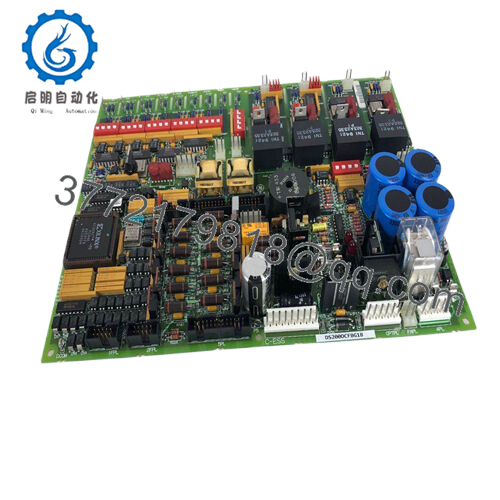
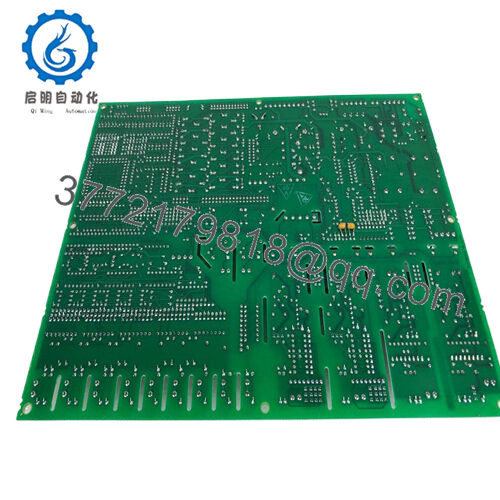
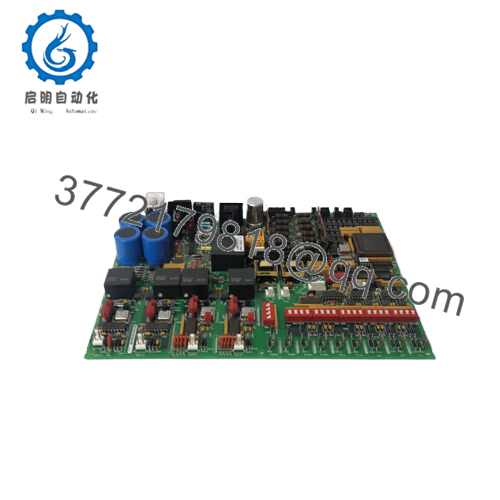
The GE DS3800HLIA1B1C is the HLI high level analog I/O board for the Mark IV Speedtronic turbine control system. This board handles ±10V and 4-20 mA signals from field devices like pressure transmitters, thermocouple amplifiers, position transducers (LVDTs), and servo valve drivers. You’ll find it in gas and steam turbine applications where analog precision matters.
The HLI board provides 8 analog inputs and 8 analog outputs with 12-bit resolution. Inputs are differential for noise rejection in industrial environments. Outputs drive actuators, I/P converters, and display meters. Each channel has jumper-selectable ranges and trim pots for field calibration. Unlike universal I/O boards, the HLI is designed specifically for Mark IV’s ±15V analog bus. This board sits between the field wiring and the main processor (CPC/PPC). Without it, analog control loops stop — the turbine won’t start or will trip.
5. Troubleshooting Quick Reference
| Symptom | Possible Cause | Relevance to this Part | Quick Check Method | Recommendation |
|---|---|---|---|---|
| No LEDs lit on HLI | Backplane ±15V or +5V missing | ❌ Low (PSU issue) | Measure +5V and ±15V on backplane pins. Reseat board. | Check rack power supply (NPSR). Replace HLI only if voltages present but board dead. |
| Run LED off, Fault LED on | ADC/DAC failure or calibration data corrupt | ✅ High | Read Mark IV diagnostic display. Look for HLI fault codes (typically 70-79 range). | Cycle power. If fault persists, replace board. Calibration EEPROM may have failed. |
| Analog input reads zero when signal present | Input channel failed or range jumper wrong | ✅ High | Apply known 5V signal to input channel. Measure voltage at trim pot test points. | If signal at test point but reading zero, ADC failed. Replace board. |
| Analog input reads erratic or noisy | Field wiring noise or input filter failure | ✅ Medium | Short input to ground. Reading should be zero ±10mV. If still noisy, board issue. | Check field wiring shielding. Replace board if shorted input still noisy. |
| Analog output stuck at 0V or 10V | DAC channel failed or output driver shorted | ✅ High | Force output from maintenance terminal (e.g., 5V). Measure at output terminal. | Replace board. Output drivers are not field-repairable. |
| Output works but is inaccurate (>1% error) | Drifted trim pot or aging reference | ✅ High | Measure output with precision meter (Fluke 87V or better). Compare to commanded value. | Field calibrate using trim pots. If calibration won’t hold, replace board. |
| All outputs read full scale (+10V or 20mA) | Missing analog ground or blown reference | ✅ Medium | Measure between analog common and earth ground. Should be near 0V. | Check field wiring ground. Replace board if reference voltage (10.000V) is missing. |
| Board works but runs hot (>60°C) | Failing op-amp or capacitor | ✅ High | Measure temperature with IR gun. Compare to adjacent HLI board. | Replace preemptively. Heat accelerates failure. |
| Intermittent control loop oscillations | One bad channel pulling down reference | ✅ High | Disconnect field wiring one channel at a time. Watch for oscillations to stop. | Replace board once bad channel identified. |
- DS3800HLIA1B1C
6. Frequently Asked Questions (FAQ)
Q: Is the DS3800HLIA1B1C a direct replacement for HLIA1A or HLIA1B?
A: Yes, with calibration verification. The “1B1C” revision includes improved op-amps (lower drift) and updated calibration EEPROM. It is backward compatible with all earlier HLI boards. However, if your system has custom calibration constants stored in the main processor, you may need to recalibrate after replacement. We recommend a full calibration check after installation. We can provide calibration data for the specific board we ship.
Q: How do I calibrate the HLI board in the field?
A: Each channel has a gain and offset trim pot (marked on the board). Procedure for an input channel:
- Apply 0V (or 4mA) to the input.
- Adjust offset pot until reading is 0 (or 4mA equivalent).
- Apply full scale (10V or 20mA).
- Adjust gain pot until reading is full scale.
- Repeat steps 1-4 once for convergence.
Use a precision calibrator (e.g., Fluke 789) and read values from the Mark IV maintenance terminal. Do not guess — use documented calibration values from your turbine’s last calibration record.
Q: Can I mix voltage and current signals on the same HLI board?
A: Yes. Each channel has independent jumpers for range selection. Set jumpers per channel for ±10V, 0-10V, or 4-20 mA. But note: All channels share a common analog ground. If you mix signal types, ensure ground loops don’t occur. For 4-20 mA loops, use isolated transmitters if possible. We can provide a wiring diagram for mixed configurations.
Q: Why are my analog readings drifting over time (hours or days)?
A: Three likely causes:
- Temperature drift — The HLI board has a temperature coefficient of 50 ppm/°C. If your panel temperature varies, readings will drift. Install a panel heater/AC or move to a temperature-controlled space.
- Reference aging — The 10V reference drifts slowly over years. Recalibrate annually.
- Capacitor aging — Old electrolytic caps cause supply ripple that appears as drift. Replace the board.
If drift exceeds 0.5% over 24 hours, replace the board.
Q: Can I use the HLI board with thermocouples directly?
A: No. Thermocouples produce millivolt signals (0-50 mV). The HLI board is for high level signals (±10V or 4-20 mA). For thermocouples, use the Mark IV TCCA or TCI board (thermocouple conditioner). The HLI expects amplified signals already scaled to ±10V.
Q: What’s the difference between HLI and other Mark IV analog boards?
A: Quick reference:
- HLI (DS3800HLI): High level analog (±10V, 4-20 mA). General purpose.
- HLAI (DS3800HLAI): High level analog with isolation per channel.
- LLI (DS3800LLI): Low level analog (mV, thermocouple, RTD).
- HFAI (DS3800HFAI): High speed analog for fast control loops.
The HLI is the standard analog board for most Mark IV installations. Use HLAI if you have ground loop problems.
Q: How do I bench test the HLI without a Mark IV rack?
A: You need a ±15V and +5V power supply (3A minimum). Procedure:
- Apply +5V to backplane pins (refer to pinout).
- Apply +15V and -15V to appropriate pins.
- Board LEDs should light (Power OK, Run).
- Apply 5.000V from calibrator to an input channel.
- Monitor the backplane bus using a logic analyzer or Mark IV simulator (advanced).
Simpler approach: Install in a known-good rack. We can provide a test report from our Mark IV test rack instead.
Q: What’s your testing process for this board?
A: We test every DS3800HLIA1B1C on a live Mark IV test rack with a known-good main processor. Test sequence:
- Visual inspection (corrosion, rework, broken trim pots)
- Power-on test (+5V and ±15V current draw, LED sequence)
- Reference voltage check (10.000V ±0.01%)
- Input test: All 8 channels, apply 0V, 5V, 10V (or 4,12,20mA). Record readings.
- Output test: Command 0V, 5V, 10V (or 4,12,20mA). Measure with calibrated DMM.
- Accuracy verification: Each channel within ±0.2% of full scale.
- 24-hour burn-in with thermal imaging (watch for hot op-amps)
Test report with as-found/as-left data available upon request. We also provide a calibration certificate traceable to NIST standards.
Q: My Mark IV system has an HLI board with a different suffix (e.g., HLIA1C1C). Will this work?
A: The suffix structure for HLI boards: DS3800HLIA1B1C
- “A1” = Hardware revision
- “B” = Minor revision
- “1C” = Firmware/calibration revision
Most suffixes are interchangeable. The exception: some very early Mark IV systems (pre-1990) used HLI boards without an on-board EEPROM. The “1C” suffix indicates EEPROM is present. If your system expects no EEPROM, the board may still work but will show a configuration fault. Send us a photo of your existing board’s label and we’ll verify compatibility.
Q: What’s the warranty on this obsolete board?
A: 1-year replacement warranty. Covers failure under normal operating conditions (0-50°C, correct backplane voltages). Does not cover damage from incorrect field wiring (e.g., applying 120V AC to an input), ESD, or physical damage. We cross-ship replacements within 24 hours for confirmed defects. We also offer a 30-day calibration guarantee — if the board fails to meet published accuracy specs, return it for full credit.