 WhatsApp: +86 16626708626
 Email:
  Phone: +86 16626708626
Description
In large-scale industrial automation systems that span entire production halls or utility plants, the physical distance between the controller and the field I/O often exceeds what any single bus technology can reliably cover without repeaters, media converters, or voltage droop problems. When you’re dealing with a few hundred to several thousand I/O points spread across multiple buildings, the cost and complexity of pulling parallel cable runs for every fieldbus quickly become prohibitive. Even worse, many older plants standardized on GE Genius I/O decades ago and now need to extend those proven networks into new skids, remote pump houses, or expanded process areas without abandoning the investment that has delivered near-zero failures for years.
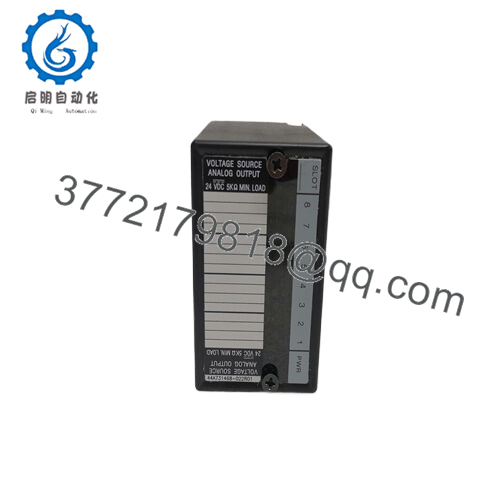
The GE IC670GBI002 exists specifically to solve that extension challenge cleanly and deterministically. As a Genius Bus Interface Unit for the FieldControl and VersaMax distributed I/O stations, the GE IC670GBI002 lets you drop a compact, DIN-rail-mounted island of modern high-density I/O anywhere on the plant floor and connect it back to the existing Genius bus with nothing more than a single twisted-pair cable run—up to 7500 feet per segment at full 153.6 kbaud speed. You keep the exact same diagnostics, redundancy options, and scan times you already trust, but now you can add VersaMax analog, discrete, or specialty modules in locations that would have required an entirely new fieldbus or a second PLC.
The GE IC670GBI002 is the bridge between legacy Genius networks and the newer FieldControl/VersaMax ecosystem. It occupies one node address on the Genius bus (configurable via thumbwheels or software) and presents the entire local I/O station as a contiguous block of data to the host—whether that host is an Rx3i, Series 90-70, or even a third-party controller with a Genius interface. The BIU handles all protocol conversion, diagnostic aggregation, and hot-insertion support internally, so the Genius controller sees the remote station exactly as if it were another Genius block. Dual-bus redundancy is fully supported, and the unit can be powered locally or from the bus, giving you maximum flexibility in brownfield expansions.
| Specification | Details |
|---|---|
| Model Number | GE IC670GBI002 |
| Brand | GE (now Emerson) |
| Type | Genius Bus Interface Unit (BIU) for FieldControl/VersaMax |
| Input Voltage | 24 VDC (18–30 VDC) |
| Operating Temp Range | –0 °C to 60 °C |
| Mounting Style | 35 mm DIN-rail |
| Dimensions | 5.04″ × 4.65″ × 2.76″ (128 × 118 × 70 mm) |
| Weight | 0.9 lb (0.4 kg) |
| Interface/Bus | Genius I/O (terminal or RJ-45) + local backplane |
| Compliance | CE, UL, CSA, Class I Div 2 |
| Supported Protocols | Genius 153.6 kbaud extended/standard |
| Typical Power Draw | 5 W (plus attached I/O modules) |
Deploying the GE IC670GBI002 means you no longer have to choose between ripping out a perfectly good Genius network and being stuck with obsolete I/O density. A single BIU plus a handful of VersaMax modules can deliver 128 discrete points or 32 analog channels in a footprint smaller than one legacy Genius block, yet the data still arrives with the same sub-10 ms determinism and rich diagnostics the plant has always had. Maintenance teams love it because the Genius handheld programmer works exactly the same way—channel faults, wiring errors, and module health are reported in the familiar format. Engineering overhead drops dramatically: no new fieldbus to learn, no additional software licenses, and no gateway latency to debug.

- IC670GBI002
The GE IC670GBI002 is the go-to choice whenever a plant needs to add capacity in remote or congested areas. Power plants use it to extend turbine and boiler I/O into new emissions-monitoring skids without running fiber or replacing the existing Series 90-70. Water/wastewater facilities stretch Genius networks across treatment compounds that are hundreds of yards apart. Food & beverage and pharmaceutical plants add it inside washdown-rated enclosures to bring high-density discrete I/O to new packaging lines while keeping the original control platform untouched. In every case, the driver is the same: proven Genius reliability plus modern I/O density at minimum migration cost.
GE IC670GBI102 – 120 VAC powered version for sites without 24 VDC field power
GE IC670ALG230 – 8-channel current analog input commonly mounted directly beside the BIU
GE IC670MDL240 – 16-channel 120 VAC discrete input for local pushbuttons and limits
GE IC670MDL740 – 16-channel 24 VDC source output for valve manifolds
GE IC670PBI001 – Profibus-DP interface alternative when migrating to newer networks
GE IC660BBA020 – Legacy 24 VDC analog block often replaced by VersaMax under a GBI002
GE IC670CHS001 – Base terminal assembly required for the first four modules
Before installation, confirm you have clean 24 VDC within the 18–30 V window and that the Genius bus is terminated correctly at both ends (75 Ω). Set the node address thumbwheels to an unused number on the existing bus and verify baud rate (153.6 kbaud extended is default on most modern systems). Leave at least one slot empty on the local rack if you anticipate future growth—hot insertion works, but airflow matters. If you’re using redundant controllers, wire both A and B cables; the BIU will automatically switch on cable fault.
Maintenance is essentially identical to any other Genius node: LED status, handheld diagnostics, and occasional terminal tightness checks. Firmware updates are rare and only needed when adding very new VersaMax modules; most installations run the factory load forever.