 WhatsApp: +86 16626708626
 Email:
  Phone: +86 16626708626
Description
High-Performance Computing in Mission-Critical Control Systems
In the demanding world of industrial automation, the central processing unit is the brain that orchestrates every sensor reading, logic calculation, and motor command. Facilities such as automated assembly plants, semiconductor fabrication labs, and power distribution centers require a controller that combines the raw power of a workstation with the ruggedized reliability of an industrial component. This is the precise role of the GE VMIC-7700. When a standard industrial PC fails due to the high-vibration or thermally volatile conditions of a factory floor, the GE VMIC-7700 provides a stable, high-performance platform that keeps critical processes synchronized and secure.
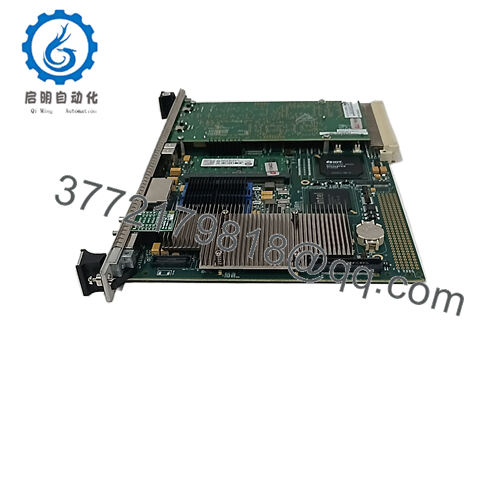
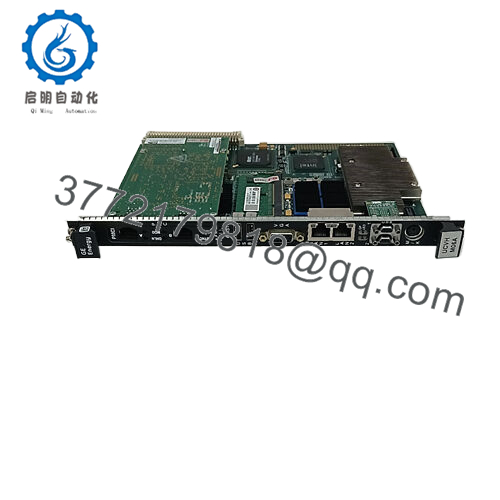
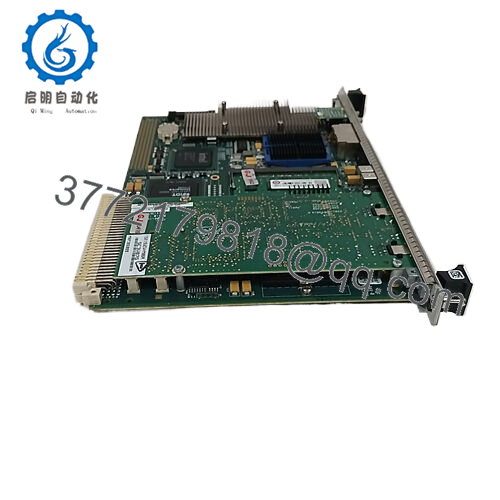
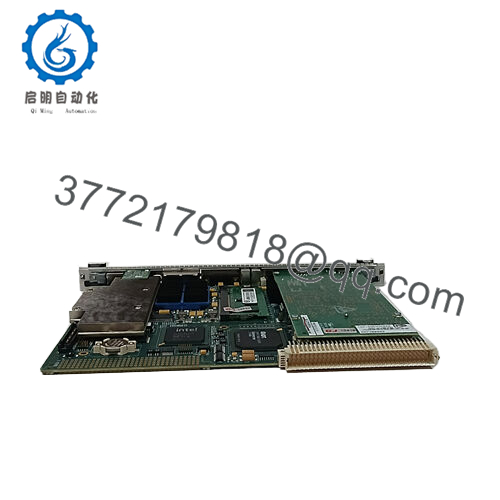
The GE VMIC-7700 is a Single Board Computer (SBC) designed to act as the primary master in a VMEbus chassis. It addresses the common challenge of modernizing legacy industrial systems by bringing Pentium-class processing power to the proven VME architecture. Whether it is performing complex real-time data analysis in a flight simulator or managing the high-speed I/O of a subsea control system, the GE VMIC-7700 delivers the deterministic performance required for closed-loop control. By integrating the GE VMIC-7700 into a control rack, engineers can run sophisticated human-machine interfaces (HMI) and real-time operating systems (RTOS) simultaneously, effectively bridging the gap between high-level IT management and low-level industrial execution without the latency issues common in networked PC solutions.
System Architecture and Processing Role
The GE VMIC-7700 is technically defined as a 6U VMEbus Single Board Computer, typically featuring an Intel Pentium III processor and a high-bandwidth system controller. It is engineered to serve as the “Bus Master,” managing the communication between various I/O modules, memory cards, and specialized interfaces within the VME backplane. As part of the VMIC (VME Microsystems International) lineage, the GE VMIC-7700 is designed for high-availability environments where a system reboot is not an option.
For a system integrator, the value of the GE VMIC-7700 lies in its extensive onboard connectivity and expansion capabilities. It provides a wealth of standard PC interfaces—including Ethernet, serial ports, and VGA—all within a single, hardened VME slot. This allows for a streamlined system architecture where a single GE VMIC-7700 can handle both the heavy computational lifting of a control algorithm and the communication tasks required to report data back to a central SCADA system. Its compatibility with industry-standard operating systems like VxWorks, Windows NT/2000, and QNX ensures that software developers have a flexible and familiar environment for deploying mission-critical applications.
Technical Performance and Ruggedized Reliability
The functional strength of the GE VMIC-7700 is found in its robust memory architecture and high-speed data paths. Equipped with synchronous DRAM (SDRAM) and a high-performance PCI-to-VME bridge, the module ensures that data moves between the processor and the field I/O with minimal bottlenecks. This is essential for “hard real-time” applications where a missing data sample can lead to system instability. The GE VMIC-7700 also features onboard non-volatile Flash memory for OS and application storage, eliminating the need for fragile rotating hard drives in high-vibration environments.
Hardware reliability is a cornerstone of the GE VMIC-7700 design. The board utilizes industrial-grade silicon and a specialized thermal management system that allows it to operate in extended temperature ranges that would cause a consumer-grade computer to throttle or fail. The VMEbus interface is electrically isolated and protected against the surges often found in heavy industrial power systems. Furthermore, the GE VMIC-7700 includes a programmable watchdog timer and a system monitor that can automatically trigger a safe shutdown or a reboot if it detects a software hang or a critical hardware fault. This level of self-healing capability is why the GE VMIC-7700 remains a trusted choice for infrastructure that must operate 24/7 for decades.

- VMIC-7700
Detailed Technical Specifications
| Parameter | Value |
| Model | VMIC-7700 |
| Brand | GE / VMIC (Abaco Systems) |
| Type | VMEbus Single Board Computer (SBC) |
| Processor | Intel Pentium III (Various Clock Speeds) |
| Memory | Up to 512MB SDRAM |
| VMEbus Interface | A32/A24: D32/D16/D08 (EO) Master/Slot 1 |
| Storage | Onboard Flash and IDE Support |
| Ethernet | 10/100BaseTX RJ-45 Connector |
| Video Output | Standard VGA Resolution Support |
| Operating Temperature | 0 to +55 Degrees Celsius (Extended Options) |
| Power Consumption | +5V at 5A (Typical, varies by CPU) |
| Form Factor | 6U Single-Slot VME |
Related Modules and System Components
VMIC-7750 – A higher-performance successor with faster clock speeds and enhanced memory support.
VMIVME-9304 – A Reflective Memory card that often communicates directly with the VMIC-7700 for distributed data.
VMIVME-4514 – An analog output module that receives its command signals from the VMIC-7700 via the VMEbus.
VMIVME-1111 – A digital input board providing the discrete field signals processed by the VMIC-7700.
VMIC-3122 – A high-precision analog input card for closing control loops with the VMIC-7700.
VMIC-0001 – A VMEbus backplane or chassis designed to house and power the VMIC-7700 and its peripherals.
Installation Notes and Maintenance Best Practices
Deploying the GE VMIC-7700 requires careful consideration of the VME chassis slot assignments. In most architectures, the GE VMIC-7700 must be installed in Slot 1 to function as the System Controller, handling the bus arbitration and clock signals for the entire rack. Before installation, technicians should verify the BIOS settings and onboard jumper configurations, especially regarding the VMEbus address mapping and interrupt levels. Ensuring that the front-panel captive screws are fully engaged is vital, as this provides a secondary grounding path and secures the GE VMIC-7700 against mechanical shock.
Maintenance for the GE VMIC-7700 focuses on thermal health and firmware integrity. We recommend a regular cleaning of the chassis intake filters to ensure that the airflow over the processor’s heatsink remains unobstructed. Using the onboard system monitoring tools, operators should periodically check the CPU temperature and voltage rails to identify any power supply issues before they cause a system crash. Additionally, keeping a backup of the GE VMIC-7700 Flash memory and CMOS settings is a critical best practice for rapid recovery in the event of a localized hardware failure or a corrupted configuration file.