 WhatsApp: +86 16626708626
 Email:
  Phone: +86 16626708626
Description
The GE VMIVME-5588-20 (legacy GE Fanuc / VMIC branding, now under Abaco Systems as part of the VME-5588 Reflective Memory family) tackles one of the toughest challenges in distributed real-time control systems: achieving deterministic, low-latency data sharing across multiple independent nodes without burdening the CPU or introducing variable I/O delays. In high-performance industrial automation setups—think synchronized motion control, simulation clusters, data acquisition in test stands, or coordinated drives in large machinery—traditional Ethernet or fieldbus protocols often fall short due to jitter, packet overhead, or non-deterministic timing. Engineers need a way to mirror memory contents transparently and near-instantly across distant controllers so that every node sees the same data as if it were local, with minimal software intervention. GE VMIVME-5588-20 solves this by providing high-speed fiber-optic Reflective Memory that broadcasts writes from one node to all others at rates up to 29.5 Mbyte/s (or 14.8 Mbyte/s in redundant mode), supporting up to 256 nodes in a loop topology. This becomes essential in environments requiring sub-millisecond synchronization, zero software protocol stack involvement, and immunity to electromagnetic interference—common in aerospace simulation rigs, power generation synchronization, automotive testing dynamometers, or military/turbine control clusters where even small timing variations can compromise stability or safety. By eliminating polling or message-passing latency, GE VMIVME-5588-20 helps maintain tight loop times and system coherence, reducing integration headaches and enabling scalable, fault-tolerant architectures in process control and real-time computing.
GE VMIVME-5588-20 functions as a VMEbus Reflective Memory node card that creates a shared, mirrored memory space across a fiber-optic network. When an application writes data to its local on-board SRAM, the board automatically broadcasts that change serially at 1.2 Gbaud over multimode fiber (typically with ST/PC connectors) to every other node in the ring, where the data is replicated into their local memory without CPU involvement on receiving nodes. Transmit and receive FIFOs handle bursty traffic to prevent overruns and optimize VMEbus utilization. The module supports interrupt generation—any node can trigger interrupts on specific nodes or broadcast to all—facilitating event-driven coordination without constant polling. It integrates directly into the VME64 backplane (double-height form factor), occupying a standard 6U slot alongside processors like PowerPC or Intel-based VME CPUs in systems such as older GE Fanuc or Abaco controllers. The network supports multimode fiber for distances up to ~300 m (1,000 ft), with options for longer single-mode runs or short twinax copper links. Redundant transfer mode (sending data twice) enhances error suppression in noisy environments, while built-in error detection ensures data integrity. Positioned in the I/O or communication layer of the automation stack, GE VMIVME-5588-20 sits below the application software but above physical field wiring, delivering transparent, deterministic inter-node communication that complements but doesn’t replace standard I/O for sensors/actuators.
| Specification | Details |
|---|---|
| Model Number | VMIVME-5588-20 |
| Brand | GE Fanuc / VMIC (legacy; now Abaco Systems) |
| Type | High-Speed Reflective Memory Module with Interrupts |
| Input Voltage | +5 V typical (VMEbus powered) |
| Operating Temp Range | 0 to +65 °C (with forced air cooling) |
| Mounting Style | 6U VMEbus slot |
| Dimensions | Standard VME 6U double height |
| Weight | Approx. 0.8–1.2 kg |
| Interface/Bus | VME64 / VMEbus |
| Compliance | Typical industrial (CE, etc., per era) |
| Supported Protocols | Reflective Memory protocol (proprietary high-speed serial broadcast) |
| Typical Power Draw | ~10–15 W |

- VMIVME-5588-20
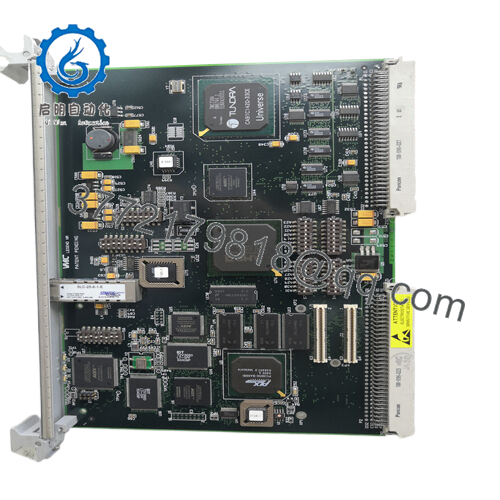
Opting for GE VMIVME-5588-20 brings tangible advantages in real-time distributed systems where timing predictability is non-negotiable. Engineered for deterministic performance, it ensures that data updates propagate consistently across the network with fixed latency, supporting stable closed-loop control even as node count grows to dozens or hundreds. The software-transparent operation eliminates protocol overhead and reduces engineering time spent on custom communication code or middleware tuning—often cutting development cycles by weeks. In harsh industrial settings, the fiber-optic isolation provides excellent noise immunity and galvanic separation, contributing to long-term reliability and fewer transient-related faults that plague copper-based networks. Maintenance teams appreciate the straightforward diagnostics (status LEDs for link health, error counters accessible via registers) and the ability to hot-swap nodes in many configurations without system shutdown. Overall, GE VMIVME-5588-20 protects uptime in mission-critical applications by minimizing single points of failure and enabling seamless scaling, while keeping the focus on core control algorithms rather than data transport plumbing.
GE VMIVME-5588-20 excels in applications demanding synchronized, low-jitter data exchange under demanding conditions. In aerospace and defense simulation environments, it’s deployed to link multiple real-time target machines for hardware-in-the-loop testing of flight controls or radar systems, where microsecond-level coherence ensures accurate scenario replication and critical system validation. Power generation and turbine control setups use it to synchronize governor, exciter, and protection relays across distributed controllers in combined-cycle plants or wind farms, supporting continuous uptime during load transients or grid disturbances. Automotive and manufacturing test stands rely on GE VMIVME-5588-20 for coordinating dynamometer, data acquisition, and safety PLC nodes in high-speed durability cycles or assembly line robotics—handling vibration, electrical noise, and fast data bursts without introducing delays that could skew results or compromise safety interlocks.
Related or alternative products in the Reflective Memory family include:
VMIVME-5588-200 – Variant with 1 MB memory and 512-word FIFO, multimode fiber ST/PC connectors, common baseline configuration.
VMIVME-5588-400 – 4 MB memory option with 512 transfer FIFO for applications needing larger shared datasets.
VMIVME-5588-610 – High-capacity 16 MB version with 4 KB FIFO, suited for data-intensive simulation or logging.
VME-5588DMA – Enhanced successor with integrated DMA controller for even lower CPU loading in high-throughput setups.
VMIVME-5565 – Newer generation Reflective Memory (Gigabit-class) offering higher speeds and modern fiber options for upgrades.
PCI-5588 – PCI form-factor equivalent for non-VME hosts needing similar reflective sharing.
VME-5588 – Current Abaco-branded direct replacement/maintainer for legacy VMIVME-5588 units.
VMIVME-5588-210 – Redundancy-focused variant emphasizing error suppression in critical links.
Before deploying GE VMIVME-5588-20, confirm VME backplane compatibility (VME64 preferred for full performance) and ensure sufficient forced-air cooling to stay within the 0–65 °C operating range—many older racks need fan tray verification. Check fiber type and length against your topology (multimode for most <300 m runs; verify ST/PC connectors and cable condition to avoid attenuation issues). Review host CPU firmware/drivers for Reflective Memory support (VMIC/Abaco libraries often required). During setup, initialize node IDs uniquely in the ring and test loop integrity with built-in diagnostics to catch cabling faults early. For ongoing maintenance, monitor link status LEDs and error registers periodically via software tools, inspect fiber connections for dust or bend damage (especially in vibrating areas), and run loopback or node ping tests yearly or after relocations. Keep spares rotated, as fiber transceivers can degrade over decades, though the core SRAM and logic prove exceptionally durable in the field.