WhatsApp: +86 16626708626
 Email:
  Phone: +86 16626708626
Description
Key Technical Specifications
- Rated Output: 200 W (0.2 kW)
- Rated Torque: 0.64 Nm (nominal)
- Rated Rotational Speed: 3,000 rpm
- Rated Current: 1.1 A
- Supply Voltage Class: 200 VAC class (per Mitsubishi’s own product specification)
- Feedback: Built-in absolute encoder, 17-bit resolution (equivalent to 131,072 pulses/rev)
- Shaft Type: Keyed shaft
- Motor Class: Low inertia / small power capacity
- Series/Platform: MELSERVO J2S — designed to pair with MR-J2S series servo amplifiers
- Weight: 1.74 lbs (distributor-listed)
- Manufacturing Status: Discontinued by manufacturer
- ⚠️ One major distributor lists this motor’s voltage as 118 VAC, which conflicts with Mitsubishi’s own published “200 VAC class” rating. Confirm actual nameplate voltage on your specific unit before pairing it with an amplifier — don’t rely on either figure alone without checking the physical nameplate.
Product Introduction
The Mitsubishi HC-KFS23K-S49 is a 200 W AC servo motor from the MELSERVO J2S platform, built with a keyed shaft and a 17-bit built-in absolute encoder delivering 131,072 pulses per revolution. It’s rated for 3,000 rpm at 0.64 Nm nominal torque, drawing 1.1 A, and is designed to pair with MR-J2S series servo amplifiers.
This motor has been discontinued by Mitsubishi, which puts it squarely in direct-replacement territory for plants running older MR-J2S-based motion systems rather than a candidate for new system design. Buyers sourcing this part are almost always doing a like-for-like swap on an existing machine, which makes exact suffix matching (shaft type, brake option, connector configuration) more important here than on a currently-produced motor.
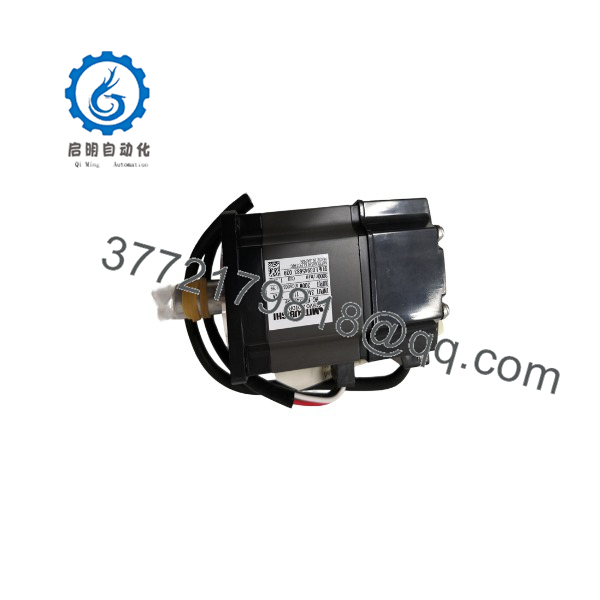
HC-KFS23K-S49
Troubleshooting Quick Reference
| Symptom | Possible Cause | Relevance to this Part | Quick Check Method | Recommendation |
|---|---|---|---|---|
| Motor doesn’t rotate, amplifier shows no alarm | Loose power or encoder cable connection | ❌ Low | Check power and encoder cable connectors at both motor and amplifier ends | Rule out cabling before suspecting the motor |
| Amplifier throws an encoder/feedback alarm | Damaged encoder cable, or genuine encoder fault in the motor | ✅ Moderate | Swap the encoder cable with a known-good one and retest | If the alarm follows the motor after a cable swap, the encoder itself is the likely fault |
| Motor runs but position drifts or loses accuracy over time | Encoder degradation, or backlash/coupling issue outside the motor | ❌ Low-Moderate | Check mechanical coupling and mounting before suspecting the encoder | Isolate mechanical causes first — encoder faults are less common than coupling wear |
| Motor overheats under normal load | Undersized for the application, or a bearing/winding fault | ✅ Moderate | Compare actual load torque against the 0.64 Nm rated torque | If load is within rating and it still overheats, this points to a motor-level fault |
| Amplifier trips on overcurrent when driving this motor | Amplifier/motor mismatch — wrong amplifier model for this motor’s rated current | ❌ Low | Confirm the paired MR-J2S amplifier model is rated for this motor’s 1.1 A draw | Verify amplifier-motor pairing per Mitsubishi’s combination charts before assuming a motor fault |
If you’re still not sure whether it’s the motor or the amplifier, send us the exact alarm code from the MR-J2S display and a description of when the fault occurs (at startup, under load, intermittently) — that’s usually enough to point to the right side of the system.
Frequently Asked Questions (FAQ)
What does the “-S49” suffix actually mean?
It denotes a specific shaft/configuration variant within the HC-KFS23K family — Mitsubishi lists both the base “HC-KFS23K” and this “-S49” version separately, though the core electrical specs (200 W, 1.1 A, 17-bit encoder) match across both. If your application depends on a specific shaft end, keyway, or connector style, confirm the exact suffix against your original nameplate rather than assuming any HC-KFS23K variant is interchangeable.
Is this motor still in production?
No — it’s discontinued by the manufacturer. What’s available now is new-old-stock, surplus, and used-tested inventory. That’s normal for MELSERVO J2S-era motors at this point, but it does mean lead times and stock levels can be unpredictable compared to a currently-produced motor.
Which amplifier does this pair with?
It’s built for the MR-J2S series of servo amplifiers. If you’re replacing a motor on an existing machine, keep the original amplifier unless you have a specific reason to change it — cross-generation motor/amplifier mismatches on Mitsubishi’s servo platforms are a common source of unexplained faults.
Do I need to reconfigure the amplifier’s parameters after swapping motors?
Possibly, depending on what changed. If you’re doing a straight like-for-like replacement with the same exact part number, parameters should carry over. If you’re swapping in a different suffix variant or an encoder resolution mismatch exists, verify the amplifier’s motor-type parameter against the new unit before running it — mismatched encoder resolution settings will cause positioning errors even if the motor spins fine.
Why does the voltage rating I’m seeing online not match?
We caught this too — Mitsubishi’s own product page lists this motor as “200 VAC class,” while at least one major distributor’s listing shows 118 VAC. That’s a real discrepancy, not just marketing copy variation. Check the actual nameplate on your unit before pairing it with any amplifier, and don’t assume either published figure without that physical confirmation.
Is this new, refurbished, or used stock?
All three show up for this part number across different sellers, which is typical for a discontinued motor still in active field use. Get a specific condition statement and test status in writing — “new” listings for a discontinued part are usually new-old-stock rather than fresh manufacture, which is worth knowing but doesn’t necessarily mean lower quality.