WhatsApp: +86 16626708626
 Email:
  Phone: +86 16626708626
Description
Key Technical Specifications
| Parameter | Value |
| Manufacturer | Motorola |
| Model Number | 23540 |
| Microprocessor | Motorola MC68030 (32-bit CISC) |
| Bus Interface | VMEbus (Standard 6U or proprietary backplane) |
| Clock Speed | Application dependent (typically 16–33 MHz) |
| Memory Support | On-board DRAM and EPROM/Flash sockets |
| I/O Ports | Serial Debug (RS-232) / Parallel options |
| Operating Temp | 0 to +70 °C (Standard Industrial) |
| Power Consumption | +5V DC Rail |
| Condition | New Surplus (Factory stock) |
Product Introduction & Supply Chain Strategy
The Motorola 23540 is an MC68030-based CPU module designed for robust processing in legacy industrial automation and embedded computing environments. As a cornerstone of early VMEbus and proprietary control architectures, it handles complex logic execution and data throughput for systems that require deterministic performance. These modules are often found in critical infrastructure such as power grid monitoring, CNC machinery, and older DCS platforms.
From a supply-chain standpoint, the 23540 is a legacy component that has long reached End-of-Life (EOL) status. Procuring “New Surplus” units is a vital risk-mitigation strategy. Relying on refurbished or “used-tested” modules introduces the risk of component fatigue—specifically aging electrolytic capacitors and weakened solder joints—which can lead to catastrophic system failure. Securing genuine new stock ensures an additional 10–15 years of operational life, significantly reducing the Total Cost of Ownership (TCO) compared to a full-scale system migration or unplanned downtime.
Installation & Configuration Guide
Stage 1: Pre-Installation (Prep & Safety)
Power down the entire chassis and follow Lock-Out/Tag-Out (LOTO) protocols. Use a grounded ESD wrist strap before touching any circuitry. Document the positions of all jumpers and DIP switches on the existing 23540 module; these define memory mapping, node addresses, and baud rates.
Stage 2: Removal
Loosen the top and bottom ejector handle screws. Use the handles to pivot the module out of the backplane connectors. Slide the board out of the card guide rails carefully, holding it by the edges to avoid static discharge to the MC68030 processor pins.
Stage 3: Installation (Clone & Seat)
Transfer any socketed EPROMs or specialized firmware chips from the old unit to the new 23540 if required. Ensure the jumpers and DIP switches match the original configuration exactly. Slide the module into the chassis rails and push firmly until the ejector handles click into place, indicating a full seat into the backplane.
Stage 4: Power-On & Testing
Power the system and monitor the front-panel LEDs. A “FAIL” or “HALT” LED should extinguish after a few seconds, replaced by a “RUN” or “STATUS” indicator. Connect a terminal to the serial debug port to verify the boot sequence and memory self-test results.
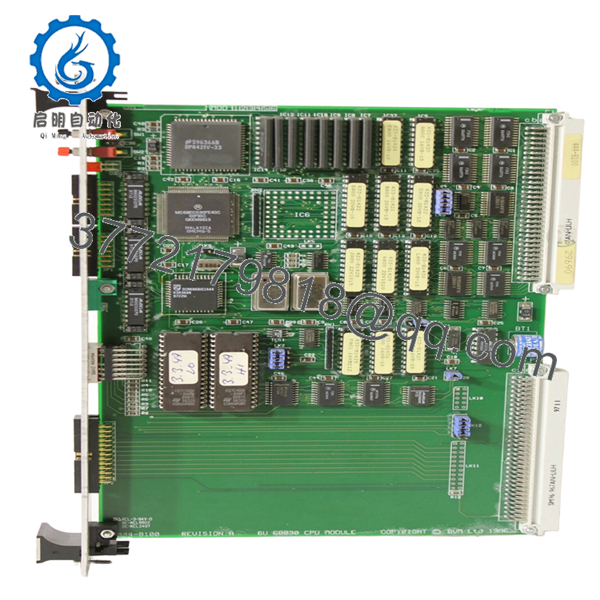
- 23540
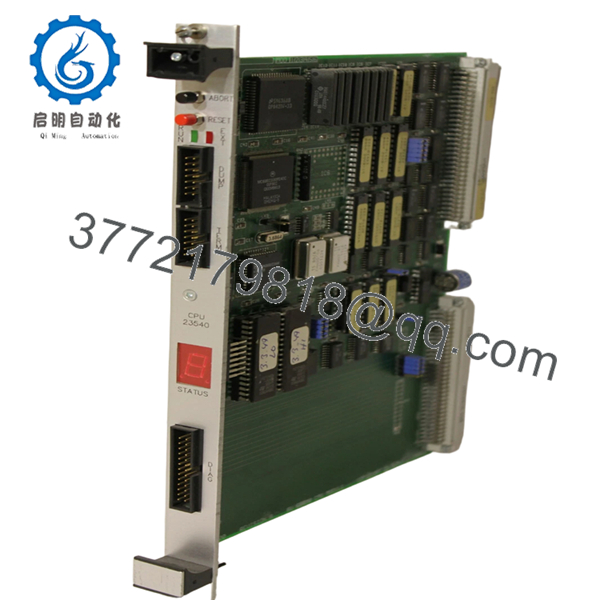
- 23540
Firmware/Software Versions & Upgrade Notes
- MC68030 Compatibility: This module is hardware-locked to the 68030 instruction set. Ensure any compiled code or RTOS (such as VxWorks or OS-9) is compatible with this specific processor revision.
- Firmware Sockets: The 23540 typically features sockets for EPROM (e.g., 27C512). Always use a non-conductive IC extraction tool when swapping firmware chips to prevent pin damage or ESD strikes.
- Revision Matching: Verify the hardware revision suffix (e.g., Rev A, B, or C) matches your application. Certain backplane signals or memory timings may vary between early and late production runs.
Frequently Asked Questions (FAQ)
Is this a new unit or a pull from a working machine?
This is a New Surplus unit. It has never been commissioned or subjected to the thermal cycles of a 24/7 production environment. It is factory-clean with no witness marks on the connectors or mounting hardware.
Does the 23540 include the MC68881/68882 Floating Point Unit (FPU)?
The 23540 board layout typically provides a socket for an optional FPU. Check your specific configuration requirements; if your math-heavy application requires a co-processor, it may need to be transferred from your existing board.
Can I hot-swap this module?
No. Most legacy Motorola 68k-series modules do not support hot-swapping. Attempting to insert or remove the board while the VME backplane is powered can cause electrical arcing, damaging both the 23540 and the backplane connectors.
Why is New Surplus better than a cheaper refurbished board?
Refurbished boards are often “cleaned and tested,” but they still contain 20+ year-old capacitors and components that are nearing their MTBF limits. New Surplus hardware gives you the peace of mind of zero-hour usage, ensuring maximum reliability for mission-critical logic.
Will I lose my program when I swap the CPU?
The program is typically stored in socketed EPROMs or on a separate memory/storage module. As long as you transfer the firmware chips or reload the software via the serial/network port, your logic will remain intact. Always perform a full system backup before any hardware swap.