WhatsApp: +86 16626708626
 Email:
 Phone: +86 16626708626
Description
Key Technical Specifications
| Parameter | Value |
|---|---|
| Analog Output Channels | 8, simultaneous update (no multiplexing) |
| AO Resolution | 16-bit |
| Max Update Rate | 1 MS/s per channel, all 8 channels simultaneously |
| Output Voltage Range | ±10 V |
| Onboard FIFO | 16,384 samples per channel group |
| DMA Channels | 3 |
| Digital I/O | 8 bidirectional lines (P0.<0..7>), software-timed static; individually configurable direction |
| Triggering | Advanced analog and digital triggering; PFI lines |
| Bus Interface | PCI (32-bit, 33 MHz) via NI MITE bus interface chip; interrupts and base addresses software-configured |
| RTSI | RTSI<0..7> for multi-device synchronization |
| DIP Switches / Jumpers | None — fully software-configured |
| I/O Connector | 68-pin male SCSI-II (VHDCI) — SH68-68/SHC68 cable, SCB-68 breakout |
| Board Dimensions | 6.87 × 4.2 in (17.5 × 10.7 cm) |
| Power Requirements | ‘+5 V: 1.25 A typical / 1.8 A max; +3.3 V: 125 mA typical / 250 mA max |
| Driver Software | NI-DAQmx (Windows XP through current releases; verify version matrix) |
| Warm-Up Time | 15 minutes to full rated accuracy |
| Operating Temperature | 0 to +55 °C, indoor use only |
| Calibration | External calibration interval 24 months; adjustable via DAQmx |
| Typical Applications | Stimulus-response test, acoustic distortion testing, three-phase power simulation, control actuation |
Verify the exact assembly revision and calibration date on the board label before ordering. Note the +5 V draw: 1.8 A maximum is significant for legacy industrial PCs — check your power budget before assuming the slot is fine.
Product Introduction
The NI PCI-6733 is a high-speed analog output board for standard PCI slots. It drives 8 channels at 16-bit resolution and 1 MS/s each, updating all channels simultaneously. Common uses: stimulus-response test, acoustic distortion testing, three-phase power simulation, and hardware-in-the-loop actuation where multiple outputs must step in lockstep.
The 6733’s edge is simultaneity. Unlike multiplexed AO boards, all 8 DACs update on the same sample clock, so phase relationships between channels hold — critical for power simulation and multi-axis control. No DIP switches or jumpers exist on the board; everything, including the 16,384-sample FIFO and 3 DMA channels, is software-configured through NI-DAQmx. One honest caveat: it’s output-only. There’s no AI on this card — if you need stimulus and response, pair it with an M or X Series input board and synchronize over RTSI.
Installation & Configuration Guide
Stage 1: Pre-Installation Preparation (Est. 10 minutes)
⚠️ Safety First: Notify operations of test-system downtime. Confirm a safe state — this board may be driving actuators or power amplifiers, so verify downstream equipment is de-energized. Shut down the PC, lock out/tag out power, wait 5 minutes for capacitor discharge.
- Tools Required: ESD wrist strap, PH2 screwdriver, multimeter, cable labels, smartphone for photos.
- Data Backup: Export your NI-DAQmx task configuration from MAX. Photograph the 68-pin cable routing. Document the DAQmx device name and any external trigger routing.
- Power Budget Check: Measure or verify your PC’s +5 V rail headroom. This card draws up to 1.8 A at +5 V. An older PSU loaded with drives and other DAQ cards can brown-out on boot. I’ve seen “bad board” diagnoses that were actually a tired PSU.
- Driver Check: NI-DAQmx 7.4 or later supports the 6733. Verify the installed version in MAX.
Stage 2: Removing the Old Card (Est. 5 minutes)
- Unscrew the PCI bracket retention screw.
- Disconnect the 68-pin SCSI-II connector — release the latch fully, pull straight out. Never yank at an angle; the pins bend.
- Pull the card straight up from the slot. Don’t pry against neighbors.
- Inspect the slot and card edge connector for dust or bent pins.
⚠️ Keep the old card until the replacement passes a full functional test.
Stage 3: Installing the New Card (Est. 5 minutes)
- Clip on the ESD wrist strap before the board leaves its anti-static bag.
- Verify the part number (778510-01) and assembly revision on the label match your order.
- Align the card with the PCI slot and press evenly until fully seated. Secure the bracket screw.
- Reconnect the 68-pin cable per your photos; confirm the SCB-68 or CB-68 breakout is seated.
Self-Checklist: [ ] Part number matches, [ ] Card fully seated, [ ] Bracket screwed, [ ] 68-pin cable latched.
Stage 4: Power-On & Testing (Est. 10 minutes)
- Power on the PC. Windows detects the board; NI-DAQmx binds the driver.
- Open NI MAX — the 6733 appears under “NI-DAQmx Devices.” Confirm the device name and run Test Panels.
- Generate a 1 V DC level on each channel into a meter or scope — confirm all 8 outputs, not just channel 0. Verify amplitude and stability.
- Run a simultaneous update test: program a step on all 8 channels and confirm they step together on the scope. That’s the feature you’re paying for.
- Reload your DAQmx AO tasks and dry-run at reduced rates before connecting to live loads.
⚠️ Troubleshooting Note: If outputs are stuck at one rail, suspect the DAC or output amplifier — but recheck the driver version first. If channels show phase skew, your update mode isn’t set for simultaneous generation. If the PC won’t boot or crashes after installation, check the +5 V rail loading before blaming the card. Allow the 15-minute warm-up before trusting absolute accuracy.
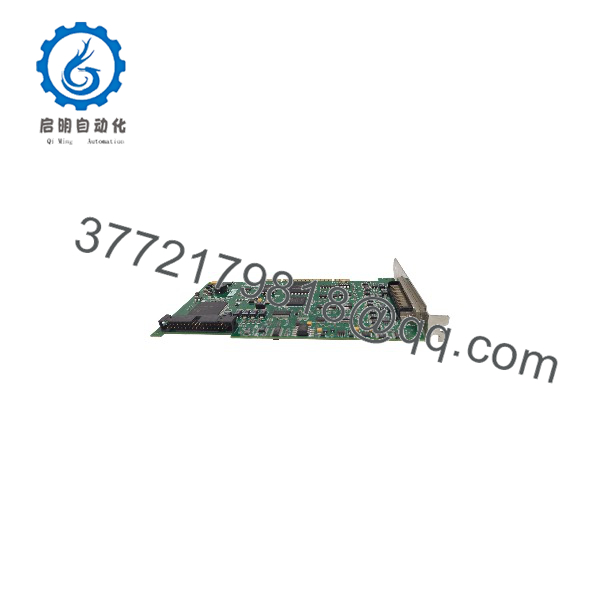
PCI-6733
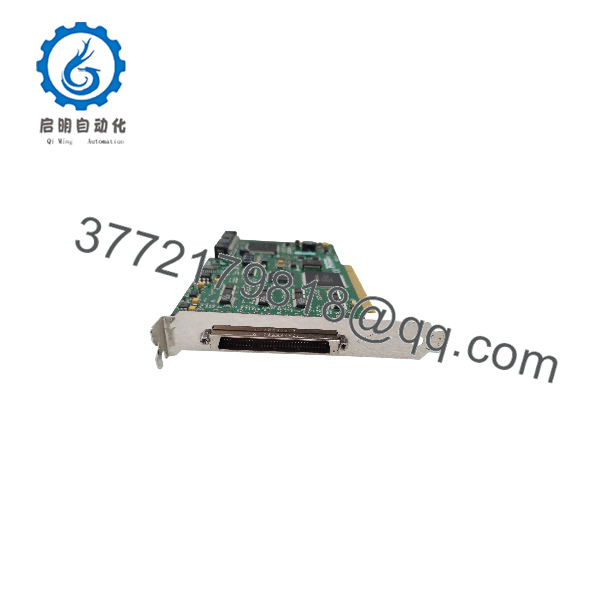
PCI-6733
Frequently Asked Questions (FAQ)
Q1: Can I hot-swap this card under power?
No. PCI is not hot-swap. Pulling a live card risks the slot, the motherboard, and the board’s output stage. Worse: if this board is driving power amplifiers or actuators, a hot pull can send transients downstream. Shut down, wait 5 minutes for capacitor discharge, then swap. De-energize the load side first.
Q2: Is the PCI-6733 obsolete, and is your stock genuinely new?
Yes, discontinued — NI’s PCI DAQ line is end-of-life, succeeded by PCIe and PXIe AO devices. Our stock is New Original / New Surplus: factory-sealed or uninstalled units with traceable sourcing, functionally tested before shipping. Test reports and photos of your exact unit are available on request. New Surplus and Refurbished (tested) are separate grades, labeled clearly. Factory-sealed units are scarce at this point — ask what’s actually on the shelf.
Q3: What’s the direct replacement if this is out of stock?
The PXI-6733 (part numbers 187995x-01L family, 778512-01) is the same 8-channel AO silicon in PXI form — but it needs a PXI chassis, not a PCI slot. On the PCIe side, the PCIe-6733 offers the same 8 simultaneous 1 MS/s channels on a PCIe interface and reuses the same 68-pin cable and breakout accessories. For a full platform upgrade, the PXIe-6738 offers higher density. If your PC has a free PCIe slot, the PCIe-6733 is the lowest-friction migration; verify against NI’s current documentation before committing.
Q4: Will I lose my configuration when I pull the old card?
Your DAQmx tasks live on the hard drive — back up the MAX export and you’re safe. The board stores no user data beyond calibration constants. If the replacement’s cal date is stale, DC accuracy won’t meet spec until recalibrated, but waveform generation and relative accuracy are unaffected. For audit-bound applications, budget for recalibration.
Q5: Why is your price lower than the original OEM list price?
The card is discontinued, so surplus stock trades below original list. We source excess inventory from OEM-authorized channels and test in-house rather than moving new production. You get a verified board at a surplus price. We state condition explicitly per unit — no mixing grades.
Q6: Can the 1 MS/s rate drive all 8 channels at once, or is it shared?
Per channel, simultaneously. All 8 DACs update at 1 MS/s on the same clock — that’s the defining feature versus multiplexed AO boards. Two real-world limits: the 16,384-sample FIFO per channel group means at 1 MS/s continuous you’re leaning on the 3 DMA channels to stream from host memory over the PCI bus — sustained 8 MB/s+ is fine on a healthy 33 MHz PCI bus but check for contention with other DAQ cards; and output slew into low-impedance or capacitive loads will degrade actual waveform fidelity regardless of update rate. Check the NI 6733 specifications for settling behavior before promising flatness at full speed.
Q7: Does this board have analog inputs or counters?
No AI, no counter/timers. It’s a dedicated analog output device with 8 static DIO lines (P0.<0..7>) and PFI trigger lines. If you need stimulus-response, pair it with an NI M Series or X Series AI board and synchronize both over the RTSI bus or a shared trigger PFI. The 68-pin connector pinout differs from AI boards — don’t assume your SCB-68 wiring carries over unchanged. Verify against the 6733 pinout diagram in the manual before landing wires.