 WhatsApp: +86 16626708626
 Email:
  Phone: +86 16626708626
Description
3. Key Technical Specifications
| Parameter | Value |
| Number of Channels | 8 |
| Input Type | Pt100 (IEC 60751, alpha=0.00385), Ni100, Ni120 |
| Connection Type | 3-wire symmetric connection |
| Resolution | 14 bits |
| Update Time | 400 ms per 8 channels (50 Hz filter), 330 ms per 8 channels (60 Hz filter) |
| Isolation | Group-wise isolation from backplane and power supply (50 V) |
| Power Supply | 24 V DC (19.2 to 30 V DC range) |
| Power Consumption | 40 mA typical from 24 V component power |
| Power Dissipation | 1.1 W maximum |
| Temperature Drift | Less than 50 ppm/°C |
| Operational Temperature | 0 to +55°C |
4. Product Introduction & Supply Chain Strategy
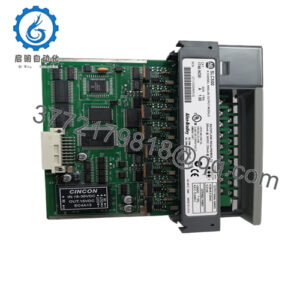
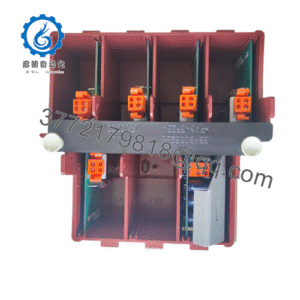
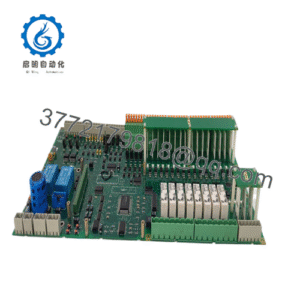
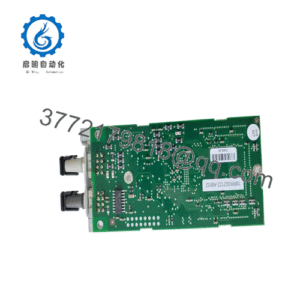
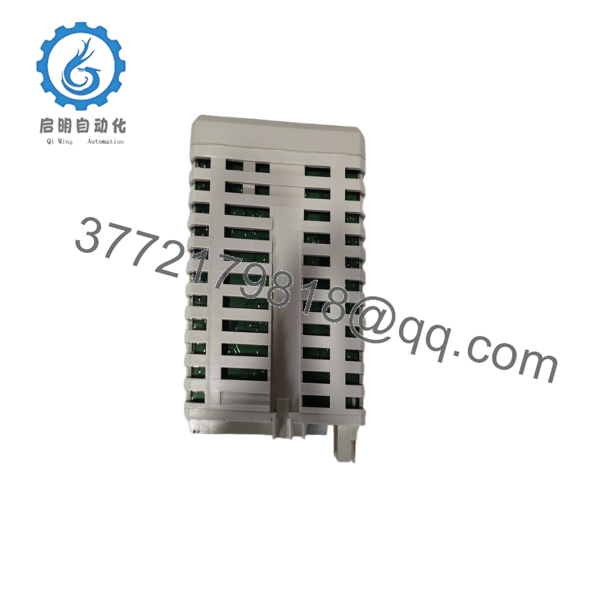
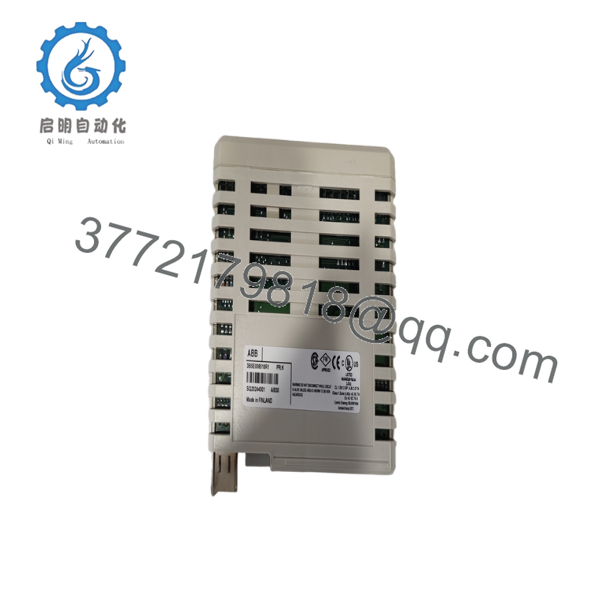
The ABB AI830 (63938751) is an 8-channel analog input module engineered for the S800 I/O platform. It provides high-accuracy interfacing for 3-wire RTD sensors, specifically Pt100 and Ni120 elements, converting thermal resistance changes into digital temperature data for Advant and Industrial IT controllers. This module is standard infrastructure in oil refineries, chemical processing plants, and power generation facilities where tight thermodynamic monitoring is vital to process stability.
From an asset management perspective, securing this module as a New Surplus unit represents a high-yield insurance policy. The AI830 is a mature, legacy component subject to lifecycle constraints. Relying on refurbished alternatives introduces hidden failures from degraded electrical insulation or aged capacitors that drift over time. Acquiring a verified New Surplus unit preserves OEM-spec 14-bit accuracy, stabilizes Total Cost of Ownership (TCO), and prevents a $500 procurement discount from transforming into a multimillion-dollar emergency outage.

- AI830 63938751
- AI830 63938751
5. Installation & Configuration Guide
Stage 1: Pre-Installation (Prep & Safety)
- Enforce lock-out/tag-out procedures on relevant field instrument loops. Ensure the 24 V DC field power supply source is isolated.
- Put on a grounded, static-dissipative ESD wrist strap connected to the enclosure chassis before handling the module.
- Record the physical position of the module on the Module Termination Unit (MTU). Document any existing field wiring arrangements and label the cables corresponding to channels 1 through 8.
Stage 2: Removal
- Release the top and bottom mechanical locking tabs on the module faceplate.
- Pull the module straight out from the MTU slide guides to avoid bending or shearing the gold-plated backplane connection pins.
- Place the extracted unit immediately into an anti-static shield bag.
Stage 3: Installation (Clone & Seat)
- Verify that the replacement module matches the required hardware revision number.
- Align the replacement AI830 with the MTU guide rails.
- Push the module firmly into the MTU connector slot until the mechanical locking latches click into place, ensuring complete backplane pin engagement.
Stage 4: Power-On & Testing
- Measure the incoming power rails at the MTU terminals to confirm stable 24 V DC supply voltage before energizing.
- Reapply system power and observe the front panel LED cluster. The green RUN LED should lock on solid, while the red ERR indicator must remain dark.
- Access the controller diagnostics interface to confirm successful module bus communication, then perform an online test by verifying live temperature readings from an active channel.
6. Firmware/Software Versions & Upgrade Notes
The AI830 module relies on specific internal firmware revisions that sync directly with the profiler definitions in your engineering environment (e.g., Control Builder M). When installing a replacement unit, verify that its hardware revision matches your running configuration. Inserting a module with a significantly newer firmware index into a system running older base software can trigger communication timeouts or invalid hardware definition errors on the fieldbus.
Avoid field firmware changes whenever possible during emergency swaps. Forcing a firmware downgrade on a newer revision board can permanently damage the flash memory sector or alter calibration tables. If your system requires a specific firmware baseline, provide your required version string during procurement to allow clean, drop-in hardware synchronization.
7. Frequently Asked Questions (FAQ)
What is the exact condition of this AI830 module?
This module is guaranteed Brand New Surplus inventory. It has never been installed in a live control panel, nor has it been pulled from a decommissioned facility. It rests in its original anti-static packaging, opened solely by our quality control engineers for inbound functional verification and serial trace documentation.
Why is the price higher than a refurbished unit but lower than factory list price?
Our pricing represents the raw scarcity value of genuine, unused OEM hardware. Refurbished parts are heavily discounted because they carry internal thermal degradation, worn solder points, and dried capacitors. We invest in extensive automated testing and trace authentication to ensure factory-level reliability, passing the savings relative to direct factory-order list prices directly to your maintenance budget.
Can I hot-swap the AI830 while the S800 cluster is energized?
Yes, the S800 I/O architecture supports hot-swapping (Removal and Insertion Under Power) of this module on the MTU. However, you must exercise extreme caution. Removing the module will instantly drop all 8 temperature loops into an open-circuit state, which can trigger emergency interlocks or safety shutdowns if your control application logic does not have specific bypass configurations active.
Do I need to reconfigure or reload program logic when installing this unit?
No software programming is required if you are replacing an identical model and revision. The module functions as an execution interface; its operational parameters, sample rates, and sensor coefficients are stored permanently in the cluster head station or main controller and pushed directly to the AI830 upon backplane initialization.
What coverage applies if the module fails post-installation?
Every New Surplus AI830 unit is backed by a comprehensive 1-year operational warranty. Unlike standard 30-day surplus warranties, our coverage mirrors traditional factory parameters to protect your plant against premature infant mortality failures or component breakdown.