WhatsApp: +86 16626708626
 Email:
 Phone: +86 16626708626
Description
Core Product Summary
The ABB CP430T-ETH, product ID 1SBP260196R1001, is a 5.7-inch TFT touch-screen operator terminal from ABB’s CP400 series of control panels, the HMI line associated with the AC500 PLC automation platform. It provides machine-level visualization and operation with a 320 × 240 pixel, 64K-color display, one menu key, and five user-defined function keys, and its applications are created with the CP400 Soft configuration software.
The -ETH variant adds an onboard Ethernet interface to the base CP430T, alongside two serial ports (COM1: RS232/RS485 on a 9-pin connector; COM2: RS232/RS422/RS485 on a 25-pin connector) rated 4.8 to 187.5 kBd, and USB 2.0 host and device ports for data transfer. The panel is driven by a 32-bit RISC processor with 4 MB of user program memory in ROM, 512 KB of user data RAM, battery-backed memory, and a real-time clock. It mounts through a 185.8 × 135.8 mm panel cut-out, presents an IP65/NEMA 4X front face (indoor use), and runs on 24 V DC at less than 20 W. Built-in software functions include alarm management, recipe management, trends, macro and ladder logic, and password protection with nine user levels.
Key Technical Specifications
| Parameter | Value |
|---|---|
| Product type | Control panel (HMI operator terminal), CP400 series |
| Type designation / product ID | CP430T-ETH / 1SBP260196R1001 |
| Display | 5.7-inch color TFT, 64K colors, 320 × 240 pixels, CCFL backlight, touch screen |
| Backlight service life | Approx. 60,000 h at 25 °C |
| Viewing area | 117.2 mm × 88.4 mm (4:3 format) |
| Character display | 40 characters × 30 lines (8 × 8 character size) |
| Operator controls | 1 menu key, 5 user-defined function keys (F1–F5); key operating force 350 ± 50 gf, lifetime over 1,000,000 activations |
| Communication interface | Ethernet (integrated on -ETH variant) |
| Serial port 1 (COM1) | RS232/RS485, 9-pin female connector |
| Serial port 2 (COM2) | RS232/RS422/RS485, 25-pin female connector |
| Serial communication speed | 4.8 to 187.5 kBd |
| USB ports | 1 × host (USB 2.0), 1 × device (USB 2.0) |
| Fieldbus/protocol support | Driver-dependent; documented drivers include Modbus RTU, AC500_Modbus, and ASCII |
| Processor | 32-bit RISC |
| Memory | User program: 4 MB ROM; user data: 512 KB RAM; 512 KB battery-backed memory |
| Real-time clock | Yes, battery-backed (rechargeable lithium battery) |
| Power supply | 24 V DC ± 15% (20.4 to 27.6 V DC), less than 20 W; internal 5 × 20 mm fuse |
| Operating temperature | 0 to +50 °C |
| Storage temperature | ‘-10 to +60 °C |
| Ambient humidity | 20 to 90% RH, non-condensing |
| Front protection | IP65 / NEMA 4X (indoor use only) |
| Mounting | Front-face panel mounting, position 0 to 135°, panel cut-out 185.8 × 135.8 mm, mounting depth 59.1 mm |
| Dimensions | Front panel 195.0 × 145.0 × 6.0 mm (W × H × D) |
| Weight | 0.86 kg |
| Configuration software | CP400 Soft |
| Security | Password protection with 9 user levels |
| Certifications | CE declaration of conformity, cUL and UL recognition, RoHS |
Engineering Selection Highlights
- Ethernet sets the -ETH variant apart. The CP430T-ETH carries an onboard Ethernet interface that the standard CP430T lacks; when replacing a unit, confirm whether the application communicates over Ethernet or only over the serial ports, since the base CP430T is not a drop-in substitute.
- Driver-dependent PLC connectivity. Serial protocols are driver-based, with Modbus RTU, AC500_Modbus, and ASCII documented among the available drivers; verify that the driver for your controller is selected in CP400 Soft before committing to the panel in a new application.
- Panel cut-out and depth are fixed. Installation requires a 185.8 × 135.8 mm cut-out and 59.1 mm of mounting depth behind the panel, and the panel may be mounted at 0 to 135° orientation; retrofit planning should check cabinet door thickness and clearance.
- IP65 front face only. The protection rating applies to the front panel for indoor use; the rear housing is not sealed, so the panel must not be specified for wash-down or outdoor doors.
- Two serial ports plus USB simplify commissioning. Applications can be downloaded over COM1 with a TK401 cable or COM2 with a TK402 cable, and USB 2.0 host/device ports support data transfer; one serial port can remain connected to the PLC during programming on the other.
- Memory budget for applications. 4 MB of ROM application memory and 512 KB of user data RAM bound the application size; for screen-heavy applications, check the project size in CP400 Soft against these limits.
- Backup and cloning support. Battery-backed memory preserves data, the real-time clock retains time, and the system menu includes a copy function that transfers application data to another CP430, which simplifies spare-unit rollout.
System Compatibility & Integration Requirements
| Item / Dependency | Verified Compatibility or Requirement | Practical Note |
|---|---|---|
| Automation platform context | CP400 series operator terminals within ABB’s PLC automation offering for AC500 applications | Panel communicates via drivers rather than a proprietary AC500 bus, so third-party PLCs supported by a driver can also be connected |
| Serial drivers | Modbus RTU, AC500_Modbus, ASCII; further protocols driver-dependent | Driver selection is made in CP400 Soft; confirm protocol match with the connected controller |
| COM1 port | RS232/RS485, 9-pin female connector, 4.8–187.5 kBd | DIP switches on the panel set RS485/RS422 modes; application download via TK401 cable |
| COM2 port | RS232/RS422/RS485, 25-pin female connector, 4.8–187.5 kBd | For RS485 the relevant DIP switch must be ON, for RS422 OFF; download via TK402 cable |
| Ethernet | Integrated Ethernet interface on the -ETH variant | Distinguishes this model from the serial-only CP430T (1SBP260195R1001) |
| Configuration software | CP400 Soft | Screens, function keys, alarms, recipes, and trends are engineered here |
| Power supply | 24 V DC ± 15%, less than 20 W | Supply voltage window 20.4 to 27.6 V DC; verify cabinet 24 V capacity |
| Installation | Panel cut-out 185.8 × 135.8 mm, depth 59.1 mm, mounting position 0 to 135° | Follow the manual’s grounding and power wiring procedure; disconnect power before connecting download cables |
Dimensions, Mounting & Connection Notes
- Front panel dimensions: 195.0 mm wide × 145.0 mm high × 6.0 mm deep; required cut-out 185.8 × 135.8 mm; mounting depth 59.1 mm behind the panel; panel weight 0.86 kg.
- Front-face mounting with an allowed mounting position of 0 to 135°, giving horizontal and inclined installation options; front face rated IP65/NEMA 4X for indoor use.
- Connectors on the rear: 9-pin female COM1 (RS232/RS485), 25-pin female COM2 (RS232/RS422/RS485), Ethernet port, USB 2.0 host and device ports, DC power outlet, and printer/keyboard connection.
- Power wiring: 24 V DC ± 15%, less than 20 W, through the DC power outlet; the panel contains an internal 5 × 20 mm fuse. The manual instructs that power must be switched off before connecting communication or download cables.
- DIP switches (1–10) configure serial modes; for RS485 on COM2 the relevant switch must be set ON, and OFF for RS422.
- Ambient limits during operation: 0 to +50 °C, 20 to 90% RH non-condensing.
Detailed Product Overview
The CP430T-ETH is a member of ABB’s CP400 series, a family of compact operator terminals characterized by touch-screen operation, a small set of defined keys, and configuration through the CP400 Soft engineering tool. Within that family, the CP430 group offers a 5.7-inch display in three principal variants: monochrome STN, color TFT, and color TFT with Ethernet. The CP430T-ETH is the top of this group, combining the 64K-color TFT touch display with an integrated Ethernet interface and two serial ports.
For an engineer, the display defines the working envelope. The 320 × 240 pixel screen shows 40 characters by 30 lines, which is enough for structured process screens, alarm lists, and trend windows, but it does require disciplined screen design; applications are built in CP400 Soft, where screens, function keys, alarms, recipes, and trend objects are laid out and downloaded to the panel. The five function keys can be defined in CP400 Soft as quick buttons for actions such as toggling values or switching screens, complementing touch operation for frequently repeated commands. The CCFL backlight is specified for approximately 60,000 hours at 25 °C, so backlight aging is a long-term maintenance consideration rather than a near-term one.
Communication is where the -ETH variant earns its place. The Ethernet interface allows the panel to be placed on the plant network and to communicate with controllers at Ethernet speed, while COM1 (RS232/RS485) and COM2 (RS232/RS422/RS485) keep the panel compatible with legacy serial architectures, including multidrop RS485 links. Protocol support is driver-based: Modbus RTU, AC500_Modbus, and ASCII are the documented drivers, which spans both ABB AC500 applications and generic Modbus devices. This driver architecture also has a procurement consequence: when replacing or adding a panel, the driver used by the existing application must match the connected controller, a point that is verified in the project rather than on the hardware label.
Hardware resources are modest but adequate for its class: a 32-bit RISC processor, 4 MB of ROM application memory, 512 KB of user data RAM, and 512 KB of battery-backed memory for data retention, with a rechargeable lithium battery also backing the real-time clock. Data retention and time stamping matter for alarm histories and trend logs, and the panel’s copy function allows application data to be cloned to another CP430, which reduces commissioning time when several identical machines use the same application.
Installation constraints deserve attention at ordering time. The panel needs a 185.8 × 135.8 mm cut-out, 59.1 mm of depth, and can be mounted at up to 135° from vertical, so inclined console doors are possible. Only the front face carries the IP65/NEMA 4X rating, and it is specified for indoor use, which rules out outdoor kiosks and hose-down areas. Power is 24 V DC ± 15% at under 20 W, well within the capacity of a standard control cabinet supply, and the manual’s safety instructions require power to be off while communication or download cables are connected.
For maintenance and procurement teams, the identification points are straightforward: CP430T-ETH with product ID 1SBP260196R1001 is the Ethernet-equipped 5.7-inch TFT touch variant, distinct from the serial-only CP430T (1SBP260195R1001) and the STN-based CP430B and CP430C models. A replacement unit is brought to service by reloading its CP400 Soft application over serial or USB, after which the copied configuration, alarms, and recipes restore its operator functions.
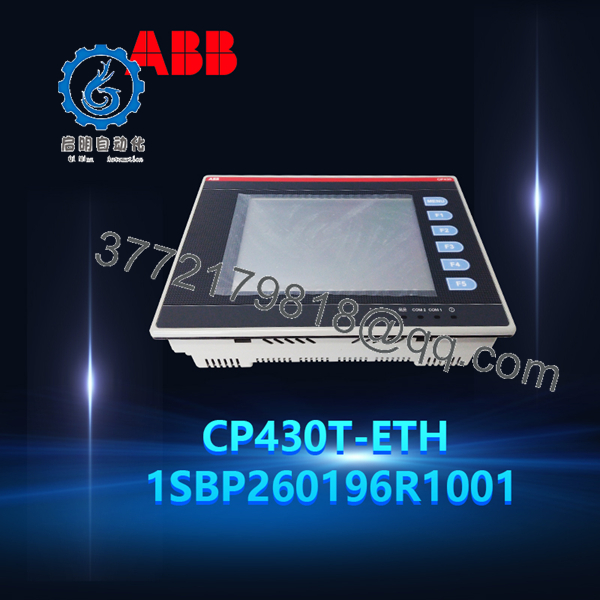
CP430T-ETH 1SBP260196R1001
Applications & System Role
In an automation architecture, the CP430T-ETH is the machine-level operator interface: the point where an operator views process screens, acknowledges alarms, adjusts setpoints, and issues commands, while the panel exchanges data with the controller over Ethernet or its serial interfaces. With AC500_Modbus and Modbus RTU drivers, its primary documented role is operator terminal for ABB AC500 PLC applications, though driver-based communication also allows connection to other PLC platforms supported by available drivers.
The panel’s built-in software functions define what a configured application can deliver: alarm management with operator notification, recipe management for parameter set handling, trend displays for process value history, macro and ladder logic for on-panel computations, and sub-screens for structured navigation. Password protection with nine user levels allows access control between operators, supervisors, and engineers. These capabilities position the CP430T-ETH for compact machines, skids, and control cabinets where a 5.7-inch touch interface with Ethernet connectivity is sufficient and where the application is engineered in CP400 Soft.
FAQ
What is the ABB CP430T-ETH 1SBP260196R1001?
It is the Ethernet-equipped variant of ABB’s 5.7-inch TFT touch-screen control panel from the CP400 series, used as a machine-level HMI operator terminal.
What display does it have?
A 5.7-inch color TFT screen with 64K colors, 320 × 240 pixel resolution, CCFL backlight with approximately 60,000 hours of service life at 25 °C, and a 117.2 × 88.4 mm viewing area showing 40 characters by 30 lines.
What communication interfaces does it provide?
An integrated Ethernet port, COM1 (RS232/RS485 on a 9-pin connector), COM2 (RS232/RS422/RS485 on a 25-pin connector) with speeds from 4.8 to 187.5 kBd, plus USB 2.0 host and device ports.
Which PLC protocols does it support?
Communication is driver-based; documented drivers include Modbus RTU, AC500_Modbus, and ASCII, making its primary documented use operator terminal for ABB AC500 applications and Modbus-based controllers.
How is it programmed and configured?
Applications are engineered in ABB’s CP400 Soft software, which is used to design screens, define the five function keys, and configure alarms, recipes, trends, and password levels, then downloaded to the panel over a serial cable (TK401 or TK402) or USB.
What are its installation requirements?
It mounts through a 185.8 × 135.8 mm panel cut-out with 59.1 mm of mounting depth, at positions from 0 to 135°, and its front face is rated IP65/NEMA 4X for indoor use.
What power supply does it need?
24 V DC ± 15% (20.4 to 27.6 V), with power consumption under 20 W and an internal 5 × 20 mm fuse.
What memory and security features does it offer?
It has 4 MB of ROM user program memory, 512 KB of user data RAM, 512 KB of battery-backed memory, a battery-backed real-time clock, and password protection with nine user levels.
What environment can it operate in?
Ambient temperatures of 0 to +50 °C in operation, -10 to +60 °C in storage, and 20 to 90% relative humidity, non-condensing.