WhatsApp: +86 16626708626
 Email:
  Phone: +86 16626708626
Description
Key Technical Specifications
| Parameter | Specification |
| Module Type | Combination Analog Input / Output Module |
| Number of Inputs | 2 high-impedance channels (Voltage or Current) |
| Number of Outputs | 2 current-sourcing channels (0 to 20 mA or 4 to 20 mA) |
| Input Voltage Ranges | \pm 10 V DC, 0 to 10 V DC, -1 to +1 V DC, 0 to 1 V DC |
| Input Current Ranges | -20 to +20 mA, 0 to 20 mA, 4 to 20 mA |
| A/D & D/A Resolution | 12-bit |
| Backplane Current (5 V DC) | 55 mA |
| Backplane Current (24 V DC) | 145 mA |
| Conversion Time | Inputs: 512 \mus per channel | Outputs: 2.5 ms per channel |
| Isolation Rating | 500 V DC field-to-backplane isolation |
Product Introduction & Supply Chain Strategy
The Allen-Bradley 1746-NIO4I is a compact 4-channel combination analog module engineered for the SLC 500 PLC platform. Combining 2 selectable analog inputs with 2 dedicated current outputs on a single card, it is designed for localized closed-loop control tasks like speed control of variable frequency drives (VFDs) or modulating valve positioning based on transmitter feedback.
Because Rockwell Automation has officially retired the SLC 500 family, maintaining New Surplus 1746-NIO4I inventory is vital for facilities running legacy process loops. Procuring uncommissioned surplus prevents sudden line stoppages and avoids the severe measurement drift, component aging, and output ripple typical of second-hand or worn electronics.
Installation & Configuration Guide
Stage 1: Pre-Installation (Prep & Safety)
- Execute Lock-Out/Tag-Out (LOTO) procedures on the main 1746 chassis power supply and connected field instrument loops.
- Put on an ESD-grounded wrist strap connected to cabinet earth ground.
- Record physical jumper settings (voltage vs. current mode for inputs) and document signal wiring polarities using clear reference photos.
Stage 2: Removal
- Unfasten the top and bottom retaining screws on the removable terminal block (RTB) and carefully pull it off the module header.
- Depress the upper and lower module release latches on the SLC 500 chassis simultaneously.
- Slide the card straight out of the slot along its guide rails to prevent twisting or damaging backplane edge connectors.
Stage 3: Installation (Clone & Seat)
- Configure hardware DIP switches or jumpers on the replacement 1746-NIO4I circuit board to mirror the input signal settings of the removed unit.
- Align the circuit board edges with the top and bottom chassis slot guides of the designated slot.
- Push the module firmly into the chassis slot until both top and bottom latches snap into place securely.
- Align the pre-wired RTB onto the terminal header and tighten the retaining screws to 0.5 N·m (4.4 lb·in).
Stage 4: Power-On & Testing
- Re-energize loop power supplies and verify signal wiring polarity. Ensure shield wires are terminated at a single system earth point.
- Apply power to the 1746 power supply and monitor the front status LEDs:
- MODULE STATUS: Solid green indicates normal initialization and POST diagnostic pass.
- Establish communication using RSLogix 500, verify the I/O data table registers (
I:e.0–I:e.1for inputs,O:e.0–O:e.1for outputs, whereeis the slot number), and command a test current output to verify downstream drive or actuator response.
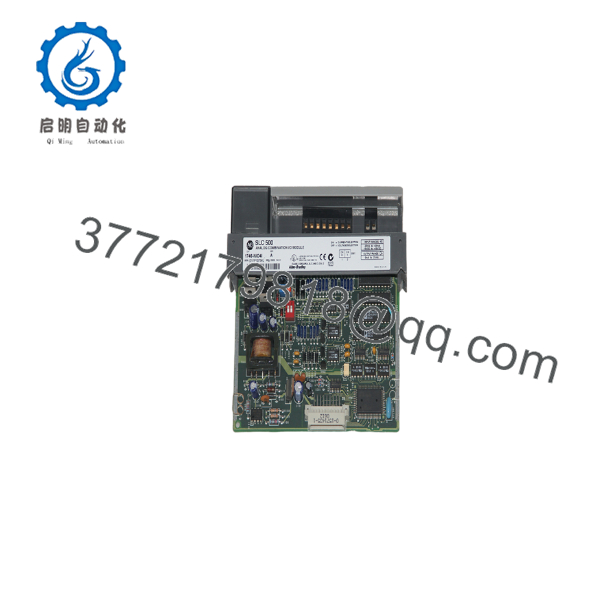
1746-NIO4I
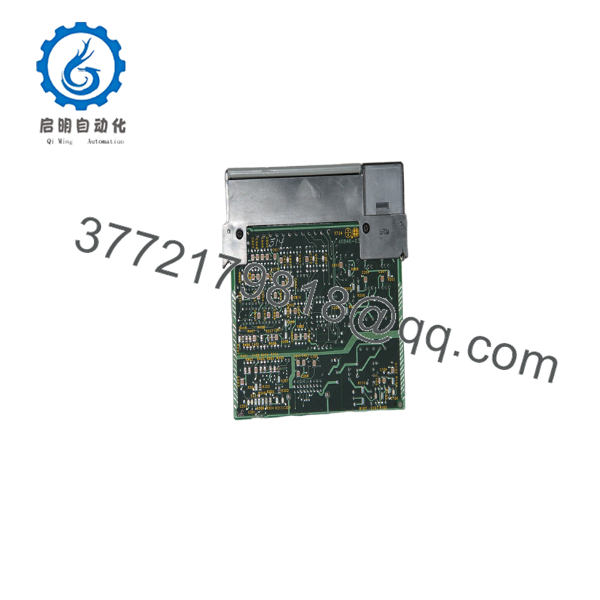
1746-NIO4I
Firmware/Software Versions & Upgrade Notes
- I/O Configuration in RSLogix 500: Select catalog number
1746-NIO4Iin the slot configuration. The card consumes 2 input words and 2 output words in the PLC data table. - Hardware Series Compatibility: Series A and Series B modules are functionally interchangeable across standard 1746 chassis racks (1746-A4, A7, A10, A13).
- Firmware Notes: Combination analog modules utilize fixed hardware scaling and on-board conversion logic; they do not support field firmware flashing. Hardware swaps are direct plug-and-play, provided physical jumper configurations match.
Frequently Asked Questions (FAQ)
Q: Is this 1746-NIO4I module a Brand New Surplus unit or a refurbished card?
A: This product is a Brand New Surplus unit. It is not used, not pulled from a decommissioned plant, and not refurbished. All modules undergo rigorous quality verification to ensure OEM-level reliability.
Q: Why is buying New Surplus preferable to a lower-cost refurbished 1746-NIO4I?
A: Combination analog modules depend on precision internal digital-to-analog and analog-to-digital converters and filtering capacitors. Refurbished boards often suffer from thermal stress, output drift, or worn connector contacts from previous plant service. Investing in New Surplus provides factory-level accuracy, a 10 to 15-year operational lifespan, and eliminates unpredictable downtime risks.
Q: How do you verify the quality and authenticity of legacy Allen-Bradley stock?
A: Every unit passes through our inbound SOP quality checks: verifying original OEM anti-static packaging, inspecting backplane edge connectors for zero insertion wear, verifying jumper header integrity, and conducting live loop signal verification tests on an SLC 500 test chassis.
Q: What is the difference between the 1746- and the 1746-NIO4V?
A: The 1746- features current-sourcing analog outputs (0 to 20 mA or 4 to 20 mA), whereas the 1746-NIO4V features voltage analog outputs (\pm 10 V DC). Always verify whether your field actuators require current loops or voltage signals before installation.
Q: Is it safe to hot-swap the 1746- while the SLC 500 rack is powered up?
A: No. Allen-Bradley SLC 500 chassis backplanes do not support Hot-Swapping (RIUP). Pulling or inserting any 1746 card while backplane power is active causes electrical arcing that can destroy the module, adjacent I/O cards, or the primary CPU. Always disconnect chassis power first.
Q: What warranty coverage applies to this New Surplus 1746-?
A: All 1746- New Surplus cards carry our comprehensive 1-year functional replacement warranty. If any channel or hardware defect occurs under standard operating parameters, we will immediately supply a replacement card or issue a full refund.