WhatsApp: +86 16626708626
 Email:
 Phone: +86 16626708626
Description
Key Technical Specifications
| Parameter | Specification |
|---|---|
| Manufacturer | Bachmann electronic GmbH |
| Model | ME203/CN |
| Manufacturer item number | 00013176-00 |
| Controller family | Bachmann M1 |
| Processor | Intel 80386EX |
| CPU clock speed | 33 MHz |
| DRAM | 8 MB |
| SRAM | 512 kB, battery-backed |
| Program flash | 8 MB |
| Boot flash | 2 MB, with system software allocation |
| CAN interface | 1 × CAN/CANopen |
| Serial interfaces | 1 × RS-232; 1 × RS-232/422/485 |
| Removable storage | Front PC-card slot; supported card capacity depends on configuration |
| Integrated I/O power supply | 17 W |
| Power via backplane | 5 V and ±15 V |
| Optional internal supply input | 24 VDC, specified range 18–34 V |
| Operating temperature | −30°C to +60°C for the standard variant |
| Status monitoring | RUN, INIT, and ERROR indicators; watchdog |
| Product lifecycle | Out of production |
Specifications are based on the Bachmann ME203-series system overview and product documentation. Power-supply details depend on the installed configuration; verify the module label and system manual before wiring.
Product Introduction & Supply Chain Strategy
The Bachmann ME203/CN provides processor and communications functions within an M1 industrial control system. Its CAN/CANopen interface and serial ports support communication with compatible devices, while onboard memory stores program and working data. The module’s one-slot format is relevant when maintaining an existing controller rack and preserving the original installation layout.
Because this model is obsolete, procurement should prioritize exact part-number matching, verified condition, and the availability of a working application backup. For production-critical systems, compare the cost of holding a tested spare against the potential downtime associated with sourcing a legacy CPU after a failure. Any proposed replacement should be evaluated as a system-level change, not merely as a component swap.
Installation & Configuration Guide
Stage 1 — Pre-installation checks
- Confirm the full designation is ME203/CN and verify the manufacturer item number.
- Check whether the installed unit is a standard or ColdClimate variant.
- Record the controller configuration, CPU-ID selector position, and connected serial and CAN wiring.
- Back up the application, configuration files, and any accessible removable-card data.
- Verify that the power supply and backplane are compatible with the replacement.
Stage 2 — Remove the existing module
- Stop the controlled process according to site procedures.
- Isolate controller power and verify the system is safe to service.
- Label and document all external connections before removal.
- Remove the module using the controller manufacturer’s prescribed procedure.
- Inspect the backplane connector and adjacent modules for damage or contamination.
Stage 3 — Install and configure
- Insert the replacement into the correct slot and secure it as specified by the system documentation.
- Set the CPU-ID selector to the required position.
- Reconnect serial and CAN/CANopen cabling, maintaining the existing network layout.
- Confirm CAN bus termination and wiring polarity against the system design.
- Restore the application and configuration only through a supported Bachmann toolchain and documented procedure.
Stage 4 — Power-on and testing
- Check the RUN, INIT, and ERROR indicators.
- Confirm the controller completes initialization without unexpected faults.
- Verify CAN and serial communications with connected equipment.
- Confirm the application is loaded and process data is valid.
- Test interlocks, communication-loss responses, and controlled restart behavior before returning the system to production.
Important: Do not assume the module is hot-swappable. Use the approved shutdown and isolation procedure for the specific M1 rack.
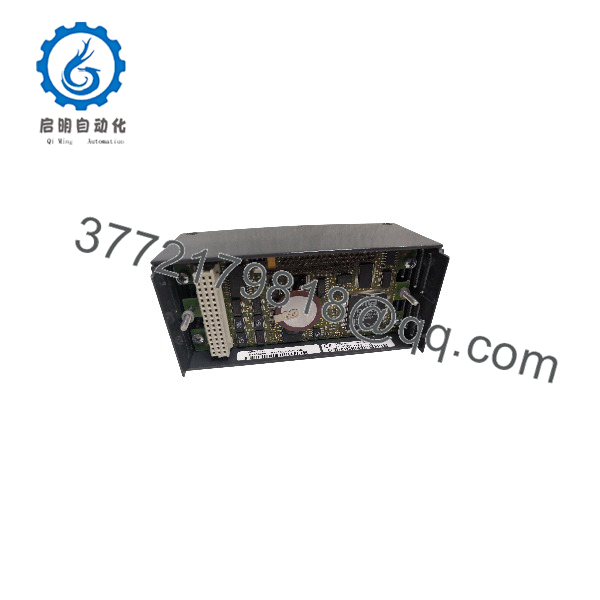
ME203CN
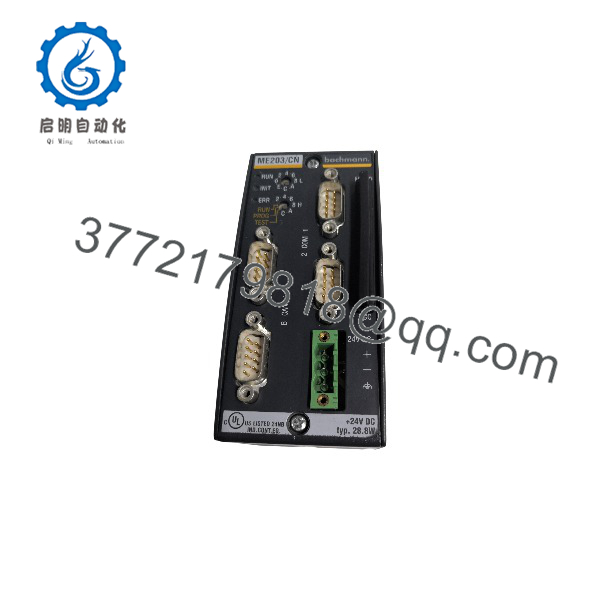
ME203CN
Firmware, Software Versions & Upgrade Notes
The ME203/CN is an M1 processor module configured using Bachmann’s controller engineering tools. The available documentation identifies the hardware but does not establish a single firmware version that applies to every installed unit.
- Engineering environment: Confirm the installed M1 software and engineering-tool versions before attempting to restore or modify a project.
- Application retention: Back up the running application and accessible configuration before replacing the CPU. Do not assume all application data is stored on the removable PC card.
- Battery-backed memory: The 512 kB SRAM and real-time clock rely on battery-backed retention. Verify retained data and clock behavior during maintenance.
- Communications: Recheck CAN/CANopen node settings, serial interface modes, baud rates, and connected-device configurations after replacement.
- Firmware changes: Use only firmware and procedures approved for the exact hardware variant and controller project.
Replacement options
The ME203/CN is listed as obsolete, and supplier documentation identifies the MX207 and MX213 as possible replacement candidates. However, these are not automatic drop-in replacements: the MX modules occupy two module widths, whereas the occupies one. Available MX213 variants also differ in configuration. Confirm rack space, software compatibility, communications, I/O power requirements, and the exact replacement part number before purchasing.
Frequently Asked Questions
Q1. What is the Bachmann /CN used for?
It serves as the CPU/processor module in a Bachmann M1 industrial control system, executing the control application and providing CAN/CANopen and serial communications.
Q2. Is /CN still in production?
The available product listing identifies it as out of production. For maintenance planning, verify remaining stock, repair options, and the availability of a qualified replacement.
Buy at Spica Controls Webshop
Q3. What is the difference between /CN and ME203/EN?
The key distinction is the fieldbus interface. The /CN provides CAN/CANopen, while the /EN variant provides Ethernet. Both have serial interfaces, but they should not be treated as interchangeable without checking the controller configuration and application requirements.
Q4. Can the MX207 or MX213 replace the ME203/CN?
They are documented as possible replacement candidates, but compatibility must be assessed first. The MX modules use two module widths, compared with the ‘s single width, and the required interface and configuration must also match.
Q5. Does the module retain its application when power is removed?
The module has battery-backed SRAM and integrated flash memory. However, the exact location of the application, configuration, and retained process data depends on the project. Back up the controller before replacement rather than relying on memory retention alone.
Q6. Can this CPU be replaced while the controller is running?
Do not assume so. Follow the specific M1 system’s approved replacement procedure and isolate power unless the applicable documentation explicitly permits the intended operation.
Q7. How should New Original or New Surplus condition be verified?
Request photographs of the actual module, the complete model marking, the manufacturer item number, and any available serial or date-code information. Obtain written confirmation of condition and warranty terms. New Surplus status should be verified from the supplier’s records; it should not be inferred from appearance alone.