WhatsApp: +86 16626708626
 Email:
  Phone: +86 16626708626
Description
Key Technical Specifications
| Parameter | Value |
|---|---|
| Manufacturer | Baldor / ABB |
| Model | CDP3445 |
| Motor Type | Permanent Magnet DC |
| Product Series | Permanent Magnet SCR |
| Rated Output | 1 HP |
| Armature Voltage | 90 VDC |
| Armature Current | 10.0 A |
| Base Speed | 1,750 RPM |
| Frame | 56C |
| Enclosure | TEFC |
| Insulation Class | F |
| Duty | Continuous |
| Ambient Temperature | 40°C |
| Mounting | F1 |
| Shaft Diameter | 0.625 in |
| Bearings | 6203 drive end / 6203 opposite drive end |
| Feedback | No feedback device |
| Shaft Rotation | Reversible |
| Motor Leads | 2 × 14 AWG |
| Approvals | CE, CSA, UL |
| UPC | 781568124482 |
Baldor’s current product data identifies CDP3445 as a 1 HP, 1,750 RPM DC motor with a 90 V armature, 10.0 A armature current, 56C frame, and TEFC enclosure.
The CDP3445 belongs to Baldor’s Permanent Magnet SCR motor family. Typical applications include conveyors, mixers, packaging machinery, and other variable-speed constant-torque machinery.
Product Introduction & Supply Chain Strategy
The Baldor CDP3445 is a 1 HP permanent-magnet brushed DC motor designed for industrial variable-speed applications. Its 90 VDC armature, 1,750 RPM base speed, 56C frame, F1 mounting, and TEFC enclosure make the exact configuration important when replacing an installed motor.
For maintenance inventory, New Surplus stock can reduce the risk associated with sourcing an exact legacy configuration during an unplanned outage. Before purchasing, match the armature voltage, frame, mounting, enclosure, shaft dimensions, and nameplate specification. A lower-cost substitute that requires mechanical or drive-system changes can carry a higher Total Cost of Ownership (TCO).
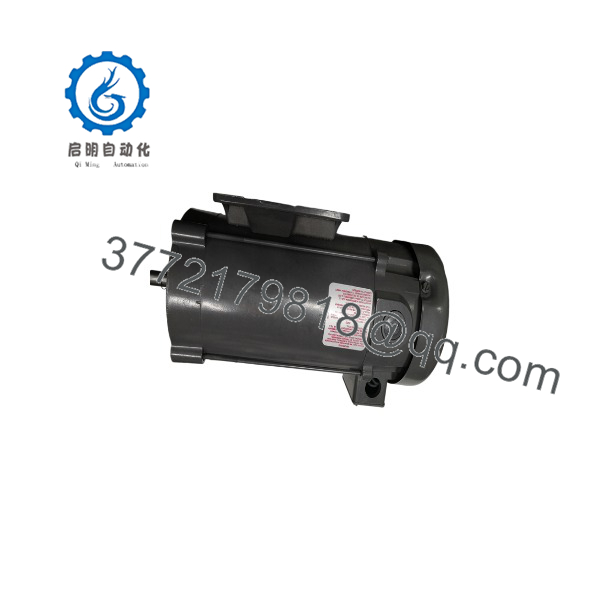
CDP3445
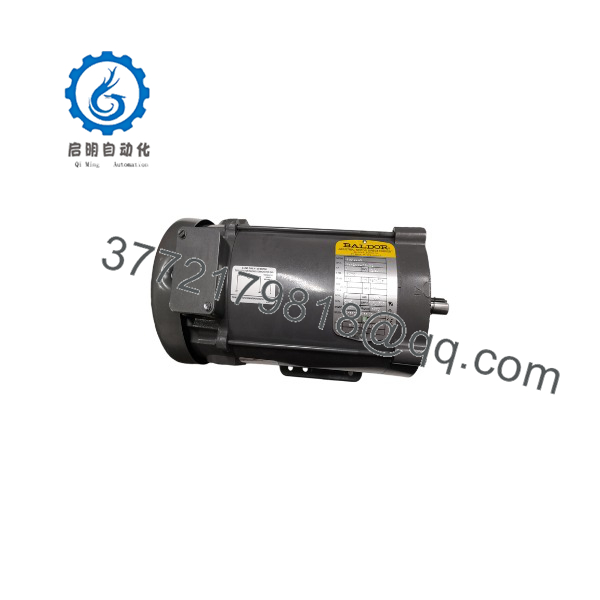
CDP3445
Installation & Configuration Guide
Stage 1: Pre-Installation — Preparation & Safety
- Apply the plant’s lock-out/tag-out procedure and isolate the DC drive and associated power sources.
- Verify zero energy with an appropriately rated meter.
- Record the existing motor nameplate information before removal.
- Photograph terminal connections, conduit routing, mounting orientation, and any drive wiring.
- Confirm that the replacement is specifically CDP3445, not CDP3445-V12 or . These are different voltage configurations. Baldor lists the V12 version at 12 VDC and the V24 version at 24 VDC.
- Prepare an ESD strap when handling associated electronic drive equipment.
Stage 2: Removal
- Label every motor conductor before disconnecting it.
- Disconnect the motor leads and secure them so they cannot contact energized conductors.
- Remove the mechanical coupling, belt, pulley, or other driven connection according to the machine manufacturer’s procedure.
- Remove the mounting hardware while supporting the motor.
- Lift the motor without forcing the shaft or damaging the bearing assemblies.
- Inspect the existing mounting surface, coupling alignment, shaft condition, and cable entry.
Stage 3: Installation — Clone & Seat
- Verify the replacement nameplate: , 1 HP, 90 VDC, 1,750 RPM, 56C, TEFC.
- Confirm the replacement shaft and mounting geometry against the removed motor.
- Install the motor in the same mounting orientation.
- Reconnect conductors according to the documented original wiring and approved motor-drive schematic.
- Align the driven equipment before tightening mounting hardware to the machine manufacturer’s specified torque.
- Verify that the shaft rotates freely by hand where the machine design permits.
- Confirm that ventilation openings and the TEFC cooling path are not obstructed.
Stage 4: Power-On & Testing
- Check the motor circuit for unintended shorts before energizing the DC drive.
- Verify the drive’s configured motor armature voltage and current limits.
- Confirm that the drive configuration corresponds to the ‘s 90 VDC armature / 10.0 A rating.
- Energize the system under controlled conditions.
- Start at low commanded speed and observe motor direction, current, vibration, and abnormal noise.
- Confirm that the motor reaches the expected operating speed without excessive current.
- Verify the machine’s stopping and interlock functions before returning it to production.
Firmware/Software Versions & Upgrade Notes
Firmware status: Not applicable to the motor itself.
The is an electromechanical DC motor rather than a programmable PLC, I/O module, or intelligent drive. It therefore has no user firmware version to document or download.
The critical compatibility point is the external DC motor controller. Before replacement, record the drive manufacturer’s model, motor configuration, armature voltage, current limit, acceleration/deceleration settings, and any tachometer or feedback configuration.
Do not assume that variants are electrically interchangeable. Baldor identifies as a 90 VDC armature motor, while -V24 uses a 24 VDC armature and -V12 uses a 12 VDC armature.
For a like-for-like motor swap, retaining the existing drive configuration is generally preferable to changing drive firmware or control parameters unnecessarily. If the drive is also being replaced, validate the complete motor/drive combination before returning the machine to production.
Frequently Asked Questions (FAQ)
1. Is a DC or AC motor?
is a permanent-magnet brushed DC motor. The standard has a 90 VDC armature and a 1,750 RPM base speed.
2. What is the difference between and -V24?
They are different armature-voltage configurations. Standard is rated at 90 VDC / 10.0 A, while -V24 is rated at 24 VDC / 40.9 A. They should not be treated as direct electrical substitutes without checking the motor controller and machine design.
3. What does the 56C frame designation mean?
The 56C designation defines the motor’s NEMA mounting geometry. When replacing an installed motor, verify the mounting pattern, shaft dimensions, shaft extension, and driven-equipment alignment rather than relying on horsepower alone.
4. Can be used with an existing DC drive?
Potentially, provided the drive is correctly sized and configured for the motor. The critical values to verify are the 90 VDC armature rating, 10.0 A armature current, motor speed, acceleration requirements, and any feedback configuration. The standard has no integrated feedback device.
5. Does retain programming?
No. There is no motor-resident application program or firmware to retain. Any programming, motor parameters, speed-loop settings, or control logic resides in the external DC drive or machine controller.
6. Is suitable as a maintenance spare?
Yes, when the installed motor’s nameplate and mechanical interface match. For equipment where motor failure can stop production, maintaining one unit of buffer stock can be justified by downtime exposure and lead time variability. Do not substitute the V12 or V24 variants without engineering verification.
7. What should I verify before purchasing a replacement?
At minimum, verify , 1 HP, 90 VDC, 10.0 A, 1,750 RPM, 56C frame, TEFC enclosure, F1 mounting, shaft dimensions, and nameplate specification. Also verify the existing drive model and motor-control parameters. Baldor identifies the standard unit with CE, CSA, and UL approvals.