WhatsApp: +86 16626708626
 Email:
  Phone: +86 16626708626
Description
Key Technical Specifications
| Parameter | Value |
|---|---|
| Device Type | Insulation monitoring device / ground detector |
| Brand | Bender |
| Model | IRDH275-435 |
| Material Number | B91065100 |
| Monitored Systems | Unearthed single-phase AC, three-phase AC, AC/DC, and DC systems |
| Nominal System Voltage | 0–793 V AC; 0–650 V DC |
| Rated Frequency | DC, 0.2–460 Hz |
| Supply Voltage | 88–264 V AC, 42–460 Hz; 77–286 V DC |
| Power Consumption | ≤ 14 VA |
| Measuring Principle | AMPPlus |
| Response Value Alarm 1 | 1 kΩ–10 MΩ |
| Response Value Alarm 2 | 1 kΩ–10 MΩ |
| Response Time | <5 s at RF=0.5×RanR_F = 0.5 \times R_{an}, Ce=1 μFC_e = 1\ \mu F |
| Maximum Leakage Capacitance | 500 μF |
| Display | Backlit, two-line LCD; 2 × 16 characters |
| Alarm Relays | Two SPDT contacts; normally energized or de-energized operation |
| Relay Contact Rating | 250 V AC / 300 V DC; 5 A making, 2 A breaking |
| Analog Output | Galvanically isolated 0–400 μA |
| RS-485 Interface | One-way ASCII stream |
| Maximum RS-485 Cable Length | Approximately 3,900 ft |
| Mounting | DIN rail per DIN EN 60715 / IEC 60715 |
| Protection Rating | IP30 internal components; IP20 terminals |
| Operating Temperature | −10 to +55 °C |
| Storage Temperature | −40 to +70 °C |
| Terminal Wire Range | AWG 24–12 rigid; AWG 24–14 flexible |
| Weight | Approximately 1.1 lb |
| Operating Standard | IEC/EN 61557-8 |
The IRDH275-435 is the high-voltage supply version with an 88–264 V AC / 77–286 V DC auxiliary supply. It is distinct from IRDH275-427 and IRDH275-425 low-voltage supply variants.
Product Introduction
The Bender IRDH275-435 ISOMETER is an insulation monitoring device for unearthed AC, AC/DC, and DC systems. It continuously measures insulation resistance to ground on systems up to 793 V AC or 650 V DC and provides two adjustable alarm thresholds, a backlit LCD, two alarm relays, RS-485 communication, and an isolated 0–400 μA analog output.
The AMPPlus measuring method supports systems containing rectifiers, converters, variable-frequency drives, and high leakage capacitance. Use the IRDH275-435 only on an unearthed system; it is not a replacement for a residual-current device on a grounded distribution system.
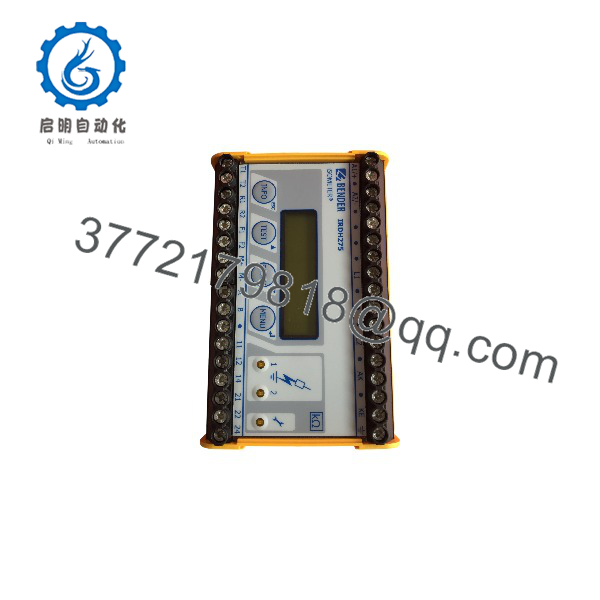
IRDH275-435
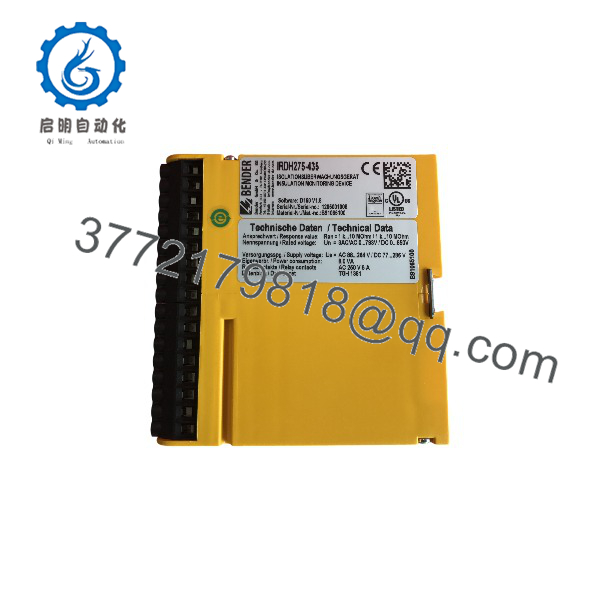
IRDH275-435
Troubleshooting Quick Reference
| Symptom | Possible Cause | Relevance to This Part | Quick Check Method | Recommendation |
|---|---|---|---|---|
| No LCD or LEDs | Missing auxiliary supply, incorrect voltage variant, blown protection device, internal failure | ✅ High | Measure 88–264 V AC or 77–286 V DC at the supply terminals; verify polarity for DC | Confirm the supply matches the IRDH275-435 version before replacing the device |
| Device reports low insulation resistance | Actual ground fault, wet motor or cable, damaged heater, contamination, filter leakage | ✅ High | Isolate feeders one at a time and use an insulation tester with the system safely de-energized | Locate and repair the field fault; do not replace the monitor as the first response |
| Alarm appears only when a VFD starts | Drive EMI filter leakage, motor cable capacitance, damaged motor insulation, incorrect threshold | ⚠️ Medium | Compare readings with the drive isolated; review leakage capacitance in the INFO menu | Check the VFD, motor, cable, and alarm settings before changing the IRDH275 |
| Reading is unstable or changes with switching | High system leakage capacitance, multiple converters, poor grounding reference, transient interference | ⚠️ Medium | Review CeC_e in the INFO menu and compare readings with major loads disconnected | Confirm the application is within the 500 μF capacitance limit and inspect grounding |
| Alarm relay does not change state | Wrong relay operating mode, incorrect threshold, welded contact, wiring error | ✅ High | Use the TEST function and measure the alarm relay contacts with a multimeter | Verify relay logic and external wiring before declaring a relay failure |
| Alarm remains after the fault is removed | Fault memory or latching configured, reset input not activated | ✅ High | Check the menu setting and operate the local or external RESET input | Reset only after confirming the insulation fault has cleared |
| System-fault LED is on | Broken equipment-ground connection, measurement circuit fault, internal self-test failure | ✅ High | Inspect PE/GND wiring and review the exact LCD fault message | Correct the ground reference; replace the unit only if self-monitoring reports an internal fault |
| Analog output is zero or incorrect | Incorrect meter burden, wrong scaling, open output wiring, external input configured incorrectly | ⚠️ Medium | Measure the isolated current output with a suitable meter and confirm the load is ≤12.5 kΩ | Check output wiring and scaling; do not apply external voltage to the current output |
| RS-485 data is missing | Wrong terminals, polarity, address/protocol mismatch, shield or termination issue | ⚠️ Medium | Confirm the IRDH275-435 uses one-way ASCII, check A/B polarity, and measure the 120 Ω termination | Configure the receiving system for the correct ASCII stream; it is not the BMS two-way model |
| False alarm after replacing the monitor | Thresholds, response delay, wiring, or system capacitance settings not copied | ✅ High | Record and compare Alarm 1, Alarm 2, hysteresis, fault memory, and relay mode | Restore the original settings and validate with a controlled insulation-fault test |
| Monitor indicates a fault on an energized system but insulation tester passes offline | Fault depends on a converter, filter, or operating temperature | ⚠️ Medium | Test each energized branch individually and compare cold/hot readings | Investigate operating equipment and leakage paths rather than replacing the monitor |
Support note: Contact technical support with the complete Bender label, material number, LCD fault text, alarm thresholds, system voltage, measured leakage capacitance, wiring photos, and event history.
Frequently Asked Questions (FAQ)
What does the Bender monitor?
The monitors insulation resistance between an unearthed electrical system and ground. It supports single-phase AC, three-phase AC, AC/DC, and DC systems up to 793 V AC or 650 V DC.
Is the suitable for a grounded electrical system?
No. It is intended for IT systems with no intentional direct connection between active conductors and ground. On a grounded TN or TT system, use the appropriate ground-fault or residual-current protection device instead. Confirm the system grounding arrangement before wiring the monitor.
What is the difference between and IRDH275B-435?
The provides a 0–400 μA analog output and one-way RS-485 ASCII communication. The IRDH275B-435 provides a 0/4–20 mA output and a two-way Bender BMS protocol interface. They are not equivalent if the existing SCADA or Bender gateway depends on the output type or protocol.
What auxiliary power does the require?
The requires 88–264 V AC at 42–460 Hz or 77–286 V DC. The IRDH275-427 and IRDH275-425 use lower DC supply ranges, so verify the complete suffix before connecting power.
Can it monitor systems with VFDs and rectifiers?
Yes. The AMPPlus measurement method is designed for modern systems containing rectifiers, converters, variable-frequency drives, and high leakage capacitance. The monitor still has an application limit: the permitted system leakage capacitance is up to 500 μF.
Can I use a standard megohmmeter to test the ?
Do not connect a megohmmeter to the energized monitoring circuit or apply its test voltage through the connected . Isolate the monitor and sensitive electronics according to the Bender installation manual before performing an insulation-resistance test. The IRDH275 measures the live system using its own measurement circuit.
Is the still available as a new factory part?
Availability depends on current Bender production and distributor inventory. Some documentation and distributor listings identify the model as an older or discontinued item. Request the exact material number B91065100, condition, production date, calibration or functional test status, warranty, and return terms before ordering.