 WhatsApp: +86 16626708626
 Email:
  Phone: +86 16626708626
Description
3. Key Technical Specifications
| Parameter | Value |
|---|---|
| Product Type | Reciprocating Cylinder Pressure Monitor |
| Model | 3500/77M |
| Series | Bently Nevada 3500 |
| Number of Channels | 4 |
| Primary Application | Reciprocating compressor condition monitoring |
| Input Type | Dynamic cylinder pressure transducers |
| Compatible Transducer | Bently Nevada 165855 approved pressure transducer |
| Measured Variables | Maximum Pressure, Minimum Pressure, Suction Pressure, Discharge Pressure, Compression Ratio, Peak Rod Compression, Peak Rod Tension, Degree of Rod Reversal |
| Rack Compatibility | 3500 Monitoring System |
| Configuration | Via 3500 Configuration Software |
| Communications | Through 3500 TDI and optional Communication Gateway |
| Standards | Suitable for API 618 compressor monitoring; 3500 platform supports API 670 machinery protection when properly configured |
| Mounting | Standard 3500 Rack |
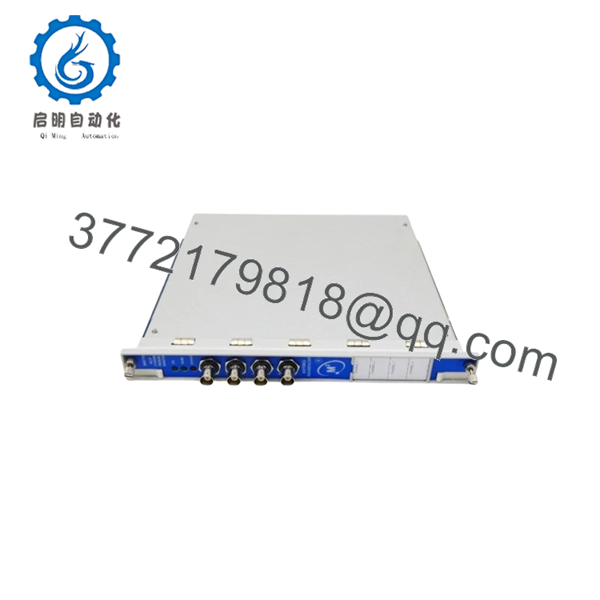
The 3500/77M is a dedicated four-channel monitor developed specifically for reciprocating compressors. It acquires dynamic cylinder pressure signals and converts them into both protection and performance measurements for machinery diagnostics.
4. Product Introduction
The Bently Nevada 3500/77M is a specialized monitor for reciprocating compressor cylinder pressure within the 3500 Machinery Protection System. Unlike general vibration monitors, this module analyzes dynamic pressure waveforms to evaluate compressor performance, loading, and mechanical condition.
Its value lies in combining machinery protection with compressor diagnostics. When integrated with System 1 software and approved pressure transducers, it calculates pressure-based operating parameters that help maintenance teams identify valve leakage, rod loading issues, and thermodynamic performance changes before they become production problems.
5. Installation & Configuration Guide
Stage 1 – Pre-Installation Preparation (10 Minutes)
⚠️ Safety First
- Notify operations of planned downtime.
- Lock out and tag out electrical power.
- Depressurize the compressor if maintenance involves field transducers.
- Wait five minutes before removing electronic modules.
Tools Required
- Grounded ESD wrist strap
- PH1 screwdriver
- Fluke 115 multimeter
- Wire markers
- Laptop with 3500 Configuration Software
- Smartphone for documentation
Data Backup
- Save the complete rack configuration.
- Record channel assignments.
- Document alarm setpoints.
- Photograph rear wiring.
- Record firmware revision.
Stage 2 – Removing the Existing Module (5 Minutes)
- Remove the front module.
- Label all field wiring.
- Remove the I/O module if replacement requires it.
- Inspect the rack connector for bent pins or contamination.
⚠️ Retain the original module until the replacement passes all operational tests.
Stage 3 – Installing the New Module (10 Minutes)
- Connect your ESD strap.
- Verify the replacement is the correct 3500/77M option code.
- Install the monitor into the rack until fully seated.
- Install the matching I/O module.
- Reconnect all pressure transducer wiring.
- Tighten all terminal screws securely.
Configuration Checklist
- ☑ Correct module installed
- ☑ Correct I/O module
- ☑ Channel assignments verified
- ☑ Alarm settings restored
- ☑ Rack recognizes module
Stage 4 – Power-Up & Functional Testing (15 Minutes)
Pre-Power Inspection
- Verify rack supply voltage.
- Check field wiring continuity.
- Confirm no short circuits exist.
Power-Up
- Energize the rack.
- Confirm the module completes self-diagnostics.
- Connect 3500 Configuration Software.
- Verify communication with the TDI.
- Confirm all four pressure channels respond.
- Compare live pressure values with expected compressor conditions.
- Verify alert and danger alarms.
⚠️ Troubleshooting
- A module reporting communication faults should first be checked for firmware compatibility and rack configuration.
- Unstable pressure readings usually indicate incorrect transducer installation, damaged cabling, or an incompatible pressure sensor.
- If one cylinder consistently reports abnormal values while others appear normal, inspect the field transducer before replacing the monitor.

- 3500/77
- 3500/77
Common Replacement Pitfalls
❗ Firmware Compatibility
Although the 3500 platform stores configuration redundantly, replacement modules should still be checked for firmware compatibility with the existing rack. Mixing revisions can complicate commissioning.
❗ Incorrect Pressure Transducers
I’ve seen technicians install standard industrial pressure transmitters instead of approved dynamic cylinder pressure sensors. The monitor powered up normally but couldn’t generate valid compressor measurements because the sensor characteristics were wrong.
❗ Channel Assignment Errors
Cylinder numbering matters. Swapping Channel 2 and Channel 3 may not trigger a fault, but it can lead engineers to diagnose the wrong compressor cylinder.
❗ Wiring Documentation
Always photograph terminal wiring before removal. Even experienced technicians occasionally transpose pressure inputs during shutdown work.
❗ ESD Protection
The monitor contains sensitive digital electronics. Handle both the monitor and I/O module only while wearing a grounded wrist strap.
Keep these checks in mind and you’ll eliminate most commissioning delays before startup.
6. Frequently Asked Questions (FAQ)
Q1. What is the primary application of the 3500/77M?
It is designed specifically for reciprocating compressors. The monitor analyzes dynamic cylinder pressure signals to support machinery protection and compressor performance diagnostics.
Q2. Can this monitor replace a standard vibration monitor?
No. The 3500/77M is dedicated to cylinder pressure measurements. Radial vibration, thrust position, and velocity monitoring require other 3500 monitor types such as the 3500/40M or 3500/42M.
Q3. Is the module hot-swappable?
The 3500 platform supports hot insertion of monitor modules under defined conditions, but the associated I/O module is not hot-swappable. For planned maintenance, many plants still schedule a controlled shutdown to minimize risk.
Q4. Which pressure transducers should be used?
The monitor is intended to work with the Bently Nevada 165855 approved cylinder pressure transducer. Using non-approved sensors can result in inaccurate measurements and unavailable calculated variables.
Q5. Is the 3500/77M still available?
Yes. Although many systems remain in service worldwide, availability often comes from New Original (New Surplus) inventory or certified refurbished stock rather than current production. Confirm the option code before ordering.
Q6. Will replacing the monitor erase configuration data?
The 3500 system stores configuration information in redundant non-volatile memory, but you should always export the rack configuration before replacing any module. This provides a verified recovery point if commissioning issues arise.
Q7. What quality inspections should be completed before shipment?
A professional quality process should include:
- OEM serial number verification
- Anti-counterfeit inspection
- Visual inspection for corrosion, scratches, or repair marks
- Functional testing in a genuine Bently Nevada 3500 rack
- Verification of all four pressure channels
- Communication testing with the TDI
- Firmware documentation
- QC sign-off
- ESD-safe packaging
- Heavy-duty export packaging
Test reports, rack power-up photographs, and functional test videos should be available upon request.