 WhatsApp: +86 16626708626
 Email:
  Phone: +86 16626708626
Description
Key Technical Specifications
| Parameter | Technical Specification |
| Model Number | 1900/27 (1900/27-01) |
| Compatible Transducers | Trendmaster 2000 accelerometers (Bently Nevada 200150, 190520) |
| Input Sensitivity | 100 mV/g nominal |
| Full-Scale Range | 0 to 2.0 in/s (0 to 50.8 mm/s) peak velocity |
| Frequency Response | 8 Hz to 4 kHz (−3 dB at 8 Hz) |
| Power Options | AC/HDC: 85–264 VAC / 110–370 VDC or Low DC: +18 to +36 VDC |
| Analog Output | 4–20 mA DC proportional to full scale (500 Ω max load) |
| Buffered Output | 500 mV/in/s (19.7 mV/mm/s) raw signal |
| Relay Outputs | Two SPDT relays (Alert & Danger), 6 A @ 300 VAC / 28 VDC |
| Local Display | Digital LCD for velocity readout and setpoint verification |
| Operating Temperature | −20°C to +70°C (−4°F to +158°F) |
| Physical Dimensions | 132 mm x 132 mm x 71.1 mm (5.20 in x 5.20 in x 2.80 in) |
Product Introduction & Supply Chain Strategy
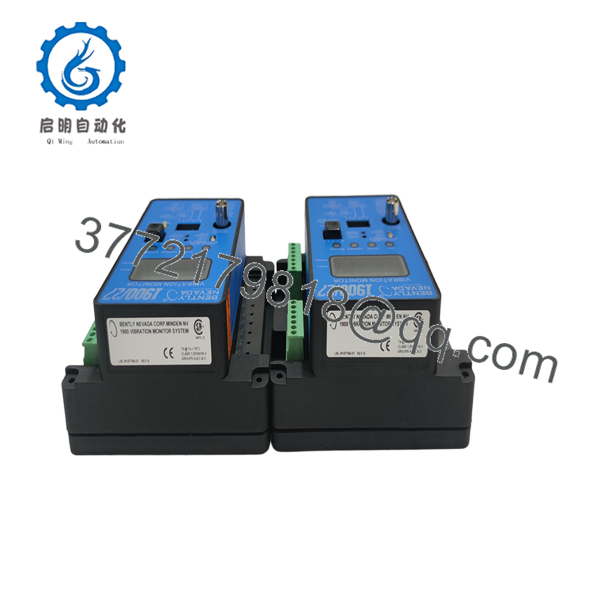
The Bently Nevada 1900/27 is a single-channel, locally mounted vibration monitor that processes accelerometer inputs into peak velocity readings for essential rotating machinery. It provides local digital display, 4–20 mA plant DCS integration, and dual alarm relay contacts for automated shutdown circuits.
Sourcing this unit as New Surplus preserves critical machinery protection on mature production lines without re-engineering panels. Refurbished vibration modules often suffer from degraded internal power supplies and drifted relay calibration points, leading to false trips or missed alarm conditions. Holding a verified New Surplus unit ensures OEM-grade signal accuracy, lowers Total Cost of Ownership (TCO), and prevents catastrophic mechanical failures.
Installation & Configuration Guide
Stage 1: Pre-Installation (Prep & Safety)
- Perform Lock-Out/Tag-Out (LOTO) on field power feeds and isolate the machine trip circuit.
- Put on an anti-static wrist strap grounded to the enclosure frame.
- Photograph internal DIP switch settings and terminal strip wiring layout on the existing 1900/27 unit.
Stage 2: Removal
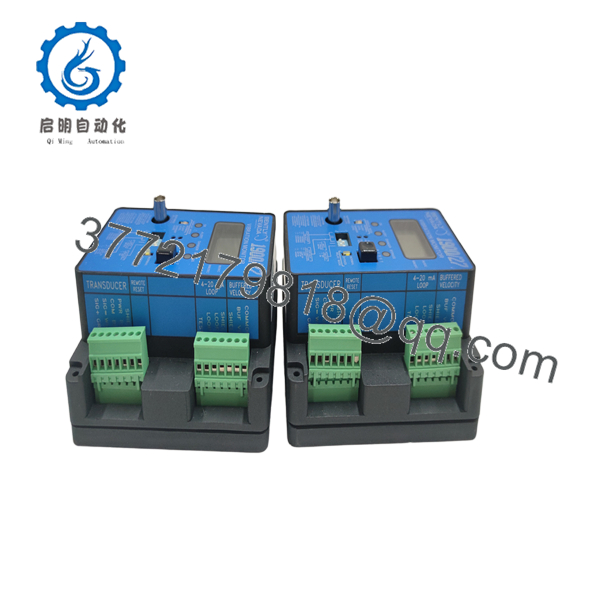
- Unplug the terminal block wiring connectors from the back of the monitor housing.
- Loosen panel mounting screws and slide the monitor out of its enclosure or panel cutout.
- Inspect field wiring for insulation tears or loose shield drain wire grounding.
Stage 3: Installation (Clone & Seat)
- Configure the DIP switches and jumpers on the new 1900/27 to match the original unit (relay logic, reset mode, and full-scale range).
- Insert the monitor into the panel cutout and tighten mounting hardware to 0.8 Nm (7 in-lb).
- Reattach the terminal block connectors, verifying correct polarity on transducer, relay, and 4–20 mA connections.
Stage 4: Power-On & Testing
- Measure incoming power lines to confirm voltage matches the option card (85–264 VAC or 24 VDC).
- Apply power and verify the front-panel green OK LED lights continuously.
- Inject a known 100 mV/g test signal at the transducer input to verify display velocity accuracy and 4–20 mA loop scaling.

- 1900/27
- 1900/27
Firmware/Software Versions & Upgrade Notes
The Bently Nevada 1900/27 monitor operates on dedicated hardware signal conditioning and internal analog-to-digital circuitry without user-flashed firmware.
- Hardware Compatibility: Designed to interface directly with Bently Nevada 200150 and 190520 accelerometers or Velomitor systems.
- System Integration: Compatible with Trendmaster 2000 diagnostic networks when used with the optional Rack Buffered Output Transducer Interface Module (TIM).
- Configuration Caution: Changing internal jumper links (such as latching vs. non-latching relays or normally energized vs. de-energized states) alters machine shutdown behavior instantly. Always document jumper layouts before placing the unit into automatic trip service.
Frequently Asked Questions (FAQ)
1. Is this Bently Nevada 1900/27 unit brand new or refurbished?
This product is a Brand New Surplus unit. It is not used, not pulled from a decommissioned plant, and not refurbished. All modules undergo rigorous quality verification to ensure original OEM-level performance.
2. Why should I buy New Surplus over a cheaper refurbished unit?
Refurbished vibration monitors frequently exhibit hidden component aging, such as dried-out electrolytic capacitors or fatigued relay contacts. In a machinery protection application, a failed relay or inaccurate vibration reading can cause thousands of dollars in unmonitored equipment damage or unnecessary plant outages. Buying New Surplus guarantees zero operating hours and original factory reliability.
3. What is the current lifecycle status of the 1900/27 monitor?
The Bently Nevada 1900/27 is a legacy single-channel monitor. Because OEM factory support has transitioned toward newer multi-channel platforms like the 2300 series, maintaining 1–2 New Surplus 1900/27 units in plant inventory is critical to avoid costly panel redesigns.
4. Can I connect the buffered output to a dynamic signal analyzer?
Yes. The front/rear buffered transducer output provides an unconditioned raw velocity signal (500 mV/in/s). You can connect portable vibration analyzers directly to this terminal without disturbing the continuous 4–20 mA DCS monitoring loop or machine trip relays.
5. What warranty is provided with this New Surplus 1900/27 monitor?
Every New Surplus 1900/27 unit includes a full 12-month replacement warranty. Units ship in ESD-protective packaging complete with individual functional quality inspection sign-offs.