 WhatsApp: +86 16626708626
 Email:
 Phone: +86 16626708626
Description
Core Product Summary
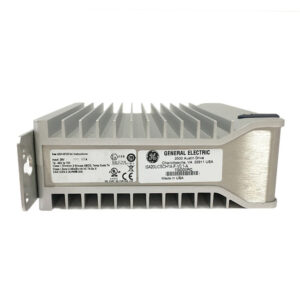
The Bently Nevada 230020-RU identifies a 2300/20 vibration monitor configured with the -RU Russia hazardous-area approval ordering option. It is a stand-alone member of the Bently Nevada 2300 Series, intended for continuous vibration monitoring and high-vibration alarming on medium- to low-criticality machinery.
The 2300/20 provides two configurable acceleration, velocity, or proximity measurement inputs, a dedicated speed/Keyphasor input, two programmable relay outputs, three buffered transducer outputs, and two internally powered 4-20 mA outputs. Configuration and data access use 10/100 Base-T Ethernet, with Modbus over Ethernet available for integration with DCS, SCADA, PLC, or System 1 environments. The -RU option covers EAC Ex hazardous-area requirements for installation in Russia.
Key Technical Specifications
| Parameter | Specification |
|---|---|
| Product family | Bently Nevada 2300 Series Vibration Monitors |
| Model function | 2300/20 continuous vibration monitor with 4-20 mA outputs |
| Measurement inputs | Two configurable acceleration, velocity, or proximity channels |
| Speed input | One dedicated speed/Keyphasor channel |
| Supported speed sensors | Proximity probes, magnetic pickups, and proximity switches |
| Analog outputs | Two 4-20 mA outputs with internal current-loop power supply |
| Relay outputs | Two dry-contact, single-pole double-throw relays with programmable setpoints |
| Buffered outputs | Three BNC buffered outputs: two vibration and one speed/Keyphasor |
| Communications | Ethernet 10Base-T/100Base-TX; Modbus over Ethernet |
| Configuration software | Bently Nevada Monitor Configuration (BNMC) software |
| DC power input | 18 to 36 VDC, maximum 7.5 W |
| Operating temperature | -30 °C to +65 °C |
| Storage temperature | -40 °C to +85 °C |
| Humidity | Up to 95%, non-condensing |
| Dimensions | 127 mm × 127 mm × 76.2 mm (W × D × H) |
| Weight | 1.03 kg |
| Mounting | Panel mount or DIN rail; DIN-rail adapter included |
| Approval option | -RU: Russia hazardous-area option covering EAC Ex requirements |
Detailed Product Overview
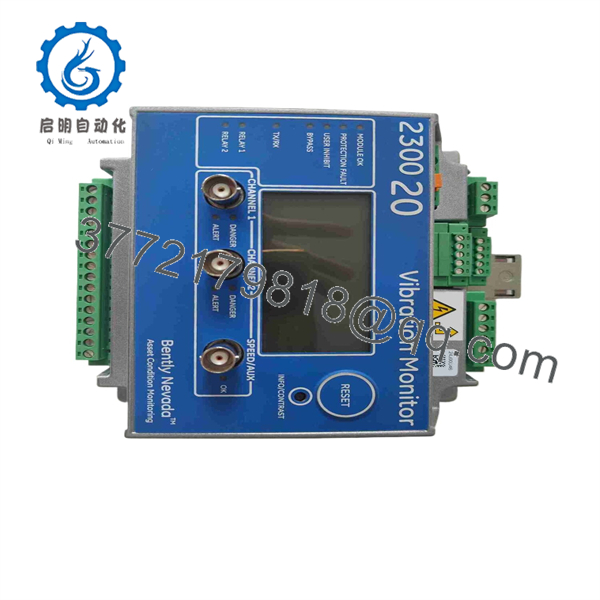
The Bently Nevada 230020-RU is the -RU approval configuration of the 2300/20 vibration monitor, a self-contained instrument in the 2300 Series. Unlike rack-based machinery protection systems, the 2300/20 combines sensing interfaces, signal processing, local indication, relay outputs, analog outputs, and Ethernet communications in one enclosure. This makes it appropriate for monitoring individual machines or small machine groups where a full rack system is not required.
Each of the two main input channels can be configured for acceleration, velocity, or displacement/proximity measurement. The monitor provides independent 24-bit ADC conversion and supports key measurements including acceleration peak or RMS, velocity peak or RMS, displacement peak-to-peak or RMS, and speed. In addition to the primary measurement group, each channel supports two bandpass measurements, enabling narrower frequency-band evaluation where required by the monitoring strategy.
The 2300/20’s two 4-20 mA outputs distinguish it from the 2300/25. Each output is software-configurable and proportional to the full scale of its assigned measurement. Because the monitor supplies the current loop internally, the outputs are intended for passive receiver loads; an externally powered loop is not supported. The output compliance range is 0 to +12 VDC across a load resistance of 0 to 600 Ω.
For local protection, the monitor provides two dry-contact SPDT relays. Their setpoints and logic are configured through Bently Nevada Monitor Configuration software, and relay status is indicated on the front panel. Three buffered outputs—two vibration channels and one speed/Keyphasor channel—are available through BNC connectors for portable analyzers, diagnostic equipment, or other monitoring devices.
Integration is performed over 10/100 Base-T Ethernet. The monitor supports Modbus over Ethernet, allowing selected static variables, statuses, event information, and time/date data to be exchanged with compatible control and supervisory systems. Configuration is performed with BNMC software, and the instrument includes an LCD and status LEDs for local review of measurements, setpoints, and operating condition.
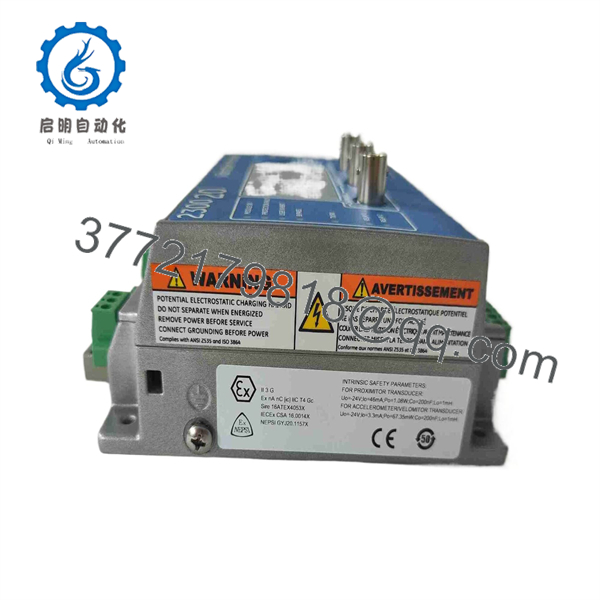
The -RU designation is a country-specific hazardous-area approval option for Russia. It covers EAC Ex requirements and includes applicable ATEX/IECEx hazardous-area markings and ratings on the product. Selection of this option should match the final installation country and hazardous-area classification requirements.
Engineering Selection Highlights
- The 2300/20 accepts two configurable seismic or proximity inputs, so sensor type and scale factor must match the installed accelerometer, Velomitor, or Proximitor system.
- Its dedicated speed/Keyphasor channel supports proximity probes, magnetic pickups, and proximity switches, allowing speed-based measurements and time-synchronous functionality.
- Two internally powered 4-20 mA outputs provide process-variable signals to a DCS or PLC; they do not operate with an externally powered current loop.
- Two programmable SPDT relays provide local alarm or protection actions, with setpoints configured in software.
- Ethernet with Modbus over Ethernet supports configuration and integration without requiring a separate communication gateway.
- The -RU suffix denotes the Russia hazardous-area approval option, which covers EAC Ex requirements rather than the standard no-approval or multi-approval configurations.
- The monitor requires 18 to 36 VDC power and is supplied with a DIN-rail mounting adapter; panel mounting is also supported.
2300/20-RU
System Compatibility & Integration Requirements
| Item / Dependency | Verified Compatibility or Requirement | Practical Note |
|---|---|---|
| Monitor series | Bently Nevada 2300 Series | The 2300/20 is the version with two 4-20 mA outputs; the 2300/25 uses a Trendmaster SPA interface. |
| Vibration sensors | Accelerometers, Velomitor sensors, and Proximitor-type proximity systems | Input channels are configurable for the connected transducer type and scale factor. |
| Speed sensors | Proximity probes, magnetic pickups, and proximity switches | The dedicated speed/Keyphasor channel supports these input types. |
| Control-system interface | Modbus over Ethernet | Suitable for integration with DCS, SCADA, PLC, or System 1 software environments. |
| Configuration tool | Bently Nevada Monitor Configuration software | Ethernet configuration uses BNMC software. |
| Power supply | 18 to 36 VDC, maximum 7.5 W | A separate 24 VDC power supply is required for operation. |
| Current-loop outputs | Internal loop power supply | The two 4-20 mA outputs must not be connected to an externally powered loop. |
| Mounting | Panel mount or DIN rail | A DIN-rail mount assembly is included with the monitor. |
Dimensions, Mounting & Connection Notes
The 2300/20 measures 127 mm wide × 127 mm deep × 76.2 mm high and weighs 1.03 kg. It can be panel mounted or installed on a 35 mm DIN rail using the included mounting assembly.
Transducer connections use a 16-pin input connector; relay outputs use a 6-pin connector; the 4-20 mA output interface uses a 10-pin connector; power input uses a 3-pin connector. Contact-input functions use separate 5-pin connectors. Buffered vibration and speed/Keyphasor signals are provided through BNC connectors, while Ethernet uses an RJ-45 interface with a maximum supported cable length of 100 m.
The monitor is rated for operation from -30 °C to +65 °C, storage from -40 °C to +85 °C, and non-condensing humidity up to 95%. Its vibration limitation is 3 g.
Applications & System Role
The Bently Nevada 2300/20-RU functions as a compact, stand-alone machinery protection and condition-monitoring node. It continuously processes vibration signals from accelerometers, velocity sensors, or proximity transducers and compares configured measurement values against alert and danger thresholds.
Its two 4-20 mA outputs can transmit selected measured variables to a plant control system, while its relays can initiate local alarm or protective actions. The speed/Keyphasor channel supports rotational-speed measurement and time-synchronous vibration functions. This makes the monitor suitable for machine trains or individual casings where the number of monitored points matches its two vibration channels and one speed channel.
FAQ
What is the Bently Nevada 230020-RU?
It is a Bently Nevada 2300/20 vibration monitor supplied with the -RU Russia hazardous-area approval ordering option. It continuously monitors machinery vibration and provides alarm, relay, analog-output, and Ethernet communication functions.
Which Bently Nevada series does it belong to?
It belongs to the Bently Nevada 2300 Series of stand-alone vibration monitors.
What inputs does the 2300/20 accept?
It accepts two configurable acceleration, velocity, or proximity measurement inputs and one dedicated speed/Keyphasor input.
Which speed sensors are supported?
The speed/Keyphasor channel supports proximity probes, magnetic pickups, and proximity-switch type sensors.
What outputs does the monitor provide?
It provides two programmable relay outputs, two internally powered 4-20 mA outputs, and three BNC buffered outputs for two vibration channels and the speed/Keyphasor signal.
How is the 2300/20 configured and integrated?
Configuration uses Bently Nevada Monitor Configuration software over 10/100 Base-T Ethernet. The monitor also supports Modbus over Ethernet for communication with compatible DCS, SCADA, PLC, or System 1 systems.
What power supply does it require?
The monitor requires 18 to 36 VDC and consumes a maximum of 7.5 W.
What does the -RU suffix mean?
The -RU suffix is the Russia hazardous-area approval option, covering EAC Ex requirements for products installed in Russia.