WhatsApp: +86 16626708626
 Email:
  Phone: +86 16626708626
Description
Key Technical Specifications
- Part Number: 330104-00-06-10-02-00
- Product Family: 3300 XL 8 mm Proximity Probes
- Probe Diameter: 8 mm
- Thread Specification: M10 × 1 metric (fully threaded, unthreaded length = 0 mm)
- Overall Case Length: 60 mm (option “06”)
- Cable Length: 1.0 meter (option “10”)
- Connector Type: Miniature coaxial ClickLoc (option “02”)
- Cable Type: Standard, non–FluidLoc (option “0” in cable-type position)
- Agency Approval: None / general industrial use (option “00”)
- Armor: Armored probe lead (stainless steel flexible armor)
- Probe Tip Material: Polyphenylene sulfide (PPS)
- Probe Case Material: AISI 303/304 stainless steel
- Sealing: Viton® O-ring; suitable for typical oil/gas environment pressures
- Sensitivity (ISF): 7.87 V/mm (200 mV/mil) ±5% with 3300 XL Proximitor
- Linear Range: ~2.0 mm (80 mils) usable range
- Recommended Gap Setting: ~1.27 mm (50 mils) nominal
- Frequency Response: 0 to 10 kHz (typical for 3300 XL 8 mm probes)
- Operating Temperature (Probe): -51 °C to +177 °C (-60 °F to +350 °F)
- Supply Voltage (at Proximitor): -17.5 to -26 Vdc (nominal -24 Vdc)
- Compliance: Designed for API 670 machinery protection systems
Product Introduction
The Bently Nevada 330104-00-06-10-02-00 is an 8 mm armored proximity probe from the 3300 XL family, used for non-contact measurement of shaft relative vibration, axial position, and keyphasor on fluid-film bearing machines. It generates a DC voltage proportional to the gap between the probe tip and the shaft, which is then conditioned by a 3300 XL Proximitor (e.g., 330180, 330780) for use in 3300/3500 racks or third-party condition monitoring systems.
This exact suffix combination (00-06-10-02-00) is common in legacy turbine, compressor, and pump trains where engineers need a direct, mechanical replacement for an existing 60 mm M10×1 probe with a 1 m ClickLoc cable. The electrical characteristics match the 3300 XL standard (200 mV/mil, 0–10 kHz), so it swaps in without recalibrating the monitoring system, provided the proximitor and rack configuration are unchanged.
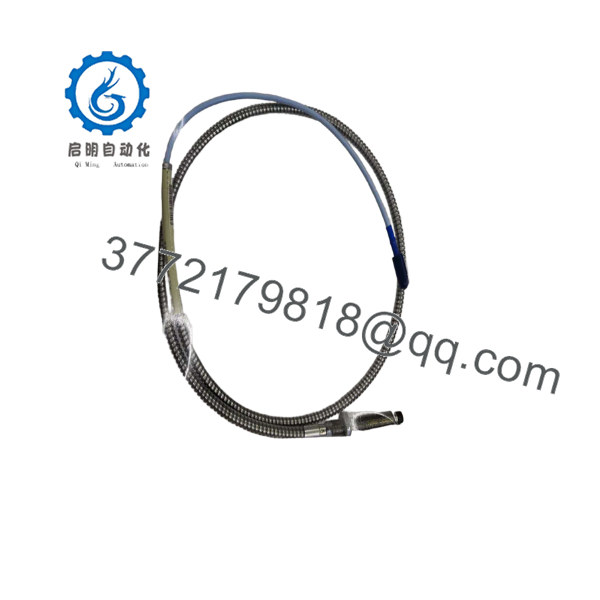
330104-00-06-10-02-00
Troubleshooting Quick Reference
| Symptom | Possible Cause | Relevance to this Part | Quick Check Method | Recommendation |
|---|---|---|---|---|
| Vibration reading stuck at 0 or rail | Probe open/short, broken cable, or no -24 Vdc at proximitor | ✅ High | Measure DC resistance probe-to-connector (typical ~5–10 Ω for coil); check -24 Vdc at proximitor input | If resistance is infinite or zero, suspect probe or cable; replace probe assembly |
| Vibration noisy, erratic spikes | Loose probe, poor grounding, or damaged armor/cable | ✅ Medium-High | Inspect probe mounting torque, check armor continuity to ground, wiggle cable while watching reading | Re-torque probe per OEM spec, fix grounding; if noise follows the probe when moved, replace it |
| Gap voltage out of range (e.g., < -5 V or > -15 V) | Wrong gap setting, bent probe, or wrong probe type for proximitor | ✅ High | Measure gap voltage at proximitor; compare with expected ~-10 Vdc at 50 mil gap | Adjust mechanical gap; if still out of range with correct gap, probe or proximitor may be faulty |
| Keyphasor missing, but vibration OK | Probe OK but not suitable for keyphasor at this speed, or wiring issue | ✅ Medium | Check frequency response and probe-to-target alignment; verify keyphasor channel config | Use a dedicated keyphasor probe if required; check wiring and channel settings before replacing |
| Probe fails insulation test in maintenance | Moisture ingress, damaged O-ring, or cracked PPS tip | ✅ Medium | Perform insulation resistance test (probe body to conductor) per API 670 / OEM procedure | Replace probe if insulation is below spec; do not reinstall leaking probes in hazardous areas |
If you’re unsure, send the gap voltage, vibration trend, and a photo of the probe installation. That usually tells us whether it’s the probe, the proximitor, or the mechanical setup.
Frequently Asked Questions (FAQ)
Q: What does each part of “330104-00-06-10-02-00” mean?
A: In Bently Nevada’s 330104 coding:
- 330104 = 3300 XL 8 mm probe family
- 00 = 0 mm unthreaded length (fully threaded)
- 06 = 60 mm overall case length
- 10 = 1.0 m total cable length
- 02 = Miniature coaxial ClickLoc connector, standard cable
- 00 = No special agency approval (general industrial)
This matches the common “M10×1, 60 mm, 1 m ClickLoc” configuration used in many OEM trains.
Q: Can I use this with a 3300 XL 5 mm system?
A: No. The 330104 is an 8 mm probe and must be paired with 3300 XL 8 mm Proximitor sensors (e.g., 330180-xx, 330780-xx) and 8 mm–configured monitor channels. Mixing 5 mm and 8 mm hardware will give wrong sensitivity and scale factors. Match probe diameter to proximitor and channel configuration.
Q: Is this probe hot-swappable?
A: The probe itself is passive, but you should never disconnect or reconnect proximity probes while the machine is running unless your procedure explicitly allows it. Changing probes under load can introduce transient signals that trip alarms or confuse the monitoring system. Plan probe swaps during shutdowns or controlled coast-downs whenever possible.
Q: Do I need to recalibrate my 3300/3500 system when replacing this probe?
A: In most cases, no. All 3300 XL 8 mm probes share the same nominal sensitivity (200 mV/mil) and frequency response. As long as you install the new probe at the same mechanical gap and the proximitor is configured for 8 mm/200 mV/mil, the vibration scale should remain valid. Always verify gap voltage and perform a bump test if your procedure requires it.
Q: Why is this listed as “New Surplus” instead of factory new?
A: The 3300 XL platform is mature and many specific suffixes like -00-06-10-02-00 are no longer actively stocked by all distributors. What’s available is often new surplus from project overruns or decommissioned trains. These units are factory original, never installed, and typically still in original packaging or anti-static bags.
Q: What warranty do you offer on the 330104-00-06-10-02-00?
A: Standard warranty is 1 year from shipment against manufacturing defects and functional failure under normal industrial use. If the probe fails within that period and shows no signs of misuse (over-torque, crushed armor, chemical attack, ESD damage), we replace it or refund, your choice.
Q: How do you verify these before shipping?
A: Each probe gets a visual inspection (armor, connector, O-ring, tip), a resistance check across the coil, and an insulation resistance check probe-body to conductor. We also verify the part number and suffix against the label and packing. Full test reports with photos are available on request for critical applications.