WhatsApp: +86 16626708626
 Email:
 Phone: +86 16626708626
Description
Core Product Summary
The Berghof QAIO 16/4-V is a compact analog input/output extension module for Moog MSC and MSC II servo controllers and associated Fico AMS-W automation systems. It adds 16 differential analog voltage inputs, four ±10 V analog voltage outputs, and one short-circuit-protected +10 V reference-voltage output.
The module connects directly to an MSC or MSC II controller through the internal extension bus (E-bus) and is configured through the Moog Axis Control Software (MACS) environment. It mounts on a 35 mm DIN top-hat rail and uses plug-in three-conductor terminal strips for field wiring. The QAIO 16/4-V order number is D137-001-007; the related QAIO 16/4-A current-input variant uses order number D137-001-006.
Key Technical Specifications
| Parameter | Specification |
|---|---|
| Product type | Analog I/O extension module |
| Model designation | QAIO 16/4-V |
| Order number | D137-001-007 |
| Analog inputs | 16 differential voltage inputs |
| Input measurement range | ±10 V |
| Input resolution | 12-bit, multiplexed conversion |
| Input impedance | 10 MΩ in the signal range |
| Analog outputs | 4 voltage outputs |
| Output range | ±10 V |
| Output resolution | 11-bit plus sign |
| Maximum output current | 5 mA, with overload protection |
| Reference-voltage output | 1 × +10 V DC, short-circuit protected |
| Controller connection | Internal extension bus (E-bus) |
| E-bus data rate | 5 MHz |
| Electrical isolation | Optically isolated toward the E-bus; no isolation between module supply and analog channels |
| Reverse-polarity protection | Yes |
| Field connection | Plug-in terminal strips for screw or clamp connection; three-conductor front wiring |
| Mounting | NS 35/7.5 DIN top-hat rail according to EN 50022 |
| Status indication | 4 module status LEDs |
| Dimensions, W × H × D | 124 × 170 × 85.5 mm |
| Attachment width | 113 mm or 118.5 mm |
| Operating temperature | 5 °C to 50 °C |
| Ingress protection | IP20 |
| Configuration software | Moog Axis Control Software (MACS) |
Engineering Selection Highlights
- The QAIO 16/4-V provides 16 differential ±10 V inputs, making it suitable for expanding an MSC or MSC II controller where bipolar voltage signals from sensors, command devices, or feedback electronics must be acquired.
- Its four ±10 V outputs are limited to 5 mA each, so they are appropriate for voltage-command signals rather than directly powering actuators or high-current loads.
- The module includes a protected +10 V reference output, which can support signal conditioning or excitation requirements within the documented analog I/O architecture.
- E-bus connection at 5 MHz is a direct controller-extension requirement; the module is intended for local expansion of MSC or MSC II I/O rather than standalone operation.
- The 12-bit multiplexed input architecture should be considered when selecting the module for applications that require high-resolution simultaneous sampling across all 16 channels.
- Optical isolation is provided toward the E-bus, but the analog channels and module energy supply are not isolated from each other; grounding and signal-reference planning must account for this boundary.
- The related QAIO 16/4-A variant provides ±20 mA current inputs instead of ±10 V voltage inputs, so the suffix must be matched to the field-signal type.
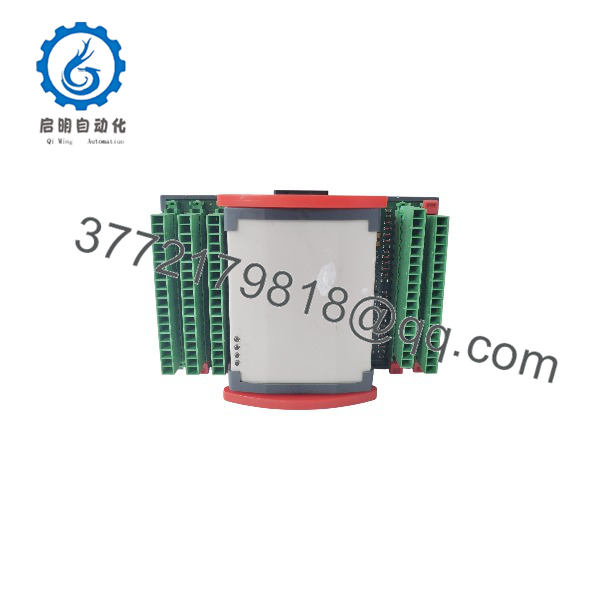
QAIO 16/4-V
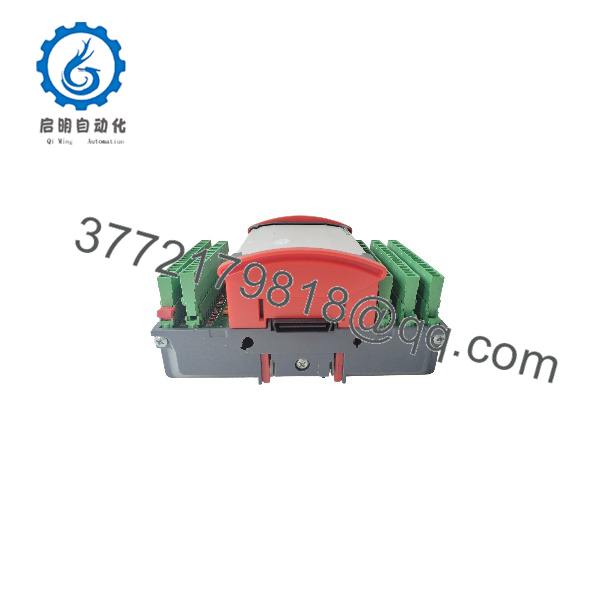
QAIO 16/4-V
System Compatibility & Integration Requirements
| Item / Dependency | Verified Compatibility or Requirement | Practical Note |
|---|---|---|
| Host controller | Moog MSC or MSC II servo controller | The module performs local analog I/O extension for these controllers. |
| System context | Fico AMS-W automation system | The QAIO 16/4-V is listed for use with Fico AMS-W. |
| Controller connection | Internal extension bus (E-bus), 5 MHz | Direct connection to the MSC or MSC II is required. |
| Extension capacity | Up to seven extension modules, such as QAIO or QDIO | The controller’s extension-bus architecture supports multiple local I/O extension modules. |
| Configuration | Moog Axis Control Software (MACS) | Analog I/O is configured through the central controller configuration in MACS. |
| Field wiring | Three-conductor front wiring with plug-in screw or clamp terminals | Terminal strips are removable for installation and maintenance. |
| Mounting | NS 35/7.5 DIN top-hat rail, EN 50022 | The module is designed for cabinet mounting on standard DIN rail. |
Dimensions, Mounting & Connection Notes
| Item | Specification |
|---|---|
| Dimensions | 124 mm wide × 170 mm high × 85.5 mm deep |
| Attachment width | 113 mm or 118.5 mm |
| Mounting method | NS 35/7.5 DIN top-hat rail according to EN 50022 |
| Field terminals | Plug-in terminal strips, screw or clamp connection |
| Wiring style | Three-conductor front wiring |
| Status indicators | Four front-panel LEDs for module status and diagnostics |
| Environmental limits | 5 °C to 50 °C operating temperature; IP20 enclosure protection |
Detailed Product Overview
The Berghof QAIO 16/4-V is an analog extension module used to add local input and output capacity to Moog MSC and MSC II servo controllers. It connects through the controllers’ internal E-bus, which operates at 5 MHz, and can be used alongside other extension modules within the controller’s supported local I/O architecture.
The voltage-input version provides 16 differential channels with a ±10 V measurement range. Input channels are converted in multiplex operation at 12-bit resolution, and the signal-area input impedance is 10 MΩ. Differential inputs are appropriate where the measured signal is referenced to its own signal return rather than relying on a single-ended measurement arrangement.
On the output side, the module provides four ±10 V voltage channels with 11-bit resolution plus sign. Each output is protected against overload and is limited to 5 mA, so the outputs are intended for low-current analog command or reference signals. A separate +10 V reference-voltage output is short-circuit protected and can be used within the documented analog signal architecture.
Configuration is performed in software through Moog Axis Control Software (MACS). The module’s four front-panel LEDs report status and diagnostic conditions, supporting commissioning and fault isolation at the cabinet level.
Installation uses a standard NS 35/7.5 DIN top-hat rail. Field signals connect through removable three-conductor terminal strips, available in screw or clamp versions. The module electronics receive power through internal DC/DC converters, and the E-bus interface is optically isolated. The analog channels and module energy supply, however, are not isolated from one another, which is an important consideration for grounding, shielding, and signal-reference design.
The QAIO 16/4-V is distinguished from the related QAIO 16/4-A by its input signal type: the -V version accepts ±10 V voltage signals, while the -A version accepts ±20 mA current signals. Both variants provide the same four ±10 V voltage outputs and +10 V reference output.
Applications & System Role
The QAIO 16/4-V extends the analog I/O capacity of a Moog MSC or MSC II servo controller. In a Fico AMS-W automation architecture, it serves as a local E-bus extension module, acquiring bipolar analog voltage signals and providing analog command outputs under control of the host controller.
Its differential ±10 V inputs are intended for voltage-based measurement and command signals, while the four ±10 V outputs provide controller-generated analog setpoints or control signals. The module’s role is therefore signal expansion at the controller level, rather than standalone data acquisition or actuator power control.
FAQ
What is the Berghof QAIO 16/4-V?
The Berghof QAIO 16/4-V is an analog I/O extension module that adds 16 differential ±10 V voltage inputs and four ±10 V voltage outputs to a Moog MSC or MSC II servo controller.
What is the order number for the QAIO 16/4-V?
The order number is D137-001-007. The related current-input version, QAIO 16/4-A, uses order number D137-001-006.
Which controllers does it connect to?
It connects directly to Moog MSC or MSC II servo controllers through the internal extension bus (E-bus), which operates at 5 MHz.
What analog inputs does the QAIO 16/4-V provide?
It provides 16 differential analog voltage inputs with a ±10 V measurement range, 12-bit resolution in multiplex operation, and 10 MΩ input impedance in the signal range.
What outputs does it provide?
It provides four ±10 V analog voltage outputs with 11-bit resolution plus sign, a 5 mA maximum output current with overload protection, and one short-circuit-protected +10 V reference-voltage output.
How is the module mounted and wired?
The module mounts on an NS 35/7.5 DIN top-hat rail according to EN 50022. Field connections use removable three-conductor plug-in terminal strips with screw or clamp termination.
Which software configures the QAIO 16/4-V?
Analog I/O is configured through the central controller configuration in Moog Axis Control Software (MACS).
What is the difference between QAIO 16/4-V and QAIO 16/4-A?
The QAIO 16/4-V accepts ±10 V voltage inputs, while the QAIO 16/4-A accepts ±20 mA current inputs. Both provide four ±10 V voltage outputs and a +10 V reference output.