WhatsApp: +86 16626708626
 Email:
  Phone: +86 16626708626
Description
Key Technical Specifications
| Parameter | Value |
|---|---|
| Manufacturer | Berkeley Process Control |
| Model | ASM81-B-0/B-00-NB/10 |
| Product Type | AC Brushless Servo Motor |
| Motor Family | ASM81 |
| Rated Speed | 5,000 RPM |
| Torque | 6.6 lb-in |
| Torque, SI Equivalent | Approximately 0.75 N·m |
| Feedback Resolution | 10,000 counts/revolution |
| Sealing Class | IP65 |
| Motor Technology | Brushless AC servo |
| Feedback Type | Encoder-based |
| Primary Application | Industrial/semiconductor motion equipment |
| Manufacturer Status | Discontinued |
| Replacement Basis | Exact mechanical, electrical, and feedback match required |
The 5,000 RPM, 6.6 lb-in torque, and 10,000-count/revolution specifications are independently listed for this Berkeley ASM81-B-0/B-00-NB/10 variant.
Important specification limitation: Publicly indexed sources do not provide enough reliable information to state the winding voltage, rated current, continuous power, shaft dimensions, mounting pattern, connector pinout, or encoder electrical interface for this exact suffix. Those values should be taken from the motor nameplate or original Berkeley Process Control documentation rather than inferred from another ASM81 variant.
Product Introduction
The Berkeley Process Control ASM81-B-0/B-00-NB/10 is an AC brushless servo motor designed for closed-loop industrial motion applications. Available records identify a 5,000 RPM rated speed, 6.6 lb-in torque, 10,000 counts per revolution, and IP65 sealing.
This motor appears frequently in legacy semiconductor-equipment spare-parts inventories, including equipment associated with Berkeley Process Control and related OEM machinery. The exact motor suffix matters: do not substitute another ASM81 variant until its winding, feedback, shaft, mounting, and connector specifications have been verified.
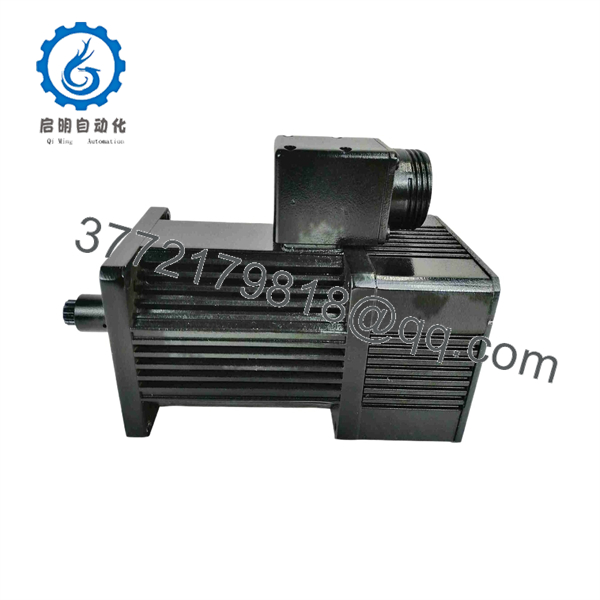
ASM81-B-0/B-00-NB/10
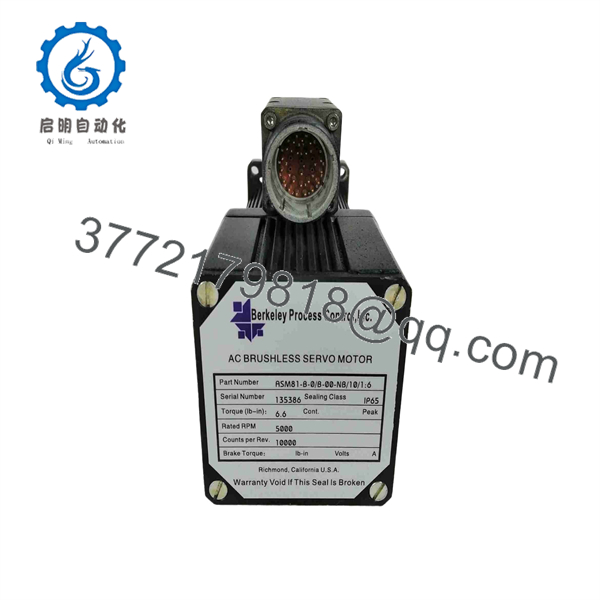
ASM81-B-0/B-00-NB/10
Installation & Configuration Guide
Stage 1: Pre-Installation Preparation — Approximately 10 minutes
⚠️ Safety First: Servo systems can retain hazardous electrical energy after the main disconnect is opened. Put the machine in a safe state, apply lockout/tagout, and follow the equipment manufacturer’s discharge procedure before touching the motor or drive wiring.
- Record the complete motor nameplate.
- Confirm the replacement reads -B-0/B-00-NB/10 rather than only “.”
- Record the connected servo amplifier model.
- Back up the machine’s servo parameters and motion configuration.
- Photograph:
- Motor connector
- Encoder connector
- Cable routing
- Shaft coupling
- Motor mounting orientation
- Nameplate
- Mark motor and encoder cables before disconnecting them.
- Prepare:
- ESD strap
- Appropriate screwdrivers
- Multimeter
- Mechanical alignment tools
- Torque wrench
- Camera/smartphone
❗ Do not order based solely on the family number. Berkeley produced multiple configurations. Public records show variants such as -A-0/L-00-LB/10 and -B-0/A-00-NB/10, with different specifications.
Stage 2: Removing the Old Motor — Approximately 10 minutes
- Verify electrical isolation.
- Disconnect the motor power cable only after confirming the drive is safe.
- Disconnect the encoder/feedback cable.
- Label both connectors.
- Remove any brake or auxiliary connection if fitted.
- Remove the mechanical coupling or belt connection.
- Support the motor before removing mounting bolts.
- Remove the mounting hardware.
- Pull the motor straight away from the machine.
- Do not use the shaft as a lifting handle.
- Inspect the coupling, shaft, keyway, mounting face, and cable connectors.
Keep the removed motor until the replacement has completed a full functional test.
Stage 3: Installing the New Motor — Approximately 10 minutes
- Verify the exact suffix: -B-0/B-00-NB/10.
- Compare the replacement motor with the removed unit mechanically.
- Verify mounting-hole spacing and shaft dimensions before bolting it into the machine.
- Check that the shaft and coupling are compatible.
- Install the motor without forcing the shaft into alignment.
- Align the coupling according to the machine OEM’s specified tolerance.
- Tighten mounting bolts to the machine manufacturer’s specified torque.
- Reconnect the motor power cable.
- Reconnect the encoder cable.
- Verify cable shielding and grounding.
- Make sure motor and encoder cables are separated from high-current switching cables where the machine wiring standard requires it.
Self-check:
- Exact motor suffix verified
- 5,000 RPM requirement confirmed
- 6.6 lb-in torque requirement confirmed
- Encoder compatibility verified
- Shaft dimensions verified
- Mounting pattern verified
- Coupling aligned
- Power cable secured
- Feedback cable secured
Stage 4: Power-On & Testing — Approximately 10 minutes
- Do not immediately command full-speed motion.
- Power the servo system according to the OEM startup sequence.
- Check the servo amplifier for encoder or motor alarms.
- Verify that the encoder feedback is detected.
- Confirm the motor’s direction at low speed.
- Run a low-speed jog test.
- Check following error and position feedback.
- Increase speed gradually.
- Test acceleration and deceleration.
- Run the machine through a controlled production cycle.
⚠️ Do not change servo-drive motor parameters simply because the replacement motor physically fits. Motor identification parameters, encoder scaling, commutation data, and current limits belong to the specific motor/drive combination.
Technical Pitfalls — What Usually Causes Rework
❗ 1. Confusing similar variants
This is the biggest procurement risk. Public listings show several variants with different suffixes. A motor that looks identical externally can have different winding or feedback characteristics.
❗ 2. Encoder mismatch
The listed 10,000 counts/revolution specification is important. Do not assume that another encoder-equipped motor with the same mechanical frame will produce the same feedback signal or scaling.
❗ 3. Incorrect coupling alignment
A servo motor can reach 5,000 RPM. Poor coupling alignment that seems acceptable during a hand check can become a vibration or bearing problem at operating speed.
❗ 4. Assuming torque and speed tell the whole story
6.6 lb-in at 5,000 RPM gives only a partial picture of motor suitability. Drive voltage, current, continuous torque, peak torque, thermal limits, feedback characteristics, and mechanical dimensions also matter.
❗ 5. Treating an obsolete motor as a generic replacement
The exact Berkeley suffix should be matched before procurement. Radwell currently identifies this variant as discontinued by the manufacturer.
Quality-Control Inspection for Replacement Stock
For this type of legacy servo motor, a meaningful supplier QC procedure should include:
- Inbound inspection: Verify nameplate, exact suffix, housing condition, shaft, mounting face, connectors, and cable exits.
- Mechanical inspection: Check shaft rotation, bearing condition, coupling interface, and mounting holes.
- Electrical inspection: Perform appropriate winding and insulation checks using test limits applicable to the motor.
- Feedback inspection: Verify encoder output with compatible test equipment or the intended servo amplifier.
- Functional test: Run the motor at controlled speed and verify feedback, direction, and abnormal vibration.
- Final QC: Record serial number, test date, equipment used, and test results.
Public secondary-market listings show this exact model being offered as used and surplus inventory, while Radwell lists surplus and repair options and identifies the manufacturer status as discontinued.
Frequently Asked Questions (FAQ)
1. What is the ley /B-00-NB/10?
It is a Berkeley Process Control AC brushless servo motor. Public technical listings identify the variant with a 5,000 RPM rated speed, 6.6 lb-in torque, 10,000 counts per revolution, and IP65 sealing.
2. Is -B-0B-00-NB10 the same part number?
The slashless designation -B-0B-00-NB10 appears to be a normalized version of the documented /B-00-NB/10 designation. Multiple spare-parts records use the slash-form part number. For purchasing, match the actual nameplate and photographs rather than relying on punctuation normalization.
3. What is the motor speed?
The published specification for /B-00-NB/10 is 5,000 RPM.
4. What is the motor torque?
The listed torque is 6.6 lb-in, approximately 0.75 N·m. Do not use this value alone to select a replacement; continuous and peak operating requirements should also be checked against the original machine specification.
5. Does the motor have an encoder?
The published listing specifies 10,000 counts per revolution, indicating position feedback associated with the servo motor. The exact encoder electrical interface and signal format should be verified from the motor documentation or nameplate before connecting it to a replacement amplifier.
Is /B-00-NB/10 obsolete?
Yes. Radwell identifies the model as discontinued by the manufacturer. Legacy inventory remains available through secondary-market suppliers, but condition varies between surplus and used units.
7. What should I verify before buying this motor?
At minimum, verify the complete suffix, 5,000 RPM rating, 6.6 lb-in torque, 10,000-count feedback specification, IP65 sealing, shaft and mounting dimensions, connector configuration, and compatible servo amplifier. Ask for photographs of the actual nameplate and connector ends. For a critical semiconductor-equipment application, also request a functional test report rather than accepting a visual inspection alone.