WhatsApp: +86 16626708626
 Email:
 Phone: +86 16626708626
Description
Key Technical Specifications
| Parameter | Value |
|---|---|
| Motor type | Digital synchronous AC servo motor, 3-phase, permanent magnet, brushless |
| Motor size / length code | 071 / B |
| Winding code | 061 |
| Material number | R911261989 |
| Continuous torque at standstill | 8 Nm at natural convection / 12 Nm surface cooled |
| Continuous current at standstill | 11.2 A (convection) / 16.8 A (surface cooled) |
| Peak current | 50.4 A |
| Pole pairs | 4 |
| Rated / Max speed | Up to 4,500–6,000 rpm depending on winding configuration |
| Holding brake | 5 Nm nominal (up to 6.5 Nm listed on some datasheets), 24 V DC ±10%, approx. 0.54 A release current |
| Feedback system | Resolver feedback with integrated multiturn absolute encoder |
| Shaft design | Keyed shaft per DIN 6885-1, with shaft sealing ring |
| Flange size | 115 mm |
| Cooling | Natural convection (surface cooling variants exist in series) |
| Protection rating | IP65 |
| Insulation class | Class F winding |
| Weight | Approx. 8.8–9 kg |
| Drive compatibility | Rexroth IndraDrive, ECOdrive (DKC/DRC), DIAX family controllers |
| Typical applications | Machine tools, printing and paper processing, robotics, packaging |
Verify the brake rating and speed limits against the Rexroth MKD Project Planning Manual for your winding configuration. The 061 winding reaches higher speeds than the 035, but continuous torque above roughly 4,500 rpm drops off — check the torque-speed curve, not just the nameplate.
Product Introduction
The MKD071B-061-KP1-KN is a mid-frame synchronous servo motor from Bosch Rexroth’s Indramat MKD series, built for machine tools, printing presses, robotics, and packaging lines. The 071 frame with the fast 061 winding covers axes that need both 8 Nm-class torque and speeds up to 6,000 rpm in one motor.
The DIN 6885-1 keyed shaft sets this variant apart from the plain-shaft KG units — it drives pulleys, gears, and couplings that rely on positive-locking torque transfer rather than friction clamping. The resolver-plus-multiturn-absolute encoder eliminates homing runs after power loss, and the holding brake locks the axis during e-stops and standby. Running against IndraDrive controllers, this motor outlasts the machines it’s mounted in — which is why plants keep sourcing this discontinued unit rather than redesign the axis.
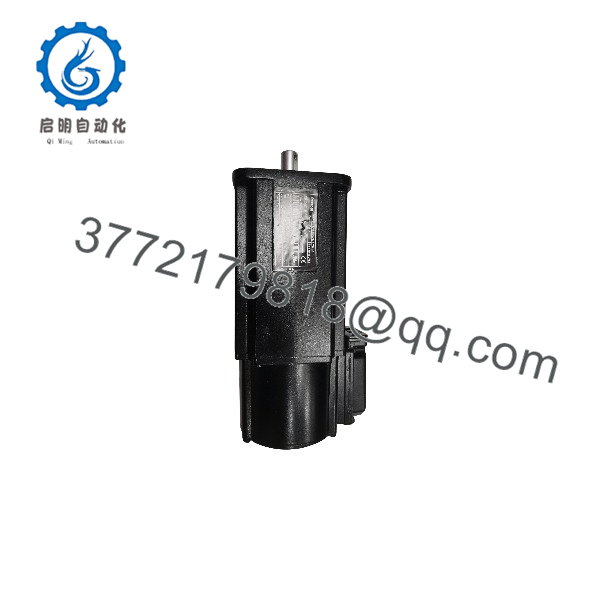
MKD071B-061-KP1-KN
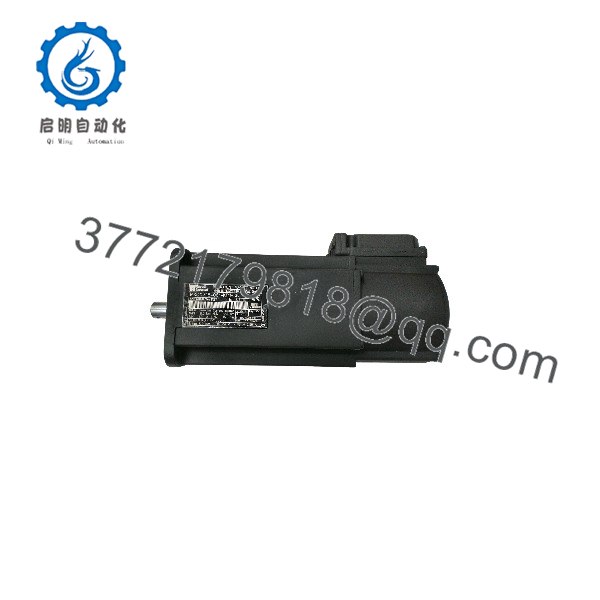
MKD071B-061-KP1-KN
Installation & Configuration Guide
Stage 1: Pre-Installation Preparation (~15 min)
- ⚠️ Safety First: Notify operations of the downtime window. Jog the axis to a serviceable position. The 5 Nm brake cannot hold an oversized vertical load — block the axis mechanically before removing power. Lock out/tag out the drive cabinet, kill the 24 V brake circuit separately, wait 5 minutes for the DC bus capacitors to discharge, then verify the bus reads below 60 V DC with a multimeter.
- Tools Required: Grounded ESD wrist strap, multimeter (Fluke 115 or equivalent), hex key set, torque wrench, dial indicator with magnetic base, cable labels, mechanical load restraint, smartphone for photos.
- Data Backup: In IndraWorks/DriveTop, save the drive’s motor data block and full parameter set. Photograph the connector positions and the keyway orientation relative to the coupling hub. Document which way the key sits — reassembly with the key 180° out is the classic rework generator here.
Stage 2: Removing the Old Motor (~20 min)
- Confirm the drive is in torque-off state, the DC bus is dead, and the mechanical restraint carries the load.
- Disconnect power, feedback, and brake connectors. Label all three. On this frame the feedback and brake connectors sit close together — mixing them up destroys the feedback board at first power-up.
- Remove the key from the shaft and set it aside with the motor. Loosen the coupling; pull the hub, never pry against the motor face.
- Unbolt the flange bolts in a cross pattern and withdraw the motor. At 9 kg this is a two-hand lift; don’t let it swing on the cables.
- Inspect the mounting face and pilot for burrs; check the new motor’s shaft sealing ring and keyway for transit damage.
- ⚠️ Keep the old motor on the bench until the replacement runs clean. Its keyway dimensions and connector clocking are your reference.
Stage 3: Installing the New Motor (~20 min)
- ESD strap on. Verify the nameplate reads MKD071B-061-KP1-KN exactly. KP1 = keyed shaft with brake; a KP0 has no brake, and a KG1 has a plain shaft that won’t accept your existing keyed coupling hub.
- Orient the connectors to match your existing cable entry before bolting the flange. Sorting this out inside a machine frame after mounting costs a half hour.
- Mount the motor, torque flange bolts in a cross pattern to the MKD manual spec. Apply thread-locker.
- Fit the coupling hub and key. Check runout with a dial indicator — keep it under 0.02 mm TIR. A scored keyway or a loose key fit hammers out under reversed torque within weeks.
- Reconnect power, feedback, and brake connectors. Route the brake lead away from the encoder cable.
- Self-Checklist: [ ] Nameplate matches, [ ] Mechanical restraint still in place, [ ] Key seated and hub locked, [ ] Connectors locked and labeled, [ ] Brake lead separated from feedback lead.
Stage 4: Power-On & Testing (~15 min)
- Restore the 24 V brake circuit first; confirm the brake releases (audible click). Then restore cabinet power with the drive disabled.
- Enable the drive. Check the diagnostic block for feedback or phase faults.
- The multiturn absolute encoder should report position immediately — no homing run. If the drive demands homing, do a full power cycle with the feedback connector seated so the drive reads the motor’s data memory.
- Jog at 10% speed. Verify rotation direction, listen for bearing noise, and feel the housing for vibration. A keyed shaft that “ticks” at low speed means hub misalignment or a high key — stop and re-check before continuing.
- Run a slow full-travel move, then a medium-speed move under reduced load. Only then release the axis to production.
- ⚠️ Troubleshooting Note: Encoder fault at power-up means power off fully before reseating the feedback connector — hot-plugging damages the feedback electronics. Rough running usually means two motor phase leads swapped. A knocking noise under load means key or coupling slack; don’t run it in, shut it down and fix it.
Frequently Asked Questions (FAQ)
Q1: Can I hot-swap this motor under power?
No. The IndraDrive DC bus holds lethal voltage well after shutdown, the connectors aren’t rated for disconnect under load, and the brake releases the instant the 24 V circuit drops. On a vertical or overhauling axis, that’s a dropped load. Isolate, verify the bus is below 60 V, block the load mechanically, then disconnect.
Q2: Is this model obsolete? Is what you’re selling genuinely new?
Yes, the MKD series is discontinued — Rexroth’s successors are the MSM and MKS lines. Our stock is New Original / New Surplus: genuine Rexroth production with factory packaging, never placed in service. We verify serial numbers against OEM records as an anti-counterfeit check, inspect for corrosion, rework marks, or UV yellowing, and audit accessories and factory certificates. Photos of the exact unit and serial number are available before you commit.
Q3: What’s the difference between KP1 and KG1 on this frame?
The shaft. KP1 is a keyed shaft per DIN 6885-1 for positive-locking torque transfer — pulleys, gears, keyed couplings. KG1 is a plain shaft for friction-locked clamping sets. They are not interchangeable without changing your coupling hardware. Both carry the holding brake; KP0/KG0 variants have none. Check your existing hub before ordering — this is the single most common wrong-part call we see on the 071 frame.
Q4: Will I lose my position data or program when I swap the motor?
No. The drive stores the motion logic and parameters, not the motor. The multiturn absolute encoder holds position through the feedback connector. One caveat: after the swap, give the drive one complete power cycle with the encoder connected before enabling the axis — it needs to read the new motor’s data memory on that first cycle.
Q5: Why is your price lower than Rexroth’s original list price?
Because Rexroth stopped making it years ago. Our stock comes from OEM spares programs, liquidated projects, and factory overruns. We’re not an authorized Rexroth distributor and say so plainly: the 12-month warranty is ours, not Rexroth’s. You’re trading factory support on a discontinued motor for price and immediate availability — a trade most maintenance managers take without hesitation when the line is down.
Q6: Can I run this motor at its full 8 Nm rating in any enclosure?
No — that figure assumes natural convection with open airflow. Sealed inside a cramped machine cavity, the same motor delivers meaningfully less continuous torque, and the drive’s thermal model won’t flag it until you’re tripping overtemperature faults. If the original installation used surface cooling or a blower, reinstall it. Overtemp faults a few months after a “like-for-like” swap almost always trace back to missing cooling hardware.
Q7: What quality checks do you run before shipping?
Every unit passes inbound inspection (serial verification, anti-counterfeit screening, visual and accessory audit), then a live bench test on a genuine IndraDrive rack: power-up sequence, resolver/encoder handshake, brake release and engage test, insulation resistance check (500 V Megger, >10 MΩ), and a continuous burn-in exceeding 24 hours with thermal monitoring. Results are logged in a signed Test Report; the unit ships in ESD bagging with a QC Passed label and date. Test videos and photos are available on request. We won’t claim it’s failure-proof — we’ll tell you exactly what we verified.