WhatsApp: +86 16626708626
 Email:
 Phone: +86 16626708626
Description
Core Product Summary
The Celesco PT801-0005-611-1111 is a cable-extension (draw-wire) linear position transducer from the Celesco PT801 series, now part of TE Connectivity’s Measurement Specialties product line. It converts linear displacement into an electrical signal by winding a measuring cable onto a precision drum: as the cable extends and retracts, a rotational sensing element tracks the movement and reports it as a proportional position value.
The order code defines this exact configuration: a 5-inch full-stroke range (0005), a stainless steel enclosure (6), a nitrile O-ring (1), a 500 Ω potentiometer sensing circuit (1), a potentiometric output (1), and a 3-foot electrical cable (1). The stainless enclosure makes the unit suited to industrial environments where corrosion resistance and sealing matter, and the potentiometric output lets the unit be read directly by a PLC analog input, controller, or display with a simple excitation voltage.
Key Technical Specifications
| Parameter | Value |
|---|---|
| Model | PT801-0005-611-1111 |
| Manufacturer / series | Celesco (TE Connectivity Measurement Specialties), PT801 series |
| Product type | Cable-extension (draw-wire / string-pot) linear position transducer |
| Full-stroke measuring range | 5 inches (order code 0005) |
| Enclosure material | Stainless steel (order code 6) |
| O-ring material | Nitrile, standard (order code 1) |
| Sensing circuit | 500 Ω potentiometer (order code 1) |
| Output type | Potentiometric (order code 1) |
| Electrical cable length | 3 ft (order code 1) |
| Enclosure dimension A | 0.49 in (12.4 mm) for the 5-inch range variant per the series dimensional table |
| Available series ranges | 2, 5, 10, 15, 20, 25, 30, 40, 50, 60 inches |
Engineering Selection Highlights
- 5-inch range → the measuring stroke must match the application’s actual travel; ordering a longer-range unit reduces resolution use, while a shorter range risks overtravel damage to the cable and drum.
- 500 Ω potentiometric output → the transducer is a passive resistive divider: it needs an excitation voltage from the reading instrument and returns a ratiometric signal, which is straightforward for PLC analog input cards but not compatible with 2-wire 4–20 mA current loops (those require the amplified output options of the same series).
- Stainless steel enclosure with nitrile O-ring → the housing choice suits general industrial and washdown-adjacent environments; for chemical exposure, the series offers alternative O-ring elastomers (ethylene propylene, silicone, fluorocarbon/Viton) under different order codes.
- 3 ft electrical cable → the built-in cable length must reach the junction or input channel; the same series offers cable lengths up to 200 ft, so cabinets farther from the sensor should be ordered with a longer cable code.
- Series output alternatives → the PT801 platform can be ordered with 4–20 mA, 0–10 VDC, or 0–5 VDC amplified outputs (available with the potentiometric sensing circuit option), so a future migration to a current-loop signal stays within the same mechanical format.
- Cable-drum principle → the measurement is mechanical and direct — no reflection, magnetism, or hydraulic medium — so accuracy does not depend on target material or field conditions, but the cable must be kept free of fouling and side loads.
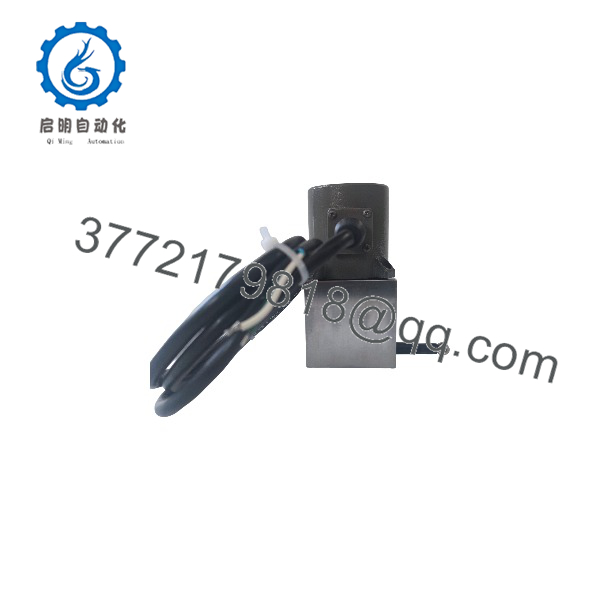
PT801-0005-611-1111
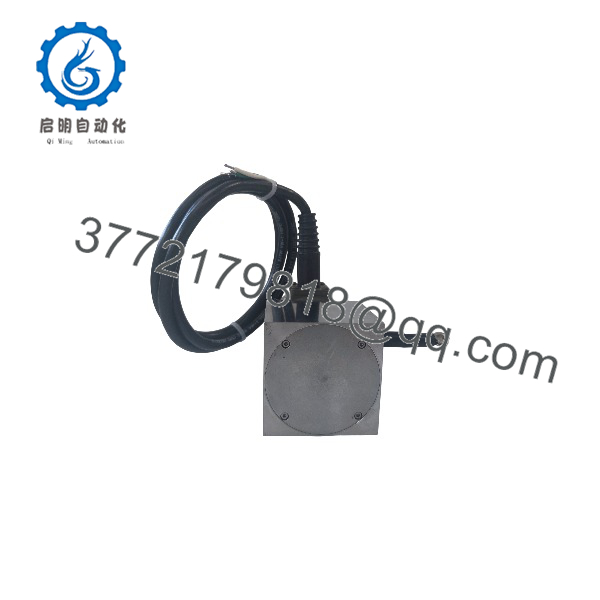
PT801-0005-611-1111
System Compatibility & Integration Requirements
| Item / Dependency | Verified Compatibility or Requirement | Practical Note |
|---|---|---|
| Signal reading | Ratiometric potentiometric output from the 500 Ω sensing potentiometer | Requires an excitation/reference voltage from the reading instrument (PLC analog input, display, controller); not a self-powered 4–20 mA device. |
| Mechanical mounting | Fixture at the cable exit point, aligned so the cable extends along the measurement axis without side loading | The measuring cable must pull straight; misalignment causes wear and reading error. |
| Measured range | 5-inch full stroke | The moving object’s travel must stay within the range without jerking the cable to its stop. |
| Electrical connection | 3 ft integrated electrical cable | Extend to the control cabinet via junction or terminal; longer cable codes exist for remote cabinets. |
| Environmental sealing | Stainless steel enclosure, nitrile O-ring | Order-code alternatives exist for other O-ring elastomers where media compatibility requires. |
| Series scalability | Same PT801 format offers 2–60 inch ranges, 1/2/5/10 kΩ potentiometers, and amplified 4–20 mA / 0–10 V / 0–5 V outputs | Interface changes or range changes are a re-order, not a redesign. |
Dimensions, Mounting & Connection Notes
The PT801 is a compact cable-extension unit; for the 5-inch range, the series dimensional table lists enclosure dimension A as 0.49 in (12.4 mm). The unit ships with a 3-foot electrical cable for signal connection. Installation consists of fixing the enclosure rigidly near one end of the travel path, attaching the measuring cable’s end fitting to the moving object, and ensuring the cable pays out along the measurement axis. The measuring cable should not be subjected to side loads or abrasion, and the travel should remain within the 5-inch stroke.
Detailed Product Overview
Cable-extension transducers occupy a distinct niche in linear measurement. Where an LVDT needs a bore, a magnetostrictive sensor needs a hollow rod, and an encoder needs a guided carriage, a draw-wire sensor only needs a place to mount and a point on the moving object to tie the cable to. That simplicity explains why Celesco’s PT801 series, and this 5-inch configuration in particular, appear in retrofit and space-constrained motion applications: the sensor body is small, the cable adds negligible mass to the moving part, and the installation is a two-point job.
The order number is worth reading carefully because it encodes everything a buyer needs to verify. PT801-0005-611-1111 breaks down as: 0005 — a 5-inch full stroke; 6 — stainless steel enclosure; 1 — nitrile O-ring as the standard seal; 1 — a 500 Ω potentiometer as the sensing circuit; 1 — potentiometric output; and 1 — a 3-foot electrical cable. Two of these positions deserve special attention in procurement checks. The output position determines the electrical interface: this “-1111” unit is a passive potentiometer, which means the reading instrument supplies excitation and measures the divider ratio — simple, robust, and essentially immune to cable-resistance errors over short runs, but not a substitute for the amplified 4–20 mA or 0–10 V versions of the same series. The range position must match the real mechanical travel with margin: hitting the end stop of the drum can damage the cable or spring, so the application’s stroke, including overshoot, should stay within the 5-inch window.
The stainless enclosure and nitrile O-ring combination positions this unit for general industrial duty, where the housing faces dust, splash, and cleaning agents. Where the environment involves solvents or temperature extremes, the same series offers O-ring alternatives (ethylene propylene, silicone, fluorocarbon/Viton) and identical hardware in other output and cable configurations up to 200 feet — useful when a design evolves and only the interface, not the mounting format, has to change.
Electrically, reading a 500 Ω potentiometer is a ratiometric measurement: the excitation voltage applied across the pot appears at the wiper in proportion to position, so a stable reference on the input card delivers good repeatability without active electronics inside the sensor. This passive construction is also why the unit is a common service-replacement part — there are no onboard amplifiers to fail, and the failure modes are mechanical ones visible in the reading (jumps, dead zones, or a slack cable).
Applications & System Role
In a measurement or control architecture, the PT801-0005-611-1111 serves as a feedback element for short-stroke linear motion. Typical roles for a 5-inch-range draw-wire transducer include monitoring cylinder stroke, actuator position, valve ram travel, gantry or table displacement, and material feed within compact machines. The transducer sits between the mechanism and the control system: it reports where the mechanism is, and the PLC or controller uses that signal for positioning, limit detection, or closed-loop control. Because the sensing principle is a cable-and-drum coupled to a potentiometer, the position signal is continuous across the whole stroke rather than incremental, so the reading is available immediately on power-up without homing.
FAQ
What is the Celesco -0005-611-1111?
It is a cable-extension (draw-wire) linear position transducer with a 5-inch measuring range, stainless steel enclosure, 500 Ω potentiometric output, nitrile O-ring, and a 3-foot electrical cable.
What does the order code mean?
0005 = 5-inch range; 6 = stainless steel enclosure; 1 = nitrile O-ring; 1 = 500 Ω potentiometer sensing circuit; 1 = potentiometric output; 1 = 3 ft electrical cable.
How does it measure position?
A measuring cable winds onto a drum as the target moves; the drum rotation drives the potentiometer wiper, producing a position-proportional resistive output.
What output signal does it provide?
A potentiometric (ratiometric) output from a 500 Ω potentiometer — the reading device supplies excitation voltage and measures the divided signal.
Does it output 4–20 mA?
Not this configuration. The PT801 series offers 4–20 mA and voltage-output variants under different output codes, but this unit is the passive potentiometric version.
Which stroke lengths are available in the PT801 series?
The series covers 2, 5, 10, 15, 20, 25, 30, 40, 50, and 60 inches.
How is it mounted?
The enclosure is fixed near the travel path, and the cable end is attached to the moving object, with the cable aligned to the measurement axis and travel kept within the 5-inch stroke.