WhatsApp: +86 16626708626
 Email:
  Phone: +86 16626708626
Description
Key Technical Specifications
| Parameter | Specification |
|---|---|
| Model | AGC/GS/3 |
| Common Part Reference | AGCGS3 |
| Manufacturer | DEIF |
| Product Type | Genset control module |
| Application | Generator-set control |
| AC Measurement Range | 100–690 VAC |
| Frequency | 50/60 Hz |
| Control Architecture | Microprocessor-based |
| Generator Operation | Single- and multi-generator applications |
| Typical Functions | Generator monitoring, synchronization, protection, control |
| Communication | Verify by exact hardware revision |
| DC Supply | Verify by exact hardware revision |
| Operating Temperature | Verify by exact hardware revision |
| Mounting | Verify by exact enclosure/panel configuration |
| Lifecycle | Discontinued |
The strongest available source for the exact AGC/GS/3 part number confirms the 100–690 VAC, 50/60 Hz specification and discontinued status. Public reseller pages contain substantially different secondary specifications, so I would not publish their unverified I/O counts, DC supply range, dimensions, or environmental ratings as definitive specifications.
One current secondary listing also identifies the AGC/GS/3 as an automatic genset controller for generator paralleling, mains-parallel operation, and load-transfer applications, but those detailed functional claims should be checked against the specific hardware revision before engineering use.
Product Introduction
The DEIF AGC/GS/3 is a legacy generator-set control module used in industrial and power-generation control systems. Available documentation identifies the unit as a 100–690 VAC, 50/60 Hz control module, while current industrial-part sources classify it as discontinued.
For replacement work, the most important point is to match the complete AGC/GS/3 identification and hardware revision. Because detailed public documentation for this legacy model is limited and secondary listings conflict on several specifications, the nameplate and existing control-panel configuration should be treated as the final reference before substitution.
Installation & Configuration Guide
Stage 1 — Pre-Installation Preparation (~10 min)
- Confirm the complete identification is DEIF AGC/GS/3.
- Photograph the nameplate, terminal arrangement, and front-panel configuration.
- Record the existing generator-control settings and protection parameters.
- Back up any accessible configuration before removing the controller.
- Verify the generator voltage and frequency range against the controller’s documented measurement range.
- Identify all breaker-control, generator, mains, and auxiliary connections.
- ⚠️ Follow the generator manufacturer’s lockout/tagout procedure before disconnecting the controller.
Stage 2 — Removing the Old Module (~5 min)
- Place the generator set in the approved maintenance state.
- Disable automatic starting according to the site procedure.
- Isolate the controller’s auxiliary/control power.
- ⚠️ Verify that automatic generator-start circuits cannot energize while work is being performed.
- Label every terminal and communication connection.
- Disconnect the field wiring carefully.
- Remove the controller from its mounting position.
- Inspect terminals and wiring for heat damage, corrosion, or loose connections.
Stage 3 — Installing the New Module (~5 min)
- Confirm the replacement label matches AGC/GS/3.
- Verify the hardware revision and terminal arrangement against the removed unit.
- Mount the controller securely.
- Reconnect the control-power wiring according to the applicable wiring diagram.
- Reconnect generator-voltage sensing and other measurement circuits.
- Reconnect breaker-control and auxiliary signals.
- Restore communication wiring if the installed system uses a communication interface.
- ⚠️ Do not energize the generator-control circuit until voltage-sensing and breaker-control wiring has been independently checked.
Stage 4 — Power-On & Testing (~10–15 min)
- Apply control power without enabling automatic generator starting.
- Confirm normal controller initialization.
- Verify the measured generator voltage and frequency.
- Check phase sequence and voltage-sensing values.
- Verify breaker status inputs.
- Test alarm and shutdown indications.
- Perform a controlled manual start if permitted by the plant procedure.
- Verify generator control and breaker logic under a controlled test condition.
- Test automatic operation only after all manual checks pass.
- ⚠️ Do not place the generator in automatic mode until start, stop, breaker, protection, and emergency-shutdown functions have been verified.
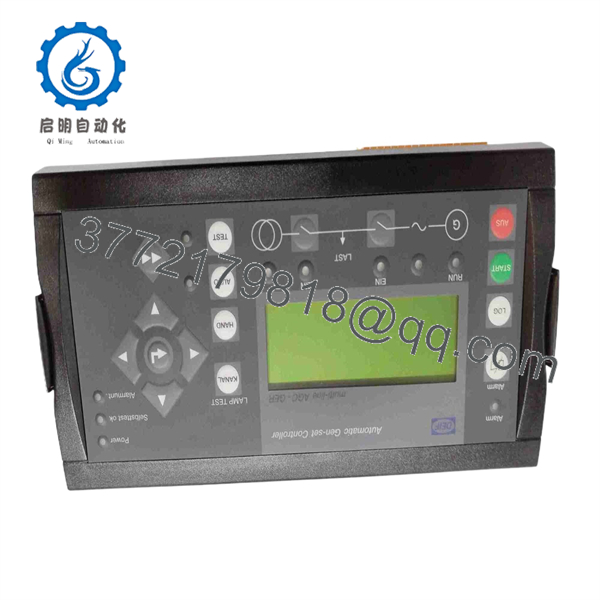
AGCGS3
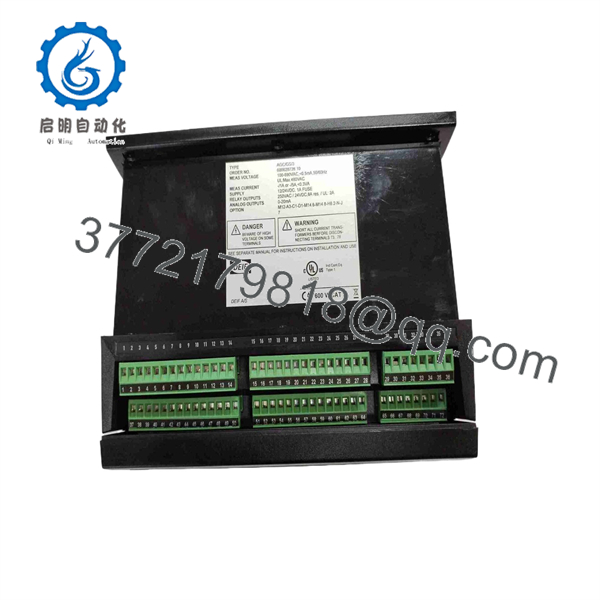
AGCGS3
FAQ
What is the DEIF AGCGS3?
AGCGS3 is a common compressed listing for the DEIF AGC/GS/3 generator control module. Industrial-part sources classify it as a DEIF control module for generator applications.
What voltage does the AGC/GS/3 support?
The strongest available listing specifies 100–690 VAC at 50/60 Hz. This should be understood as the documented AC measurement/control range rather than automatically assuming that it is the controller’s auxiliary DC supply voltage.
Is AGC/GS/3 discontinued?
Yes. Radwell and other industrial-part databases identify the AGC/GS/3 as discontinued by the manufacturer. Replacement units are therefore generally sourced from existing inventory, surplus stock, used equipment, refurbishment, or repair channels.
Is AGC/GS/3 an ordinary PLC?
Not in the conventional machine-control sense. It is categorized as a generator-set control module, intended for power-generation control rather than general-purpose PLC logic.
Can I replace AGC/GS/3 with another DEIF generator controller?
Not without checking the complete application. Generator controllers differ in voltage-sensing range, auxiliary supply, breaker logic, synchronization functions, I/O arrangement, communication interfaces, and protection functions. A controller with a similar appearance is not necessarily a functional replacement.
What should I verify before purchasing a replacement?
Verify the AGC/GS/3 marking, DEIF part/order number, hardware revision, terminal layout, AC measurement range, auxiliary supply, communication configuration, generator application, and existing protection settings. A clear photograph of the front label and terminal side is particularly useful for identifying a legacy unit.
What condition should be specified when sourcing AGC/GS/3?
Because the model is discontinued, specify the required condition explicitly: new old stock, unused original packaging, used/tested, or refurbished/tested. Industrial suppliers currently list multiple condition categories for this model.