WhatsApp: +86 16626708626
 Email:
  Phone: +86 16626708626
Description
Key Technical Specifications
| Parameter | Specification |
| Manufacturer | Emerson Electric Co. / Epro |
| Part Number / Order Code | A6410 / 9199-00005 |
| System Compatibility | AMS 6500 Mechanical Health Monitor (3U Chassis) |
| Channel Count | 2 Independent Channels (Channel 1: Static/Dynamic; Channel 2: Static/Relative) |
| Compatible Sensors | Inductive Displacement Transducers (LVDT, half-bridge, full-bridge, e.g., PR 9350/xx, K20315/xx) |
| Signal Input Voltage | 3.6 VDC max range; 200 kΩ input resistance |
| Carrier / Measurement Frequency | 4.75 kHz Carrier; 0 to 100 Hz (−3 dB) measurement bandwidth |
| Outputs | Dual 0/4–20 mA current loops, 0–10 V DC voltage, buffered front/rear, relay logic interlocks |
| Standard Compliance | API 670 Machinery Protection Systems |
| Form Factor | 3U size, 1-slot plug-in card |
| Weight & Origin | Approx. 1.0 kg (2.2 lbs); Manufactured in Germany |
Product Introduction & Supply Chain Strategy
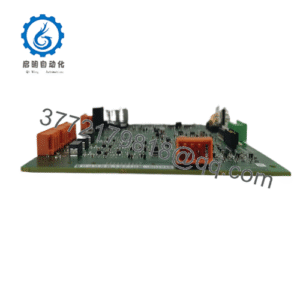
The Emerson A6410 is a specialized 2-channel machinery protection module within the AMS 6500 Machinery Health Monitor framework. Engineered specifically for steam turbines, gas turbines, and large industrial compressors, the A6410 measures main valve stem displacement (load indication) and casing thermal expansion. During turbine startup or severe load changes, uneven thermal expansion across the turbine shell can cause casing “bowing” and fatal rotor-to-stator rubs. Processing high-accuracy signals from inductive LVDT sensors, the A6410 compares real-time movement against tight mechanical setpoints, driving alerts and hardwired interlock trip relays to protect multi-million-dollar turbomachinery assets.
From an inventory and maintenance perspective, keeping a factory-fresh Emerson A6410 as New Surplus is a critical operational safeguard. Refurbished expansion cards often suffer from aged oscillator/carrier circuits, drifting LVDT signal conditioning amplifiers, and degraded backplane contacts. These flaws lead to false trips or, worse, blind spots during thermal ramps. Purchasing New Surplus guarantees factory-calibrated accuracy, original signal isolation, and protection against catastrophic downtime cost.
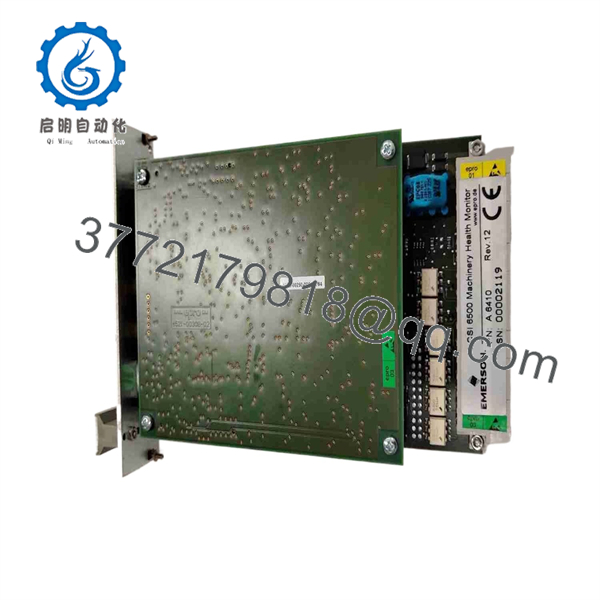
A6410
Installation & Configuration Guide
1.Stage 1: Pre-Installation (Safety & Prep):Bypass trip logic, isolate rack power, and wear ESD strap.
Bypass or override the protective interlock relays in the Safety Instrumented System (SIS) or DCS to prevent accidental unit trips during maintenance. Isolate rack slot power if required by local safety procedures and follow Lock-Out/Tag-Out (LOTO) protocols. Wear a grounded ESD wrist strap before handling the module. Document existing configuration settings in AMS Machinery Manager and photograph field sensor terminal assignments.
2.Stage 2: Module Extraction:Release front retention screws and pull ejector levers.
Unscrew the top and bottom captive retention screws on the faceplate. Unlatch the ejector handles to disengage the rear 3U edge connector from the AMS 6500 system backplane. Slide the original module out along its guide tracks and place it directly into an antistatic shielding bag.
3.Stage 3: Insertion & Mechanical Seating:Align card edges, slide into 3U slot, and secure fasteners.
Align the new Emerson A6410 module with the guide rails of the target slot in the 19-inch 3U rack card cage. Gently push the module inward until the rear backplane connectors make contact, then press the ejector handles flush to seat the card completely. Tighten the front panel screws firmly.
4.Stage 4: Power-On & Calibration Verification:Verify initialization LEDs, download parameters, and perform stroke check.
Re-energize the rack and monitor the front status LEDs. Ensure the OK LED stays solid green and no system hardware faults are flagged. Connect via AMS 6500 configuration software to download the channel parameter file (LVDT calibration curves, zero/span offsets, alarm setpoints). Perform a zero and full-stroke verification on the LVDT sensors before restoring relay trips to active service.
Software Configuration & Upgrade Notes
- AMS Machinery Manager Integration: Parameter configuration (sensor carrier frequency, zero point offset, alert/danger setpoints, and relay logic) is transferred digitally via the AMS 6500 configuration software suite.
- LVDT Sensor Matching: Ensure the connected inductive transducers (e.g., Emerson PR 9350 or K20315 series) match the carrier voltage and stroke parameters selected in the module software. Incorrect sensor pairing causes significant linear measurement drift.
- Hot-Swappability Advantage: The supports live rack insertion/extraction (hot-swapping). However, channel trip outputs must be bypassed in the DCS prior to card swap to avoid transient-induced trip signals.
Frequently Asked Questions (FAQ)
Q: What is the main operational difference between the Emerson A6210 and the ?
A: The A6210 is primarily configured for continuous vibration and proximity measurements (shaft displacement, casing vibration, speed). The is specifically tailored for valve position (valve stem travel) and casing thermal expansion (shell growth) using inductive displacement sensors / LVDTs.
Q: Can I use non-Emerson LVDT sensors with the module?
A: The module is optimized for Emerson/Epro inductive displacement sensors (PR 9350/xx and K20315/xx series). Third-party half-bridge or full-bridge LVDTs can be connected if their electrical excitation, carrier frequency, and millivolt range match the input specifications.
Q: Why choose New Surplus over a refurbished unit?
A: Thermal casing expansion and valve stroke measurements operate near zero-frequency (DC to low-Hz) signal levels. Refurbished modules with aged analog conditioning components experience baseline drift that can trigger false thermal expansion alarms or mask true casing expansion issues. New Surplus provides factory-level calibration stability.
Q: Does the module ship with factory warranty coverage?
A: Yes, every Emerson module is delivered in anti-static packaging with verifiable serial numbers and is backed by a full 1-year replacement warranty.