WhatsApp: +86 16626708626
 Email:
 Phone: +86 16626708626
Description
Core Product Summary (Brand / Model / Key Attributes)
The Emerson Epro PR9268/202-000 is an industrial absolute vibration sensor designed for continuous monitoring of casing and bearing housing vibration on heavy rotating machinery. Belonging to the PR9268 vibration velocity sensor family, this unit measures absolute mechanical vibrations (velocity) generated by unbalance, misalignment, gear mesh issues, and bearing degradation in harsh industrial environments such as steam turbines, gas turbines, pumps, fans, and compressors.
Engineered for direct mechanical mounting on machine structures, the PR9268/202-000 converts physical oscillation velocity into a proportional electrical signal. Its rugged housing and internal electromechanical design ensure dependable long-term performance across heavy industrial processes, integrating seamlessly with machinery protection systems and condition monitoring racks (such as the Epro MMS series).
Key Technical Specifications
| Parameter | Specification |
| Manufacturer & Series | Emerson / Epro, PR9268 Vibration Velocity Series |
| Model / Order Code | PR9268/202-000 |
| Sensor Type | Absolute Vibration Velocity Transducer |
| Measurement Parameter | Vibration velocity (mm/s or inch/s) |
| Mounting Configuration | Stud or threaded base mounting for direct casing attachment |
| Operating Frequency Range | Industrial low to mid frequency vibration spectrum |
| Enclosure Protection Class | Rugged industrial weather-resistant housing |
| Electrical Connection | Integrated cable or terminal pin connection (depending on specific sub-variant) |
Detailed Product Overview
The Emerson Epro PR9268/202-000 provides machinery protection and condition monitoring architectures with vital data regarding the absolute mechanical health of structural housings. While proximity probes track relative shaft movement inside fluid-film bearings, absolute velocity sensors like the PR9268 measure the physical vibration transmitted to the outer bearing caps and machine casings, capturing forces transmitted through rolling-element bearings or structural foundations.
The sensor is built to endure severe mechanical stress, continuous thermal exposure, and exposure to industrial fluids. By converting velocity oscillations into stable electrical signals, it enables early fault detection before minor mechanical anomalies escalate into critical machinery failures.
Dimensions, Mounting & Connection Notes
- Mounting Interface: Threaded stud mount for secure mechanical coupling to machinery housing pads.
- Mounting Orientation: Can be mounted vertically or horizontally depending on the desired measurement axis (axial, vertical, or horizontal radial).
- Cable Routing: Protect sensor cabling using flexible metal conduit in areas exposed to foot traffic, hot oil spray, or sharp machinery edges.
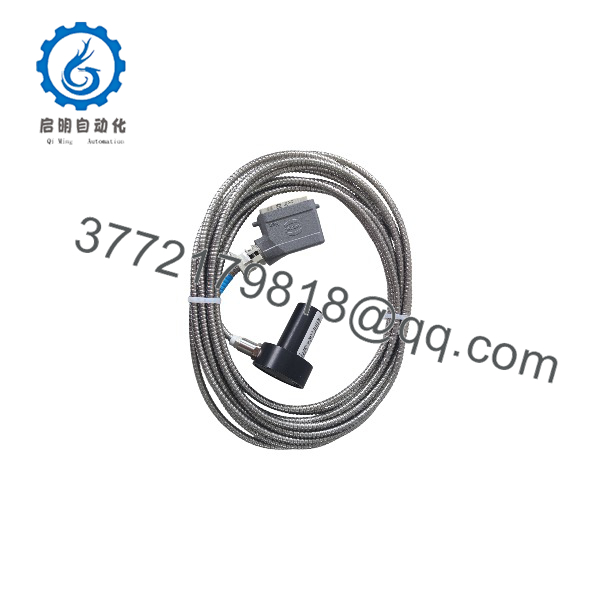
PR9268/202-000
Engineering Selection Highlights
- Absolute Casing Vibration Tracking: Measures structural vibration velocity directly on bearing caps and machine frames.
- Robust Industrial Construction: Encased in a heavy-duty housing designed to withstand harsh plant floor conditions, high vibration, and moisture.
- Early Fault Detection: Sensitive to broad frequency spectra covering unbalance, looseness, and gear mesh defects.
- System Integration Compatibility: Connects directly with standard industrial vibration monitoring systems and PLC analog input channels.
System Compatibility & Integration Requirements
| Item / Dependency | Verified Compatibility or Requirement | Practical Note |
| Monitoring Racks | Epro MMS series protection systems or compatible vibration monitors | Input channel must support velocity sensor signal processing and power supply requirements. |
| Mounting Base | Rigid flat surface with matching threaded mounting stud | Proper mechanical torque is essential to ensure high-frequency vibration transfer without dampening. |
| Signal Cabling | Shielded instrumentation twisted-pair cable | Shielding must be grounded correctly at one end to prevent electromagnetic interference (EMI). |
FAQ
What is the Emerson Epro PR9268/202-000?
The Emerson Epro PR9268/202-000 is an absolute vibration velocity sensor designed to measure casing and bearing housing vibration on industrial rotating machinery.
What is the difference between casing vibration and shaft vibration?
Shaft vibration sensors (like eddy current probes) measure relative movement between the shaft and the bearing. Casing sensors (like the PR9268) measure absolute vibration transmitted to the outer structure of the machine.
What parameters does the sensor monitor?
It monitors vibration velocity, which provides an effective indicator of overall mechanical severity across machines like fans, pumps, compressors, and turbines.
Is specialized software required for the sensor?
The sensor itself is a hardware transducer; configuration and alarm thresholds are set within the connected machinery protection system or monitoring rack.
Verification & Troubleshooting Notes
- Mechanical Tightness Check: Periodically verify that the mounting stud is torqued securely. A loose mounting base will distort vibration readings and cause artificially low or erratic amplitudes.
- Cable Shield Integrity: Inspect shielded signal cables for damage or grounding loops that could introduce electrical noise into the monitoring system.
- Baseline Comparison: Compare current vibration velocity trends against baseline commissioning data to isolate mechanical wear from electrical interference.