WhatsApp: +86 16626708626
 Email:
 Phone: +86 16626708626
Description
Core Product Summary (Brand / Model / Key Attributes)
The Emerson MVME7100 (historically associated with Motorola Embedded Communications and Artesyn Embedded Technologies) is a high-performance 6U VMEbus single-board computer (SBC). Built around the Freescale/NXP MPC864xD system-on-chip featuring dual PowerPC® e600 processor cores (clocked at 1.06 GHz or 1.3 GHz), the MVME7100 provides a migration path for legacy VMEbus systems while delivering advanced processing power, high-speed memory subsystems, and flexible I/O connectivity.
The board supports up to 2GB of DDR2 ECC system memory, 128MB of boot NOR flash, and on-board NAND flash storage (ranging from 2GB to 8GB depending on the exact build variant). Designed for critical industrial, defense, and automation control environments, it integrates quad Gigabit Ethernet interfaces, USB 2.0 connectivity, multiple RS-232 serial ports, and high-speed 2eSST VMEbus protocol capabilities supporting data transfer rates up to 320MB/s.
Key Technical Specifications
| Parameter | Verified Specification |
| Manufacturer / Brand | Emerson / Artesyn Embedded Technologies (formerly Motorola Embedded Communications) |
| Model Series | MVME7100 (common assembly variants include MVME7100-0161, -0163, -0171, -0173) |
| Product Type | 6U VMEbus Single-Board Computer (SBC) |
| Microprocessor | NXP / Freescale MPC8640D or MPC8641D System-on-Chip (Dual PowerPC e600 cores) |
| Clock Frequency | 1.06 GHz or 1.3 GHz |
| System Memory (RAM) | 1GB or 2GB DDR2 SDRAM with ECC, running at 533 MHz via dual memory controllers |
| Flash Memory | 128MB NOR Flash (boot/firmware); 2GB, 4GB, or 8GB NAND Flash (storage) |
| VMEbus Interface | Tsi148 controller supporting ANSI/VITA 1-1994 VME64 and 2eSST protocol (up to 320MB/s bandwidth) |
| Ethernet Interfaces | Four 10/100/1000 Mbps Gigabit Ethernet ports (two routed to front-panel RJ-45, two routed to VMEbus P2 connector) |
| Serial Ports | Five 16550-compatible RS-232 asynchronous serial ports (one front-panel Mini DB-9, four routed via VMEbus P2) |
| USB Interface | USB 2.0 controller (available on commercial temperature variants) |
| Expansion Slots | Dual IEEE P1386.1 PCI Mezzanine Card (PMC-X) sites supporting 33/66/100 MHz; 8x PCI Express connection for XMCspan |
| Form Factor & Weight | Standard 6U VMEbus single slot card; Height: 233.4 mm, Depth: 160.0 mm, Width: 19.8 mm; Weight: ~0.57 kg to 0.68 kg (1.25 to 1.5 lbs) |
Detailed Product Overview
The Emerson MVME7100 serves as a bridge between legacy VMEbus hardware infrastructures and contemporary high-performance embedded computing. In industrial control, energy management, and defense applications, systems built around older processor architectures (such as the MVME16x, MVME17x, or MVME2300/2700 series) face obsolescence. The MVME7100 allows system architects to upgrade processing capability, throughput, and memory density without discarding existing VME backplanes and chassis investments.
At its core, the dual-core PowerPC architecture combined with dual memory controllers yields high data-processing efficiency. The integration of the 2eSST VMEbus protocol accelerates inter-board communication across the backplane to 320MB/s, eliminating traditional bottlenecks found in older VME systems. Firmware initialization and hardware diagnostics are managed via the resident MOTLoad firmware package, which provides power-on self-tests and a debugger interface comparable to traditional Bug monitors. Board Support Packages (BSPs) are available for major real-time operating systems (RTOS) like VxWorks and LynxOS, as well as embedded Linux distributions.
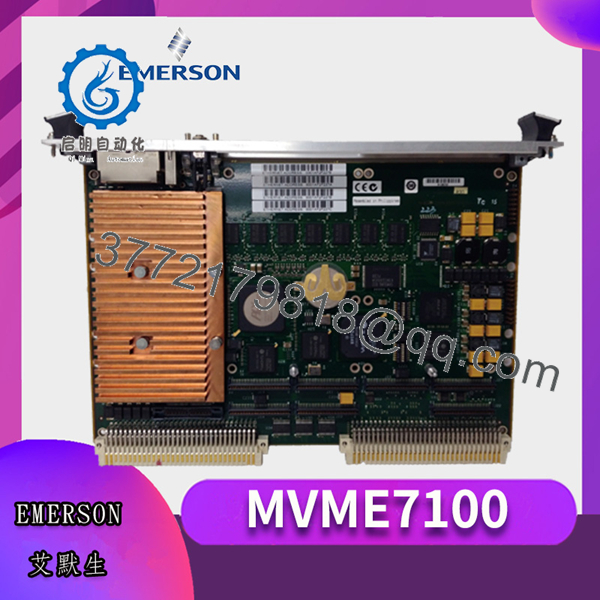
MVME7100
Engineering Selection Highlights
- VMEbus Backplane Compatibility: Fully backward compatible with VME64 and legacy VME32 backplanes while supporting high-speed 2eSST transfers → Confirm that backplane slot geo-addressing and bus terminators support 2eSST data rates if maximum throughput is required.
- Commercial vs. Extended Temperature Variants: Available in standard commercial temperature ranges (0°C to +55°C) and extended temperature variants (MVME7100ET, -40°C to +71°C) → Select the correct environmental grade matching cabinet climate controls.
- Processor and Memory Configuration: Offered in 1.06 GHz (1GB RAM / 4GB Flash) or 1.3 GHz (2GB RAM / 8GB to 8GB Flash) configurations → Match computing capacity and memory footprint to target application software and real-time kernel requirements.
- Front Panel vs. Rear Transition Module (RTM) I/O: Ethernet and serial lines can be accessed via front-panel connectors or routed through the rear using a compatible transition module (such as the MVME7216E) → Verify cabinet cabling constraints and RTM slot availability behind the VME chassis.
System Compatibility & Integration Requirements
| Item / Dependency | Verified Compatibility or Requirement | Practical Note |
| Chassis & Backplane | Standard 6U VMEbus enclosure | Occupies a single front slot; verify slot power distribution (+5V primary supply requirements). |
| Rear Transition Module (RTM) | MVME7216E direct-connect RTM (optional) | Used to route P2 connector signals (Gigabit Ethernet and serial ports) to rear panel connections. |
| Mezzanine Expansion | PMC-X modules or Emerson XMCspan via 8x PCI Express link | Permits integration of secondary specialized communication or data acquisition mezzanine cards. |
| Operating System Support | VxWorks (AMP/SMP), Embedded Linux, LynxOS | Requires matching the board support package (BSP) version with the targeted OS kernel build. |
Dimensions, Mounting & Connection Notes
- Physical Dimensions: Standard 6U board height (233.4 mm) by depth (160.0 mm), front panel width of 19.8 mm (single-slot wide).
- Weight: Varies by specific model configuration from approximately 0.57 kg to 0.68 kg (1.25 to 1.5 lbs).
- Handling Precautions: Sensitive electronic components and integrated circuits are exposed on the board surface. Standard ESD wrist straps, grounded work areas, and proper insertion/extraction lever handling must be observed to prevent electrostatic damage or bent backplane pins.
- Battery Maintenance: Features an on-board Maxim DS1375 real-time clock device with a replaceable lithium battery backup (rated for 10 years storage life at 25°C). Ensure proper polarity and safe disposal when replacing the cell.
FAQ
What is the Emerson MVME7100? The Emerson MVME7100 is a high-performance 6U VMEbus single-board computer (SBC) powered by NXP/Freescale MPC864xD dual-core PowerPC processors, engineered for industrial automation, defense, and real-time computing applications.
What processor options are available on the MVME7100?It is available with either a 1.06 GHz MPC8640D or a 1.3 GHz MPC8641D processor featuring dual e600 cores.
What VMEbus protocols does the board support?It features a Tsi148 controller supporting ANSI/VITA VME64 and high-speed 2eSST data transfer protocols up to 320MB/s while maintaining backward compatibility with older VME systems.
What operating systems are supported by the MVME7100?The board supports several real-time operating systems and kernels, including VxWorks (AMP and SMP configurations), embedded Linux distributions, and LynxOS via dedicated Board Support Packages (BSPs).
How are peripheral signals managed on the MVME7100?Ethernet and serial ports are accessible via front-panel connectors or can be routed through the VME chassis P2 connector to a compatible rear transition module (RTM) such as the MVME7216E.
Verification & Troubleshooting Notes
- BOOT / MOTLoad Diagnostics: If a board fails to boot, connect a terminal cable to the front-panel serial port (COM1 via Mini DB-9 using a adapter cable) and observe the MOTLoad firmware prompt to run hardware diagnostics and check error codes.
- Power Supply Voltage Verification: Ensure the VME chassis delivers stable +5V DC power within tolerance limits, as high-performance dual-core SBCs draw substantial current (typical power draws range around 40W to 55W depending on workload and configuration).
- LED Status Indicators: Monitor front-panel status LEDs during power-up to confirm CPU execution, health state, and Ethernet link/activity status.
- Firmware Write Protection: Verify that board-level hardware write-protection switches for the NOR flash are configured correctly if attempting firmware or bootloader updates.