WhatsApp: +86 16626708626
 Email:
 Phone: +86 16626708626
Description
Core Product Summary
The EPRO PR6423/010-130 with CON021 is a matched eddy current measuring chain from Emerson’s EPRO machinery monitoring range: an 8 mm non-contact sensor probe plus the CON021 signal converter that energizes it. It is used on critical turbomachinery — steam, gas and hydro turbines, compressors, gearboxes, pumps and fans — to measure radial and axial shaft dynamic displacement, shaft position, eccentricity and speed/keyphasor signals without contacting the shaft.
This variant combines an M10x1 case thread and 25 mm case with a mechanically protected cable run: the integral cable is armored over its full 8 m length, supplied without an adapter plug, and terminates in a Lemo connector. The converter provides the probe excitation and outputs the scaled gap and vibration signal over 0 to 20 kHz (-3 dB) with a rise time below 15 µs, feeding EPRO MMS monitoring modules. The sensor side delivers a 2 mm linear range at 8 V/mm (±5% over 0 to 45 °C) and IP66 protection, with the sensor rated to +180 °C including its first metre of cable.
Key Technical Specifications
| Parameter | Value |
|---|---|
| System composition | 8 mm eddy current sensor PR6423/010-130 + CON021 signal converter |
| Probe configuration | M10x1 case thread, 25 mm case, armored cable, no adapter plug, 8 m total cable, Lemo cable end |
| Linear measurement range | 2 mm (80 mils) |
| Initial air gap | 0.5 mm (20 mils) |
| Incremental scale factor (ISO) | 8 V/mm (203.2 mV/mil) ± 5% at 0 to 45 °C |
| Deviation from best fit straight line (DSL) | ± 0.025 mm (± 1 mil) at 0 to 45 °C |
| Minimum shaft diameter | 25 mm (0.79 in) |
| Target material (standard) | 42CrMo4 (AISI/SAE 4140) ferromagnetic steel |
| Sensor operating temperature (incl. 1 m cable) | ‘-35 °C to +180 °C |
| Cable and connector temperature | ‘-35 °C to +150 °C |
| Probe protection class | IP66 per IEC 60529 |
| Armored cable diameter / bend radius | 6.0 mm / minimum 35 mm |
| Converter supply voltage | ‘-23 V to -32 V (output -4 V to -20 V) or -21 V to -32 V (output -2 V to -18 V) |
| Converter frequency response (-3 dB) | 0 to 20,000 Hz |
| Converter rise time | < 15 µs |
| Converter operating temperature | ‘-30 °C to +100 °C |
| Converter shock/vibration resistance | 5 g at 60 Hz, 25 °C |
| Converter protection class | IP20 |
| Approvals (sensor) | CE, ATEX, IECEx, CSA; intrinsic safety (ia) and non-sparking (nA) |
Detailed Product Overview
The PR6423/010-130+CON021 is supplied as a complete measurement channel, and its stated accuracy belongs to the chain as a whole: the 8 V/mm scale factor and ±0.025 mm linearity apply to the matched probe–cable–converter set, not to the probe in isolation. The probe measures the changing gap between its 8 mm tip and the conductive shaft surface; the CON021 supplies the high-frequency excitation, demodulates the impedance variation caused by shaft motion, and outputs a DC voltage proportional to the average gap with the dynamic vibration component superimposed. A single channel therefore serves both static position monitoring (thrust, axial displacement) and dynamic radial vibration measurement.
This order code positions itself between the shorter and longest armored configurations of the family. The 8 m total cable length suits machines where the converter cabinet is in the same hall as the unit but not adjacent to the bearing — long enough to bridge the distance across a turbine deck, short enough to avoid unnecessary cable slack in trays. Because the chain calibration is referenced to this total electrical length, the cable must be routed as supplied: shortening, splicing or extending it changes the system scale factor and invalidates the stated linearity.
Two construction details define the installation practice for this variant. First, the cable is armored along its full run, so the 6 mm stainless steel flexible armor — not a separate conduit — is what protects the cable from crushing, abrasion and impact along the route. Installers should respect the 35 mm minimum bending radius at tray corners and gland entries, which is larger than the 25 mm radius of the unarmored cable. Second, the variant has no adapter plug: the armored cable is continuous from the sensor to the Lemo connector at the converter end. That makes for a simpler, electrically uniform run, but it also means the entire cable must be pulled and re-terminated if the probe is ever replaced with a different configuration, so the complete order code should be matched exactly at replacement time.
Electrically, the converter draws a negative supply from the monitoring rack — either -23 to -32 V for the -4 to -20 V output range or -21 to -32 V for the -2 to -18 V range — with the working gap voltage set near the midpoint of the linear range during commissioning. The 20 kHz bandwidth and sub-15 µs rise time preserve the dynamic signature of high-speed machinery, including speed and keyphasor pulses picked up from a toothed wheel or shaft notch.
As across the family, accuracy is target-dependent: the stated tolerances apply to 42CrMo4 (AISI/SAE 4140) steel between 0 and 45 °C, with a minimum shaft diameter of 25 mm. Different alloys, residual shaft magnetization or smaller targets shift the effective sensitivity and reduce usable linear range. The IP66 probe rating supports permanent dust and wash-down exposure at the machine, the IP20 converter must be panel-mounted inside a cabinet, and the sensor family’s hazardous-area approvals (ATEX, IECEx, CSA, with intrinsic safety ia and non-sparking nA modes of protection) permit classified-area installation when the converter and barrier arrangement follows the approval conditions.
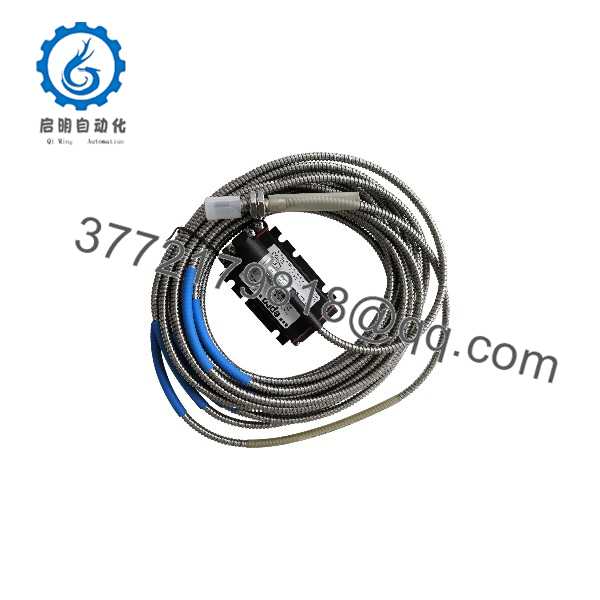
PR6423/010-130+CON021
Dimensions, Mounting & Connection Notes
- Case thread: M10x1 with a 25 mm case length; standard M10 hardware uses SW 8 mm wrench flats on the case and SW 17 mm flats on the mounting nut side.
- The probe is installed facing the shaft surface with a 0.5 mm (20 mils) initial air gap inside the 2 mm linear range, verified against the converter’s gap voltage during commissioning.
- The armored cable has a 6.0 mm diameter and a minimum bending radius of 35 mm; the cable end is a male Lemo connector 11.0 mm in diameter, with no adapter plug along the run.
- Sensor including 1 m of cable is rated -35 °C to +180 °C; the remaining cable and connector section is rated -35 °C to +150 °C.
- The probe reaches IP66 per IEC 60529; the CON021 converter is IP20 and must be panel-mounted in a protected location.
- Cable length tolerance is 0 to +10% of the nominal 8 m.
System Compatibility & Integration Requirements
| Item / Dependency | Verified Compatibility or Requirement | Practical Note |
|---|---|---|
| Sensor–converter pairing | PR6423/010-130 probe with CON021 eddy current signal converter | The chain is calibrated as a matched probe–cable–converter set |
| Converter supply | ‘-23 V to -32 V (output -4 V to -20 V) or -21 V to -32 V (output -2 V to -18 V) | Supplied by the monitoring system |
| Probe connection | Lemo connector at the cable end mates with the converter input | The 8 m cable length is part of the chain calibration |
| Converter mounting | Panel mounting in a protected cabinet | Converter is IP20 |
| Monitoring system | Output feeds EPRO MMS series monitoring modules | Output range must match the monitor input channel configuration |
| Measured target | 42CrMo4 (AISI/SAE 4140) steel, minimum shaft diameter 25 mm | Other materials require recalibration of the chain |
| Mechanical fit | M10x1 thread, 25 mm case | Standard short-case holder geometry |
| Cable routing | Armored 8 m cable, continuous without adapter plug, minimum bending radius 35 mm | Route to gland entries without sharp bends; do not modify length |
FAQ
What is the EPRO PR6423/010-130+CON021?
It is a complete eddy current measuring chain from Emerson’s EPRO range: an 8 mm non-contact sensor probe with a continuous armored 8 m cable and Lemo termination, paired with the CON021 signal converter that drives it.
What is measured with this system?
The system measures radial and axial shaft dynamic displacement, shaft position, eccentricity and speed/keyphasor signals on rotating machinery such as steam, gas and hydro turbines, compressors, gearboxes, pumps and fans.
How is this probe variant configured?
It has an M10x1 case thread with a 25 mm case, an armored cable without an adapter plug, an 8 m total cable length, and a Lemo connector at the cable end.
What are the key measurement specifications?
The chain provides a 2 mm linear range, a 0.5 mm initial air gap, an 8 V/mm incremental scale factor ±5% over 0 to 45 °C, and a deviation from best fit straight line of ±0.025 mm over the same temperature range.
What does the lack of an adapter plug mean for maintenance?
The armored cable runs continuously from the sensor to the Lemo connector, so there is no mid-run separation point; a probe replacement involves the full cable run, and the replacement should match this complete order code.
What power supply does the CON021 require?
The converter operates from -23 V to -32 V with a -4 V to -20 V output, or from -21 V to -32 V with a -2 V to -18 V output, supplied by the connected monitoring system.
Which shaft material and size are required for the stated accuracy?
The stated scale factor and linearity apply to 42CrMo4 (AISI/SAE 4140) steel with a shaft diameter of at least 25 mm; other materials or smaller targets require recalibration or reduce the effective range.
Can the 8 m armored cable be shortened or extended on site?
No. The stated performance applies to the complete matched probe–cable–converter chain, and the 8 m cable length is part of that calibration; modifying the cable changes the system scale factor.