 WhatsApp: +86 16626708626
 Email:
 Phone: +86 16626708626
Description
Core Product Summary
The EPRO PR6425/010-100+CON011 is an eddy current measurement assembly intended for non-contact displacement measurement on rotating machinery. The PR6425 probe detects changes in the gap between its sensing face and a metallic target, while the CON011 signal converter processes the probe signal and provides a voltage output for compatible monitoring equipment.
The CON011 product family supports PR6425 sensors, but the PR6425 requires an extended-range converter configuration. The complete converter variant must therefore be matched to the probe’s measuring range and intended measurement channel. When selecting this assembly for an existing installation, the probe’s full ordering code, integrated cable configuration, converter designation, and output range are important identification details.
Key Technical Specifications
| Parameter | Specification |
|---|---|
| Manufacturer | EPRO |
| Sensor model | PR6425/010-100 |
| Converter family | CON011 |
| Measurement principle | Eddy current, non-contact |
| Measurement functions | Shaft displacement, vibration, position, eccentricity, and speed/key measurement |
| Sensor input compatibility | PR6422, PR6423, PR6424, PR6425, PR6426 |
| Converter frequency response | 0–20 kHz at −3 dB |
| Converter rise time | Less than 15 μs |
| Converter operating temperature | −30 to +100°C |
| Converter protection rating | IP65 |
| Output configurations | −4 to −20 V or −2 to −18 V |
| Supply voltage for −4 to −20 V output | −23 to −32 V DC |
| Supply voltage for −2 to −18 V output | −21 to −32 V DC |
| Converter weight | Approximately 600 g |
| Converter mounting | Four M5 × 20 screws |
| Sensor connector | Self-locking LEMO plug |
| Supply/output terminals | Spring-type terminals; maximum conductor cross-section 1.5 mm² |
Engineering Selection Highlights
- Measuring range: The PR6425 requires an extended-range converter configuration. Select the converter range according to the required displacement span.
- Signal bandwidth: The converter’s 0–20 kHz frequency response is relevant when evaluating dynamic shaft movement and vibration measurements.
- Voltage interface: The selected output range determines the required negative DC supply voltage and the receiving instrument’s input configuration.
- Probe and converter pairing: The sensor and converter form a calibrated measurement chain. Their model and configuration should be matched.
- Target material: The measurement chain must be adjusted for the shaft material to achieve the intended measurement accuracy.
- Mechanical installation: PR6425 mounting requires a suitable threaded holder that is stiff and free from vibration.
- Environmental protection: The converter’s IP65 rating and operating-temperature range should be considered separately from the probe’s installation conditions.
System Compatibility & Integration Requirements
| Item | Requirement | Engineering Consideration |
|---|---|---|
| Sensor input | PR6425 is supported by the CON011 family | The required extended-range converter variant must be selected. |
| Converter range | PR6425 options include 4.0 mm standard range and 6.0, 8.0, and 10.0 mm extended ranges | Confirm the range specified for the intended measurement channel. |
| Measurement target | Calibration depends on target material | The shaft material should be identified when configuring the measuring chain. |
| Monitoring interface | Compatible voltage-input monitoring equipment | Match the converter output range and signal scaling to the receiving channel. |
| Sensor connection | Self-locking LEMO plug | Confirm the connector and cable assembly used by the installed probe. |
| Power supply | Negative DC supply | Select a supply within the voltage limits for the chosen output configuration. |
| Hazardous-area installation | Depends on the applicable converter approval and installation arrangement | Observe the relevant approval conditions and safety-barrier requirements. |
Dimensions, Mounting & Connection Notes
The PR6425 sensor is installed in a threaded holder. A stiff, vibration-free mounting arrangement is important because movement of the probe itself can affect the displacement measurement.
The sensor must be positioned relative to the shaft according to the intended measurement range. Installation should use the complete sensor-and-converter measurement chain so that the converter output can be used to adjust the probe gap.
The CON011 converter uses a self-locking LEMO connection for the sensor and spring-type terminals for supply and output wiring. The converter housing is mounted using four M5 × 20 screws.
During installation, avoid twisting or bending the sensor cable. The final sensor gap, target material, output scaling, and mechanical clearance must be considered together rather than configured independently.
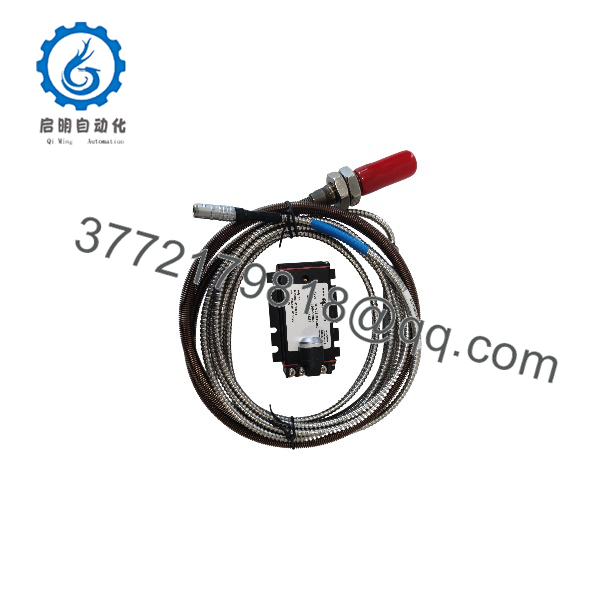
PR6425/010-100+CON011
Detailed Product Overview
Eddy current measurement principle
The PR6425 uses an eddy current sensing principle to detect changes in the distance between the probe tip and a metallic target. The probe does not need to contact the rotating shaft, allowing it to provide a measurement input for monitoring shaft movement while the machine operates.
The sensor is used with a compatible signal converter. Together, these components form a measurement chain for static and dynamic distance measurements, including shaft displacement and vibration-related movement.
CON011 signal conditioning
The CON011 supplies the sensor and processes its measurement response. Its output provides a voltage representation of the measured displacement for connection to suitable monitoring equipment.
The converter supports a frequency response from 0 to 20 kHz at −3 dB and a rise time below 15 μs. These characteristics are relevant when selecting a measurement channel for dynamic shaft behavior. They should be assessed alongside the monitoring instrument’s own bandwidth and input characteristics.
The converter has selectable output configurations with different negative DC supply requirements. The selected output range must match the intended measurement setup.
Measuring range and calibration
The CON011 ordering information lists several measuring-range configurations for the PR6425, including a 4.0 mm standard-range option and extended-range options of 6.0, 8.0, and 10.0 mm. The selected configuration affects the measurement span and the specified linearity error.
The sensor and converter should be treated as a matched measurement chain. The measuring target’s material is also relevant because calibration characteristics depend on the target material. When replacing a probe or converter, the installed component designations and calibration requirements should be reviewed together.
Installation considerations
The probe must be installed in a rigid, vibration-free holder, with the sensing gap adjusted for the measurement task. The sensor cable should be protected from twisting and mechanical damage. Converter mounting, electrical connections, and environmental conditions should follow the applicable installation requirements.
For an existing machine protection system, confirm the probe configuration, converter range, signal polarity, output scaling, and monitoring-channel settings before returning the measurement channel to service.
Applications & System Role
The EPRO PR6425/010-100 + CON011 assembly belongs to the sensing and signal-conditioning portion of a rotating machinery monitoring system. The probe detects changes in the distance between its sensing face and a metallic target, and the converter translates the probe response into a voltage signal for downstream measurement equipment.
Its documented measurement functions include:
- Shaft vibration monitoring: Measuring dynamic changes in the gap between the probe and the shaft.
- Axial displacement measurement: Monitoring shaft movement along its axis when installed in the appropriate orientation.
- Radial displacement measurement: Detecting radial shaft movement relative to the sensor mounting position.
- Shaft position and eccentricity: Measuring changes in the relative position of the shaft and probe.
- Speed and key measurement: Supporting speed-related measurements when the appropriate shaft target arrangement is used.
The CON011 product family is intended for monitoring applications involving steam, gas, and hydro turbines, compressors, pumps, and fans. The exact measurement function depends on probe placement, the selected measuring range, and the capabilities of the connected monitoring equipment.
For maintenance and replacement work, the full measurement chain should be identified before procurement. A matching probe designation alone does not establish that a converter has the correct measuring range or calibration for an installed channel.
FAQ
What is the EPRO PR6425/010-100 + CON011?
It is an eddy current sensor and signal-converter combination intended for non-contact displacement measurements on rotating machinery.
What does the PR6425 measure?
It supports measurements of shaft displacement, vibration-related movement, position, and eccentricity. Speed or key measurement is also possible with a suitable target arrangement.
Which measuring ranges are available for the PR6425 with CON011?
The CON011 ordering information lists 4.0 mm standard range and 6.0, 8.0, and 10.0 mm extended-range configurations for PR6425.
What output does the CON011 provide?
The documented output configurations are −4 to −20 V and −2 to −18 V. The selected configuration determines the applicable supply-voltage requirement.
What is the CON011 frequency response?
The specified frequency response is 0–20 kHz at −3 dB, with a rise time of less than 15 μs.
Does the probe need to be calibrated with the converter?
The sensor and converter form a matched measurement chain. Their configuration and calibration should be considered together, including the material of the measurement target.
What should be checked when ordering a replacement?
Check the complete probe ordering code, converter range variant, cable and connector arrangement, target material, output configuration, and receiving monitoring-channel requirements. These details help establish whether the proposed assembly matches the installed measurement system.