 WhatsApp: +86 16626708626
 Email:
 Phone: +86 16626708626
Description
Core Product Summary (Brand / Model / Key Attributes)
The Emerson Epro PR6426/010-000 is an industrial, non-contact extended-range eddy current displacement sensor probe engineered for critical rotating machinery protection and condition monitoring. Designed specifically for applications requiring large measurement spans—such as differential thermal expansion, axial thrust position, and extended rod drop tracking—this probe utilizes a specialized coil geometry to achieve an extended linear working range compared to standard proximity probes.
Operating on the non-contact eddy current physical principle, the PR6426/010-000 measures static and dynamic distance variations between the probe tip and a conductive metallic target surface without physical wear. Capable of enduring harsh thermal environments up to +200 °C at the probe head, the sensor integrates smoothly with matched signal converters (such as the CON021 or CON041 series) to deliver high signal linearity, stable sensitivity, and reliable performance across steam turbines, gas turbines, hydro units, and heavy industrial compressors.
Key Technical Specifications
| Parameter | Specification |
| Manufacturer & Series | Emerson / Epro, PR6426 Extended-Range Series |
| Model / Order Code | PR6426/010-000 |
| Sensor Type | Non-contact eddy current displacement probe |
| Nominal Linear Range | Extended range model (typically 8.0 mm linear measuring span depending on calibration/driver) |
| Frequency Response (-3 dB) | 0 Hz to 20,000 Hz |
| Compatible Signal Converters | Epro CON021 or CON041 series signal conditioning units |
| Target Material Standard | Ferromagnetic steel targets (e.g., AISI 4140 / 42CrMo4) |
| Probe Tip Operating Temperature | -35 °C to +200 °C (-31 °F to +392 °F) |
| Enclosure Protection Class | Probe tip and threaded housing: IP66 / IP68 |
| Electrical Connection | High-frequency coaxial cable with miniature connector |
Detailed Product Overview
The Emerson Epro PR6426/010-000 addresses specialized monitoring requirements where standard 2.0 mm or 4.0 mm proximity sensors are insufficient. In large utility turbines and heavy industrial compressors, thermal growth of the casing relative to the rotor or major axial shifts demand an extended linear range to maintain continuous measurement integrity without signal saturation or clipping.
The probe functions as part of a tuned resonant circuit powered by an external signal converter. High-frequency excitation signals travel to the internal probe coil, generating an electromagnetic field at the tip. As the distance between the sensor tip and the conductive target surface changes, the eddy currents alter the coil impedance. The connected signal converter translates these changes into a proportional negative DC voltage output that interfaces directly with machinery protection systems, vibration racks, and Distributed Control Systems (DCS).
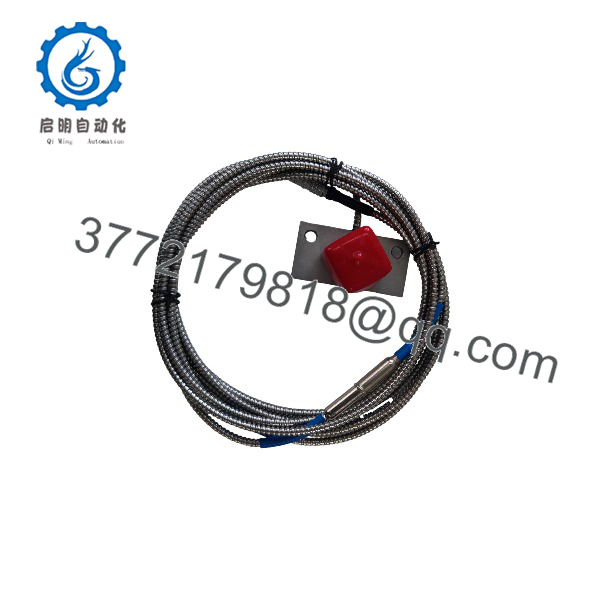
PR6426/010-000
Engineering Selection Highlights
- Extended Linear Measuring Span: Designed with specialized coil parameters to accommodate significantly larger mechanical gaps and movement ranges (such as 8.0 mm linear range) than standard sensors.
- Specialized Thermal Expansion & Thrust Tracking: Ideal for monitoring slow-moving, large-displacement parameters like rotor differential expansion and axial position.
- High-Temperature Robustness: Engineered to withstand continuous exposure up to +200 °C in close proximity to hot turbine casings and bearing housings.
- Wear-Free Non-Contact Operation: Measures static shaft position (0 Hz) and dynamic mechanical shifts up to 20,000 Hz without physical contact or mechanical friction.
- Hermetically Sealed Construction: IP68-rated probe housing and tip resist aggressive industrial lubricants, high-pressure steam, and moisture ingress.
Dimensions, Mounting & Connection Notes
- Mechanical Thread / Body: Threaded cylindrical body allowing precise zero-gap mechanical adjustment via locking nuts.
- Mounting Orientation: Installed perpendicularly to the target surface using rigid mounting brackets or direct machine casing penetrations.
- Cable Routing: High-frequency coaxial cable should be routed away from high-current motor leads and variable frequency drives to prevent electromagnetic interference (EMI).
- Initial Gap Setup: Calibrate the static mechanical air gap during installation by monitoring the signal converter DC output voltage against the manufacturer’s extended-range calibration chart.
System Compatibility & Integration Requirements
| Item / Dependency | Verified Compatibility or Requirement | Practical Note |
| Signal Converter / Driver | Epro CON021 or CON041 series signal converters | Must be paired with a compatible, matched driver calibrated for extended-range PR6426 sensors. |
| Monitoring System Racks | MMS6000 protection systems or PLC analog input cards | Channel input must support negative voltage processing (-24 V DC nominal system power). |
| Target Material & Size | Ferromagnetic steel targets with adequate surface area | Target diameter must be sufficiently large to prevent edge-effect distortion across the extended range. |
| Enclosure Protection | Local IP65/IP66 junction box for signal converter housing | Signal converters carry an IP20 rating and must be enclosed in protected cabinetry or junction boxes. |
FAQ
What is the Emerson Epro PR6426/010-000?
The Emerson Epro PR6426/010-000 is an extended-range non-contact eddy current displacement probe designed to measure large mechanical shifts, such as axial thrust position and differential thermal expansion on heavy rotating machinery.
How does the PR6426 series differ from standard PR6423 or PR6424 probes?
The PR6426 series provides an extended linear measurement range (such as an 8.0 mm span), making it suitable for applications where expected mechanical displacement exceeds the limits of standard 2 mm or 4 mm proximity probes.
Does the PR6426/010-000 require a signal converter?
Yes. Like other eddy current sensors, it requires a matched signal converter (such as the CON021 or CON041) to provide high-frequency excitation and convert gap changes into a usable DC voltage signal.
What is the operating temperature limit of the probe head?
The probe tip and housing are rated for continuous industrial operation in environments ranging from -35 °C to +200 °C (-31 °F to +392 °F).
What target material is required for accurate measurement?
The system is calibrated for standard ferromagnetic steel targets (such as AISI 4140 or 42CrMo4). Non-ferrous materials alter sensitivity and require specific system recalibration.
Verification & Troubleshooting Notes
- Static DC Voltage Verification: Following installation, check the static output voltage at the signal converter terminal to confirm the probe is operating precisely in the center of its extended linear working range.
- Target Surface Inspection: Ensure the target track is clean, free of deep mechanical scratches, and demagnetized to avoid introducing false electrical runout into slow-speed expansion measurements.
- Converter Matching Check: Verify that the part number configuration of the connected signal converter matches the extended-range electrical requirements of the PR6426 probe to maintain correct scaling.
- Shielding and Grounding: Ensure system coaxial shields are grounded properly at the converter housing to eliminate high-frequency noise interference in industrial environments.