WhatsApp: +86 16626708626
 Email:
 Phone: +86 16626708626
Description
Core Product Summary
The EPRO PR9268/203-000 is an electrodynamic velocity sensor designed to measure absolute vibration on machinery housings and bearing supports. It uses a spring-mass sensing mechanism to convert relative movement between the sensor housing and its internal seismic mass into an electrical signal proportional to vibration velocity.
This configuration is a vertical-orientation sensor with a 10 m armored cable and a Harting connector. It is intended for machinery monitoring applications involving equipment such as turbines, compressors, pumps, and fans. Its self-powered operating principle allows the sensor to generate a measurement signal without a separate sensor power supply. The sensor’s frequency response, installation orientation, cable termination, and input requirements of the connected monitoring system should be considered when selecting it for a vibration measurement channel.
Key Technical Specifications
| Parameter | Specification |
|---|---|
| Manufacturer | EPRO |
| Product model | PR9268/203-000 |
| Product type | Electrodynamic velocity sensor |
| Measurement principle | Seismic spring-mass |
| Measurement orientation | Vertical |
| Cable length | 10 m |
| Cable type | Armored |
| Cable conductor | 3 × 0.5 mm² |
| Cable termination | Harting plug |
| Sensor power | Self-powered |
| Sensitivity | 28.5 mV/mm/s |
| Frequency range | 4–1,000 Hz |
| Natural frequency | 4.5 Hz ± 0.75 Hz at 20°C |
| Amplitude linearity | Less than 2% |
| Vibration amplitude limit | 3,000 μm peak-to-peak |
| Mechanical vibration amplitude limit | 4,000 μm peak-to-peak |
| Maximum continuous acceleration | 10 g peak-to-peak |
| Maximum intermittent acceleration | 20 g peak-to-peak |
| Maximum transverse acceleration | 2 g |
| Transverse sensitivity | 0.13 at 110 Hz |
| Electrical resistance | 1,875 Ω ± 10% |
| Inductance | ≤ 90 mH |
| Active capacitance | Less than 1.2 nF |
| Operating temperature | −20 to +100°C |
| Protection rating | IP55 |
| Relative humidity | 0–100%, non-condensing |
| Sensor material | Al Mg Si Pb F 28 |
| Weight | Approximately 930 g |
Engineering Selection Highlights
- Vertical measurement orientation: The PR9268/203-000 is designed for vertical installation. Confirm the actual vibration direction and mounting geometry before selecting it.
- Velocity output: The nominal sensitivity of 28.5 mV/mm/s establishes the relationship between vibration velocity and the generated signal. The monitoring input must support the corresponding signal level.
- Frequency coverage: The 4–1,000 Hz response covers a broad vibration-frequency range. Confirm that it includes the frequencies relevant to the monitored machine.
- Integrated cable: The 10 m armored cable provides a defined cable configuration for routing between the sensor and monitoring equipment.
- Harting connector: The specified connector arrangement must match the receiving cable interface or terminal assembly.
- Self-powered operation: The electrodynamic sensing principle generates its own measurement signal, so the sensor does not require a separate excitation supply.
- Environmental limits: The −20 to +100°C operating range and IP55 protection rating should be evaluated against the sensor’s installation environment.
System Compatibility & Integration Requirements
| Item | Requirement | Practical Note |
|---|---|---|
| Measurement input | Compatible vibration monitoring input | Confirm input sensitivity and signal-conditioning requirements. |
| Installation orientation | Vertical | Maintain the specified mounting orientation. |
| Cable | 10 m armored cable | Plan the route to avoid mechanical damage and excessive strain. |
| Connector | Harting plug | Match the mating connector and wiring arrangement. |
| Signal interpretation | Velocity-proportional output | Configure the monitoring channel for the sensor’s sensitivity. |
| Sensor power | Self-powered | Do not assume that a separate excitation supply is required. |
| Environmental conditions | −20 to +100°C; IP55 | Confirm the actual site conditions fall within the specified limits. |
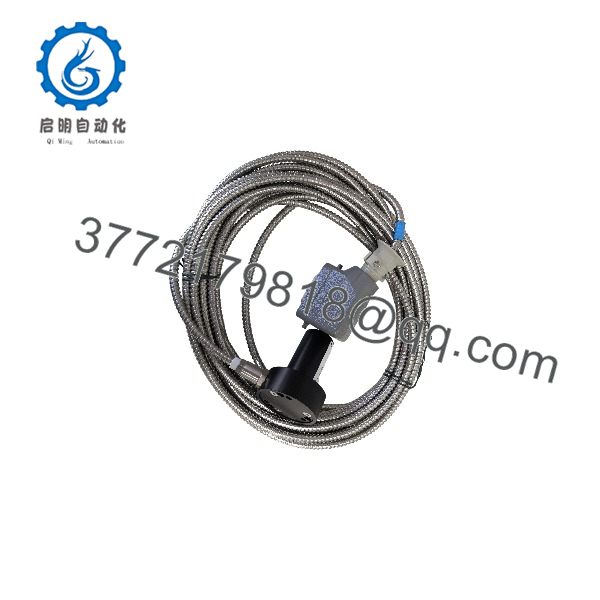
PR9268/203-000
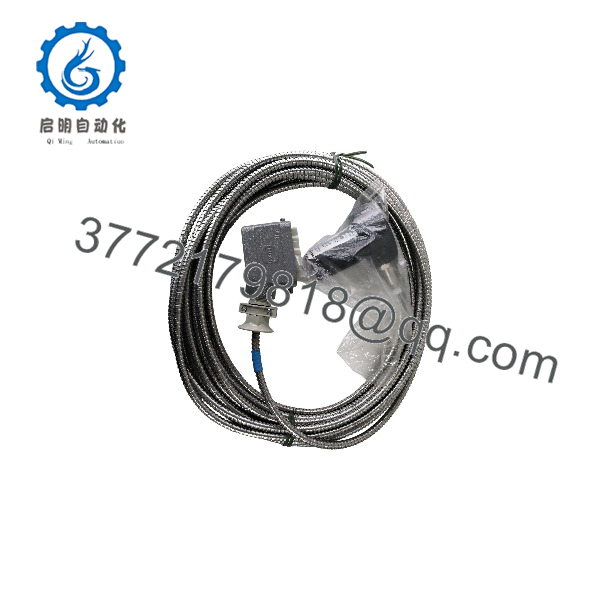
PR9268/203-000
Dimensions, Mounting & Connection Notes
The PR9268/203-000 uses a vertical measurement configuration and an integrated 10 m armored cable. The sensor should be mounted securely to the machinery housing or bearing support so that the measured motion represents the vibration of the monitored structure.
The Harting plug provides the specified cable termination. Before installation, confirm the mating connector, cable routing, and receiving instrument connections. The armored cable should be routed to minimize mechanical strain and interference with moving machinery.
The sensor’s IP55 protection rating and operating-temperature range should be considered when choosing its mounting location. The mechanical mounting arrangement must also preserve the intended vertical orientation.
Applications & System Role
The EPRO PR9268/203-000 serves as a vibration pickup in machinery condition-monitoring and protection systems. Unlike an eddy current probe that measures relative shaft displacement, this electrodynamic sensor measures vibration velocity associated with movement of the machine housing or bearing support.
Typical application contexts include:
- Steam and gas turbines: Measuring casing or bearing-support vibration.
- Hydro turbines: Providing a velocity-related vibration signal for machinery monitoring.
- Compressors: Monitoring vibration transmitted through the machine structure.
- Pumps and fans: Measuring housing vibration for condition-monitoring channels.
- Machinery protection systems: Supplying a vibration signal to compatible monitoring equipment.
The sensor’s output is proportional to vibration velocity. The connected monitoring system interprets this signal according to its configured sensitivity and measurement range. Installation direction, mounting stiffness, cable routing, and the instrument input characteristics all affect the suitability of the measurement channel.
For replacement work, preserve the complete PR9268/203-000 designation. The orientation, cable length, armor, and connector are encoded in the ordering configuration and are important when matching the installed sensor.
Detailed Product Overview
Electrodynamic sensing principle
The PR9268 uses a mechanical spring-mass arrangement. An internal measuring coil acts as a seismic mass suspended by membrane springs. When the sensor housing moves with the monitored machine structure, relative movement between the housing and the coil generates a voltage proportional to vibration velocity.
This operating principle distinguishes the PR9268 from non-contact eddy current sensors. The PR9268 measures absolute structural vibration, while an eddy current probe typically measures displacement relative to a target surface.
Dynamic measurement characteristics
The PR9268/203-000 has a nominal sensitivity of 28.5 mV/mm/s and a specified frequency response of 4–1,000 Hz. Its natural frequency is 4.5 Hz ± 0.75 Hz at 20°C, and its amplitude linearity is less than 2%.
These parameters help engineers determine whether the sensor’s dynamic response is suitable for the monitored equipment. The measurement system should be configured for the sensor’s velocity sensitivity rather than treated as a displacement-probe input.
Cable and mechanical installation
The /203-000 configuration identifies a vertical sensor with a 10 m armored cable and Harting plug. This arrangement affects both mounting orientation and the physical interface with the monitoring cabinet.
The sensor should be secured to a suitable machine surface, and the cable should be routed without imposing unnecessary mechanical loads on the connector. The mounting point should represent the structural vibration being monitored.
Environmental and system considerations
The sensor is specified for operation from −20 to +100°C and carries an IP55 protection rating. These characteristics should be assessed against the actual installation conditions, including temperature, moisture, and exposure to contaminants.
The PR9268 is self-powered and produces an electrodynamic signal. The receiving instrument must therefore be suitable for the sensor’s electrical characteristics, including sensitivity, frequency range, and input requirements.
FAQ
What is the EPRO PR9268/203-000?
It is a vertical electrodynamic velocity sensor for absolute vibration measurement on machinery housings and bearing supports.
What does the PR9268/203-000 measure?
It measures vibration velocity through an electrodynamic sensing mechanism that generates a voltage proportional to the relative movement of its internal seismic mass.
What does the “10M” designation mean?
It indicates a 10-meter cable configuration. For the PR9268/203-000, the complete ordering code specifies an armored cable with a Harting connector.
What is the frequency range?
The specified frequency response is 4–1,000 Hz.
Does the sensor require an external power supply?
No separate sensor excitation supply is required for its electrodynamic sensing principle because the sensor is self-powered.
What are the environmental limits?
The PR9268/203-000 is specified for −20 to +100°C and IP55 protection, with relative humidity from 0 to 100% under non-condensing conditions.
What should be checked before replacing an installed sensor?
Confirm the full model number, vertical mounting orientation, cable length and armor, Harting connector, vibration-monitor input compatibility, and required measurement sensitivity. These details determine whether the replacement matches the installed measurement channel.