WhatsApp: +86 16626708626
 Email:
 Phone: +86 16626708626
Description
Core Product Summary
The EPRO PR9350/02 is a passive half-bridge inductive linear displacement transducer. It measures linear movement through a ferromagnetic tracing pin that moves within a differential coil, providing a ±25 mm measuring range.
The PR9350/02 has a sensitivity of 270 mV/V and is intended for use with a compatible carrier-frequency measuring bridge or transmitter. It measures static and dynamic displacement, and can be applied to linear position, mechanical movement and related physical quantities that can be converted into linear motion.
Key Technical Specifications
| Item | Verified Information |
|---|---|
| Manufacturer / product family | EPRO / Emerson, PR9350 series |
| Exact model | PR9350/02 |
| Product type | Passive half-bridge inductive linear displacement transducer |
| Measuring range | -25 mm to 0 to +25 mm |
| Sensitivity | 270 mV/V |
| Linearity error | ±3.5% at 100% of measuring range; ±0.5% at 60% of measuring range |
| Coil resistance, A–C | Approximately 66.0–73.6 Ω |
| Coil resistance, A–B and B–C | Approximately 33.0–36.8 Ω |
| Tracing-pin connection | M3 thread at the tip |
| Electrical connection | 3-pole Cannon connector |
| Housing | Hermetically encapsulated |
| Weight | 255 g, excluding cable and packaging |
| Required excitation | 5 V supply from a compatible measuring system |
| Compatible evaluation | Carrier-frequency measuring bridge or dedicated transmitter / monitoring card |
Engineering Selection Highlights
- ±25 mm measurement span: The PR9350/02 is the ±25 mm version of the PR9350 family, so the required travel and mechanical zero position must fall within its -25 mm to +25 mm range.
- Half-bridge inductive principle: The sensor uses a differential coil and moving ferromagnetic core, so it requires a compatible carrier-frequency measuring bridge or transmitter to produce a usable displacement signal.
- M3 tracing-pin interface: The M3-threaded tracing pin provides the mechanical connection to the measured object, making correct linkage, alignment and mechanical freedom important for accurate measurement.
- Low moving mass: The tracing pin has low mass, which limits the force imposed on the measured object; this is relevant for measuring delicate or low-force mechanical movement.
- Electrical compatibility: The sensor must be powered from a safe low-voltage 5 V source meeting the applicable low-power or low-voltage/current supply requirements.
- Coil-resistance check: The documented coil resistances provide a practical electrical check for identifying a healthy PR9350/02 sensor before installation or troubleshooting.
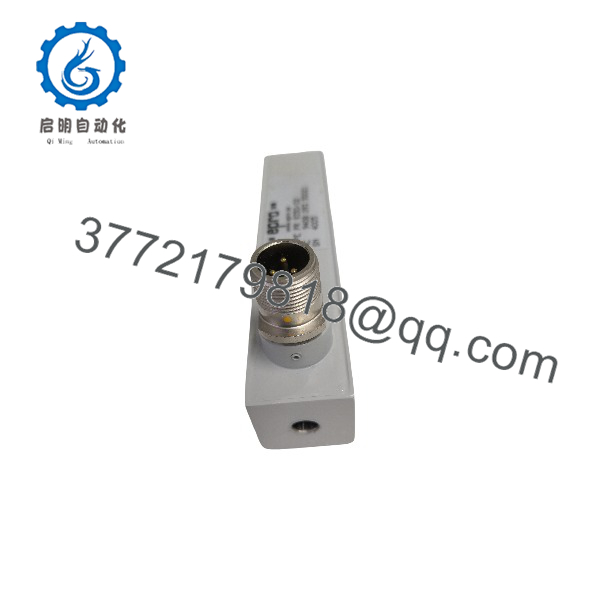
PR9350/02
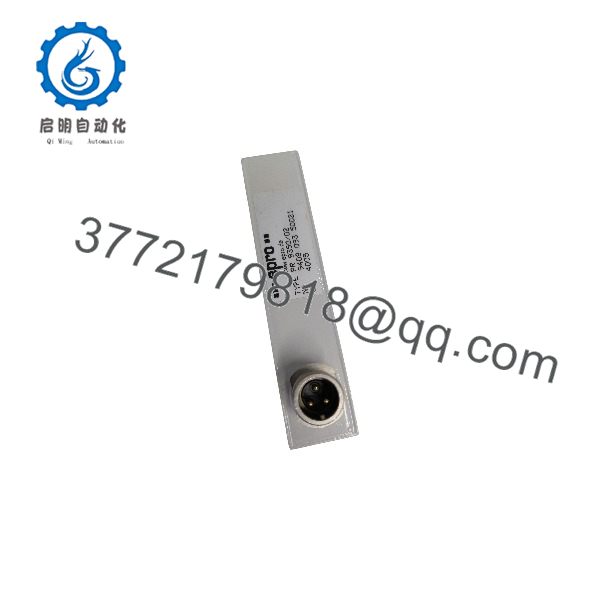
PR9350/02
System Compatibility & Integration Requirements
| Item / Dependency | Verified Compatibility or Requirement | Practical Note |
|---|---|---|
| Sensor family | EPRO / Emerson PR9350 | The PR9350/02 is the ±25 mm version of the PR9350 linear displacement transducer range. |
| Evaluation system | Carrier-frequency measuring bridge or dedicated transmitter / monitoring card | The passive half-bridge sensor requires a compatible excitation and signal-conditioning device. |
| Excitation voltage | 5 V | The sensor can only be used with devices powered by a safe low voltage of 5 V. |
| Power-supply requirement | LPS-compliant supply to EN/IEC 60950-1, or LV/LC-compliant supply to EN/IEC 61010-1 | The supply must meet the applicable low-power or low-voltage/current standard. |
| Mechanical connection | M3 thread on tracing pin | Use an appropriate mechanical linkage to the measured object. |
| Electrical connection | 3-pole Cannon connector | Confirm connector condition and wiring assignment during installation. |
| Measurement application | Static and dynamic displacement | The sensor can measure linear movement and related quantities converted into linear motion. |
Dimensions, Mounting & Connection Notes
| Item | Verified Information |
|---|---|
| Weight | 255 g, without cable and packaging |
| Housing | Hermetically encapsulated |
| Electrical connector | 3-pole Cannon connector |
| Tracing-pin thread | M3 at the tip |
| Coil resistance, A–C | Approximately 66.0–73.6 Ω |
| Coil resistance, A–B / B–C | Approximately 33.0–36.8 Ω |
The tracing pin must be mechanically connected to the measured object using its M3 thread. The sensor should be installed so that the pin can travel freely through the required ±25 mm displacement range and remains aligned with the measurement axis. The 3-pole Cannon connector provides the electrical connection to the compatible measuring bridge or transmitter.
Detailed Product Overview
The EPRO PR9350/02 is a passive half-bridge inductive transducer designed for linear displacement measurement. It belongs to the PR9350 sensor family and provides a measuring range of -25 mm to 0 to +25 mm, making it suitable for applications requiring moderate-travel position or movement measurement.
The sensor consists of a coil form with two windings and a tracing pin carrying a ferromagnetic core. When the pin is centered, the impedance of both windings is equal. As the pin moves from the center position toward either end of the sensor, the impedance of one winding increases while the other decreases. A compatible carrier-frequency measuring bridge detects this imbalance and converts it into a displacement signal.
The PR9350/02 has a sensitivity of 270 mV/V. Its linearity error is specified as ±3.5% across the full measuring range and ±0.5% at 60% of the measuring range. The coil resistance is approximately 66.0 to 73.6 Ω between terminals A and C, and approximately 33.0 to 36.8 Ω between A–B and B–C. These values can be used as an electrical reference during sensor verification.
Mechanically, the sensor housing is hermetically encapsulated and fitted with a 3-pole Cannon connector. The tracing pin has an M3 thread at its tip for attachment to the measured object. The pin’s low moving mass limits the controlling force applied to the measurement target, which is useful where the measured mechanism cannot tolerate significant loading.
The PR9350/02 requires a 5 V supply from a safe low-voltage source. The supply must conform to the LPS requirements of EN/IEC 60950-1 or the LV/LC requirements of EN/IEC 61010-1. The sensor weighs 255 g excluding cable and packaging. For installation, the tracing-pin travel, mechanical alignment, connector wiring and compatible transmitter or bridge configuration should be verified before commissioning.
Applications & System Role
The PR9350/02 is a contact-type linear displacement sensor used to measure mechanical movement. Its tracing pin follows the measured object, while movement of the ferromagnetic core within the differential coil changes the impedance balance of the two windings.
With a compatible carrier-frequency measuring bridge or transmitter, the sensor can measure static and dynamic displacement. It can also be used for physical quantities such as tensile or compressive force, gas or liquid pressure, material thickness and transverse moments when those quantities are converted into linear movement by suitable mechanical accessories.
In a machinery-monitoring architecture, the PR9350/02 provides the primary displacement measurement, while the associated transmitter or monitoring card supplies excitation, conditions the signal and provides the output used by monitoring or control equipment.
FAQ
What is the EPRO PR9350/02?
It is a passive half-bridge inductive linear displacement transducer with a ±25 mm measuring range.
What is the measuring range of the PR9350/02?
Its measuring range is -25 mm to 0 to +25 mm.
What is its sensitivity?
The PR9350/02 has a sensitivity of 270 mV/V.
What is its linearity error?
The linearity error is ±3.5% at 100% of measuring range and ±0.5% at 60% of measuring range.
What type of sensor is it?
It is a passive half-bridge inductive sensor with a differential coil and a moving ferromagnetic tracing pin.
What excitation does it require?
It requires a safe low-voltage 5 V supply from a compatible carrier-frequency measuring bridge or transmitter.
How is it mechanically connected?
The tracing pin has an M3 thread at the tip for connection to the measured object.
What electrical connector does it use?
It uses a 3-pole Cannon connector.
What can it measure?
It measures static and dynamic linear displacement, and can measure other physical quantities that are converted into linear movement through suitable mechanical accessories.